
Vaseline doesn't remove dark skin in the sense of lightening it, because it contains no ingredient that reduces melanin. What it does is seal the skin's surface and slow water loss, which softens the grey, dull look of dry, flaky skin on the knees, elbows and lips, and reduces the friction that deepens darkening over time. If your darkening comes from dryness and rubbing, you may see a real difference; if it's melasma or acanthosis nigricans, Vaseline alone won't help.
The Arabic pages that rank for this search present mixtures of Vaseline with lemon, cornstarch or toothpaste as lighteners, without explaining what Vaseline actually does to skin. This article separates what studies show from promises without evidence, and helps you work out which kind of darkening you have.
What does Vaseline do to the skin?
Vaseline is a brand of petroleum jelly, also called petrolatum: a mixture of mineral oils and waxes that sits on the surface of the skin and forms a film. It doesn't sink in and it doesn't feed the skin anything. Instead, it slows the evaporation of water from the outer layer, so the skin stays more hydrated, the outer cells lie flatter, and the dry flakes that scatter light and make skin look darker and duller are reduced.
In a randomised clinical trial published in 2025, fifty-four healthy volunteers had extra virgin olive oil applied to one area of the forearm, petrolatum to another, and a third area left untreated. Both products increased hydration of the outer layer and reduced redness, and petrolatum alone also reduced the water lost through the skin:
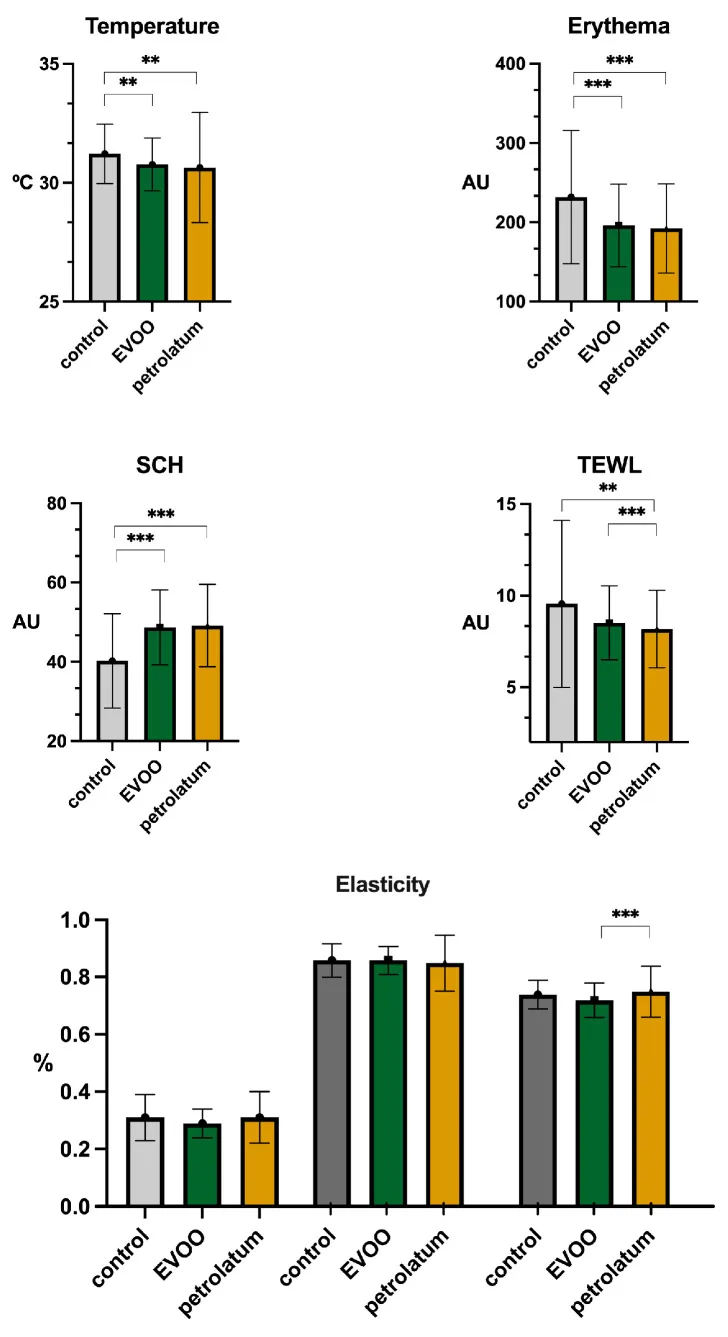
This study didn't measure skin colour, so it shows hydration and barrier improvement, not lightening. That is exactly what you can reasonably expect from Vaseline: smoother, less flaky skin, not less pigment. It's also worth noting the study was done on healthy forearm skin, not on darkened knees or elbows, so it tells us how petrolatum behaves rather than how much a particular dark patch will change.
Why does dry skin look darker?
Healthy skin sheds its outer dead cells invisibly, a few at a time. When skin is dry, those cells stick together and pile up in rough, uneven scales. The scales scatter light and catch dust, so the area looks grey, ashy and darker than the surrounding skin, especially on the knees, elbows and the tops of the feet, where the skin is thicker and has fewer oil glands.
In the same trial, the desquamation index, a measure of flaking, fell after petrolatum, and the proportion of mature, built-up dead cells on the surface dropped more clearly than with olive oil:
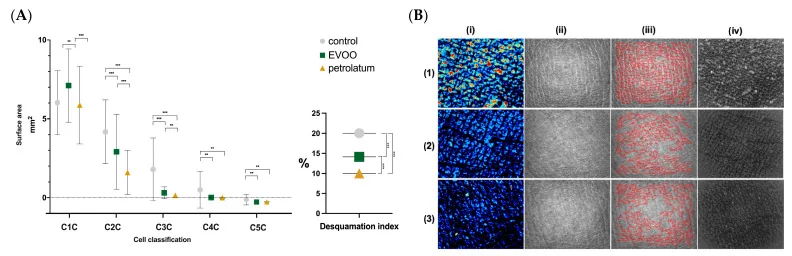
That's why your knee may look "lighter" after a few weeks of Vaseline. What has changed is that the grey scale has gone, while the pigment in the deeper layers is the same as it was. That's a genuine improvement in appearance, and for many people it's most of what was bothering them, but it isn't lightening, and it's important not to expect more from Vaseline than it can give.
Friction: the other half of the story
Repeated rubbing is one of the commonest reasons skin darkens in olive, brown and dark skin. Kneeling, leaning on elbows, thighs rubbing together when walking, and tight clothing all cause low-grade irritation, and the skin responds by thickening and making more pigment. Vaseline can help here in a modest way, by acting as a lubricant that reduces friction and protects the barrier while the skin is under strain.
But the main treatment for friction darkening is reducing the friction itself: cushioning the knees when you kneel, not resting your weight on your elbows, choosing breathable cotton clothing, and keeping the skin between the thighs dry. Without that, any cream, Vaseline included, is working against a cause that keeps going every day. For darkening between the thighs specifically, read darkening between the thighs.
Darkening that wipes away: built-up dead skin
There is one condition that looks like stubborn darkening but is actually a layer of dead cells and oils that has built up on the skin. It's called terra firma-forme dermatosis, and it often appears on the neck, ankles or back of people who wash regularly, because ordinary gentle washing doesn't remove it. In a 2025 case report and review it appeared as brown, net-like plaques:
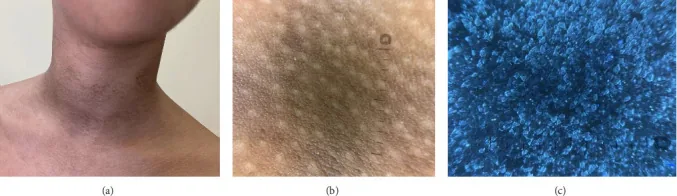
A dermatologist can confirm it by rubbing the area with a medical alcohol swab, which removes the darkening almost immediately. Vaseline doesn't solve this one and may even add to the build-up if applied on top, which is why it's worth ruling out before starting any treatment. The authors stress that recognising it spares people unnecessary treatments and worry.
When Vaseline helps and when it doesn't
| Type of darkening | Usual area | Does Vaseline help? | What helps |
|---|---|---|---|
| Dryness and flaking | Knees, elbows, feet | Yes, improves the look | Regular moisturising after bathing |
| Friction | Inner thighs, underarms | Partly, reduces rubbing | Reducing friction, cotton clothing |
| Dry, cracked lips | Lips | Yes, protects and hydrates | Moisturising and sun protection |
| Built-up dead skin | Neck, ankles | No | Medical wipe test and gentle cleansing |
| Acanthosis nigricans | Neck, underarms | No | Assessment for insulin resistance |
| Melasma | Face | No | Sunscreen and a melasma plan |
If the darkening is thick and velvety on the neck or underarms, read about neck darkening treatment, because acanthosis nigricans is a sign worth investigating rather than just covering up. The American Academy of Dermatology notes that treating the underlying cause is what makes this kind of darkening fade.
How to use Vaseline on dry areas
Apply it to damp skin straight after bathing, because it locks in the water that's already there rather than adding any of its own. On dry skin it can feel greasy and achieve little. A thin layer is enough on the knees, elbows and tops of the feet; on cracked heels a thicker layer under cotton socks overnight is a common approach. On the lips you can apply it several times a day, and a lip product with sunscreen during the day protects them from the sun as well.
If you have oily, acne-prone skin, keep Vaseline to the body and lips and choose a light, non-comedogenic moisturiser for the face. And if you're also using a lightening product prescribed by your dermatologist, ask whether to apply Vaseline before or after it, because a heavy film can change how much of the other product reaches the skin.
flowchart TD
  A[Darkening on an area of the body] --> B{Dry, rough, flaky skin?}
  B -->|Yes| C[Vaseline after bathing plus less friction]
  B -->|No| D{Thick, velvety darkening on the neck or underarms?}
  D -->|Yes| E[Assessment for acanthosis nigricans and insulin resistance]
  D -->|No| F{Patches on the face that worsen with sun?}
  F -->|Yes| G[Likely melasma - sunscreen and a treatment plan]
  F -->|No| H[Assessment by a dermatologist]
Why to avoid Vaseline mixtures
Recipes mixing Vaseline with lemon, cornstarch, toothpaste or baking soda are widely shared as lighteners. There are no studies showing that they lighten skin. Lemon, toothpaste and baking soda all irritate the skin, and irritation leaves new pigmentation behind in olive, brown and dark skin, so you can end up darker than you started. Lemon on skin that is then exposed to the sun can also cause a burn-like reaction. Use Vaseline on its own, and if you want a lightening ingredient, choose a studied one as part of a plan with your dermatologist; face pigmentation removal covers the options for the face.
mindmap
  root((Vaseline and darkening))
    Helps
      Dryness and flaking
      Friction
      Dry lips
    Doesn't help
      Melasma
      Acanthosis nigricans
      Built-up dead skin
    Avoid mixing with
      Lemon
      Toothpaste
      Baking soda
Frequently asked questions
Does Vaseline really remove dark skin?
Vaseline contains no lightening ingredient, so it doesn't reduce pigment in the skin. But it moisturises and reduces water loss, which softens the grey, dull look of dry skin on the knees, elbows and lips, and it reduces the friction that deepens darkening over time.
Does mixing Vaseline with lemon or cornstarch lighten skin?
No studies show that it does. Lemon is acidic and irritates the skin, irritation itself leaves pigmentation in olive and brown skin, and lemon can cause a reaction with sunlight. It's better to use Vaseline on its own on clean skin.
Does Vaseline clog pores and cause spots?
Plain petroleum jelly doesn't cause spots in most people, but its heavy layer may not suit oily, acne-prone skin on the face. On the body, lips and dry areas it's usually suitable.
When won't Vaseline help with darkening?
It won't help melasma, acanthosis nigricans linked to insulin resistance, or pigmentation from active inflammation or medicines. These need a diagnosis and treatment of the cause.
When to see a clinician
See a dermatologist if the darkening is thick and velvety on the neck, underarms or skin folds, if it appeared suddenly and is spreading quickly, or if it comes with weight gain, increased thirst or irregular periods. See one too if dryness hasn't improved after several weeks of regular moisturising, if itching or redness develops, or if a spot changes in shape or colour or bleeds.
Related articles
- Dry skin on the body: treatment
- Home remedies for dark lips
- Neck darkening treatment
- Darkening between the thighs
Further reading
- Dermatologists' top tips for relieving dry skin — American Academy of Dermatology
- Acanthosis nigricans: Diagnosis and treatment — American Academy of Dermatology
- Effects of Extra Virgin Olive Oil and Petrolatum on Skin Barrier Function and Microtopography — Journal of Clinical Medicine
Medical disclaimer: This article is for health education only and is not a substitute for professional medical advice. If you have a skin condition that concerns you, please consult a dermatologist.