

There is no single inner thigh darkening cream that works for everyone, because dark inner thighs aren't one condition. The most common cause is chronic friction that stimulates the pigment cells, but the same appearance can be acanthosis nigricans linked to insulin resistance, or a bacterial or fungal infection that simply looks like darkening. The cream that works is the one that matches the cause — and only once whatever is feeding it has stopped.
The pages that rank for this search mostly offer home remedies with lemon and baking soda, then a list of product names. They rarely ask the question that matters most: is this pigmentation at all? This article starts there.
Why do inner thighs darken?
The skin of the upper inner thighs is naturally a little darker than the rest of the body in many women, and that is not a disease. Darkening that deepens over time, however, usually follows one of three paths, and each is treated completely differently.
Path one: friction. When the thighs rub together while walking, against tight clothing, or after shaving and waxing, the skin is mildly and repeatedly inflamed. Pigment cells respond to inflammation by making more melanin, and brown colour builds up gradually. This is post-inflammatory hyperpigmentation, and it shows most clearly in olive and brown skin.
Path two: acanthosis nigricans. Here the darkening isn't colour alone: the skin itself thickens and feels velvety, sometimes with small skin tags. It is usually linked to insulin resistance.
Path three: infection. Bacteria or fungi that thrive in warm, damp skin folds can leave brown or reddish, slightly scaly patches that no lightening cream will touch.
Acanthosis nigricans: when the darkening is a sign, not a skin problem
Acanthosis nigricans makes the skin in body folds dark, thick and velvety, usually on the neck, in the armpits, on the upper inner thighs and under the breasts. A 2025 systematic review describes it as often linked to metabolic abnormalities, and in practice it frequently accompanies weight gain, polycystic ovary syndrome and prediabetes. The image below, from a published case, shows what it looks like and what it looks like under the microscope:
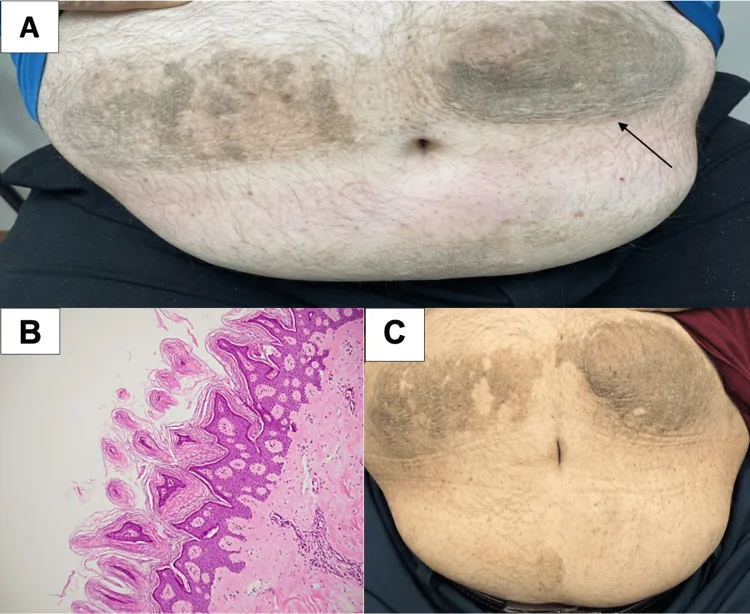
The lesson from that case is that improvement came from treating the cause, not from a lightening cream. So if the darkening between your thighs is velvety and thick, or you have similar darkening on your neck or in your armpits, the first step is an assessment and blood tests, not a shopping trip.
It is also worth knowing what acanthosis nigricans is not. It isn't caused by poor hygiene, and scrubbing it harder won't remove it; scrubbing only inflames the skin and adds friction pigmentation on top. Because the thickened skin traps light differently, it can look "dirty" even when it is perfectly clean, which is exactly why so many women scrub it. A dermatologist can usually recognise it on sight and will want to know about your periods, weight changes and family history of diabetes.
Inner thigh darkening cream: which ingredient for which cause?
Once you know the cause, choosing a cream becomes logical. The table summarises what has been studied, without strengths or regimens — those are for your dermatologist to set:
| Ingredient | Suits | What to watch for |
|---|---|---|
| Niacinamide | Mild friction darkening | Gentle and well tolerated |
| Azelaic acid | Post-inflammatory pigmentation | Mild stinging at first |
| Retinoids (tretinoin) | Pigmentation and acanthosis nigricans | Irritation in already sensitive skin |
| Urea and salicylic acid | Thickened skin in acanthosis nigricans | Dryness and peeling |
| Hydroquinone | Stubborn pigmentation | Prescription, supervision and a limited period only |
| Antibacterial or antifungal | Infection | Only helps if it really is an infection |
The same systematic review pooled seven randomised trials and found that both urea and tretinoin were effective for acanthosis nigricans: tretinoin did best for dark pigmentation, urea suited people who couldn't tolerate irritation, salicylic acid was a tolerable alternative, and side effects were mild and settled on their own. But most of those trials were done on the neck and armpits, and the skin between the thighs is more sensitive and more exposed to rubbing, so irritation is more likely there.
To understand how azelaic acid acts on overactive pigment cells, see azelaic acid and Skinoren.
When the darkening isn't pigment: erythrasma and fungal infection
Erythrasma is a superficial bacterial infection of warm, damp skin folds — the armpits, the groin and upper inner thighs, and between the toes. It looks like brown or pinkish, slightly scaly patches, so it is easily mistaken for ordinary darkening. The image below shows it in the groin fold before and after treatment:
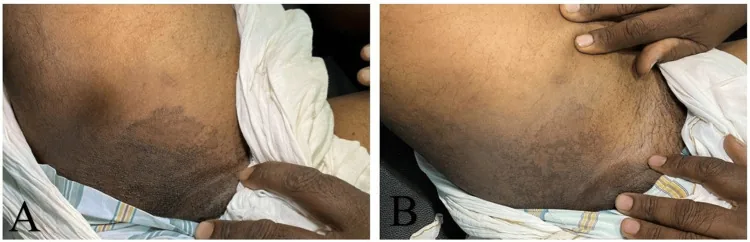
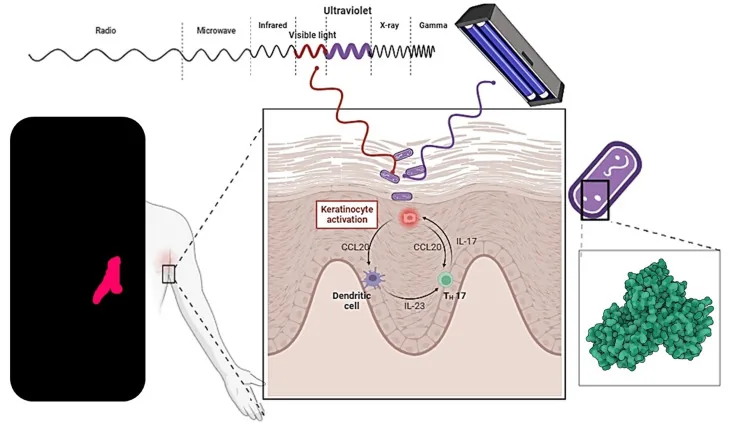
Diagnosis in clinic is simple: under an ultraviolet Wood's lamp the patches glow a characteristic coral red, because the bacteria produce a pigment that fluoresces under that light. The illustration below explains why:
A lightening cream is a waste of time here, and it can add irritation. The same applies to tinea cruris, the fungal groin rash, which usually comes with an advancing red edge and itch; it needs an antifungal, not a brightener. A 2020 review of erythrasma lists candida, fungal infection and pityriasis versicolor among the conditions it is routinely confused with — which is why a quick examination before you start any cream saves weeks.
How to tell the causes apart
The flowchart below puts the questions in order before you choose any cream:
flowchart TD
  A[Dark inner thighs] --> B{Skin thick and velvety, or darkening on neck and armpits too?}
  B -->|Yes| C[Possible acanthosis nigricans - tests and medical assessment]
  B -->|No| D{Itch, a red edge or obvious scaling?}
  D -->|Yes| E[Possible fungal or bacterial infection - examination before any cream]
  D -->|No| F{Worse with walking, tight clothes and hair removal?}
  F -->|Yes| G[Friction darkening - stop the rubbing plus a suitable cream]
  F -->|No| H[Probably the area's natural colour - no treatment needed]
What actually stops the friction?
In my clinic, what fails most often isn't the cream; it is carrying on with the cause. A cream fades what has formed, and friction forms more every day. So:
- Reduce rubbing when you walk with light cotton shorts under a dress or skirt, or an anti-chafing barrier balm.
- Choose loose cotton underwear that lets the skin breathe.
- Dry skin folds properly after showering and sweating.
- Ease off irritating hair removal; repeated shaving and waxing are a cause of inflammation in themselves. If the darkening began after laser specifically, see bikini darkening after laser.
- Skip lemon, baking soda and harsh scrubs; they irritate the skin and so add pigment rather than remove it.
Patience matters too. Pigment that took months of daily rubbing to build doesn't fade in a fortnight, and the skin between the thighs renews no faster than anywhere else. Judge a cream over weeks, not days, and only once the friction has genuinely stopped; otherwise you are measuring the cream against a cause that is still running.
Hydroquinone and unlabelled creams: caution is essential
Hydroquinone works, but it is a medicine, not a cosmetic. Long unsupervised use has been linked, as a 2026 case report in skin of colour describes, to a condition called exogenous ochronosis, in which the skin turns darker and bluish-grey and is hard to treat. More dangerous still are unlabelled creams sold for "intimate lightening", which may contain steroids or other undeclared ingredients. Steroids thin the skin of body folds and can leave stretch marks and irritation that outlast any lightening.
The map below summarises what feeds dark inner thighs and what eases them:
mindmap
  root((Dark inner thighs))
    What makes it worse
      Daily friction
      Irritating hair removal
      Lemon and harsh scrubs
      Unlabelled creams
    What helps
      Stopping the friction
      A cream that matches the cause
      Treating any infection
      Managing insulin resistance
Where professional treatments fit
When friction pigmentation is stubborn despite stopping the rubbing and using a suitable cream for several weeks, a dermatologist may discuss in-clinic options such as superficial chemical peels or, for acanthosis nigricans, procedures studied in trials on the neck. These sit after the basics, not instead of them, and they carry a real risk of rebound darkening in olive and brown skin if the skin is inflamed by them. Any laser near the groin should be done by someone experienced with your skin type. For the vulval skin itself, where darker colour is usually normal anatomy, see intimate area lightening.
Frequently asked questions
What is the best cream for dark inner thighs?
There is no single best cream, because dark inner thighs have more than one cause. Friction darkening responds to ingredients such as niacinamide, azelaic acid and retinoids once the rubbing stops; acanthosis nigricans needs treatment for the thickened skin and its metabolic cause; and a bacterial or fungal infection needs treating itself, not lightening.
Are dark inner thighs linked to diabetes or PCOS?
Sometimes. When the skin is dark and thickened with a velvety feel, and similar darkening appears on the neck or in the armpits, it may be acanthosis nigricans, which is closely linked to insulin resistance alongside weight gain, polycystic ovary syndrome and prediabetes. That deserves a medical assessment and blood tests, not just a cream.
Is hydroquinone safe for the inner thighs?
Hydroquinone is an effective lightening treatment, but it is used under medical supervision and for a limited period. Long unsupervised use, especially in darker skin, has been linked to a rare condition called exogenous ochronosis, which darkens the skin instead of lightening it. Don't buy it without a prescription and don't extend its use.
Why do dark inner thighs come back after lightening?
Because the cause hasn't stopped. Daily friction when walking, sweat, irritating hair removal and insulin resistance all keep stimulating the pigment cells. Any cream can fade what has formed, but it can't prevent what forms tomorrow if the cause is still there.
When to see a clinician
See a dermatologist if the skin between your thighs is thick and velvety or similar darkening appears on your neck or in your armpits; if the darkening appeared suddenly or is spreading quickly; if it comes with itch, scaling or a red edge; or if it hasn't improved after several weeks of stopping the friction and using a suitable cream. If you have polycystic ovary syndrome, have gained weight or have a family history of diabetes, mention it. For body darkening more broadly, read causes of skin and body darkening.
Related articles
- Causes of skin and body darkening
- Intimate area lightening
- Bikini darkening after laser
- Getting rid of dark knees and elbows
- Azelaic acid and Skinoren
Further reading
- Dark Inner Thighs: Causes, Home Remedies, Prevention, and More — Healthline
- Dark Inner Thighs & Bikini Line: 5 Causes, Skin of Colour — Skincare by Dr V
- The efficacy of topical treatments for acanthosis nigricans: a systematic review — Frontiers in Medicine
Medical disclaimer: This article is for health education only and is not a substitute for professional medical advice. If you have a skin condition that concerns you, please consult a dermatologist.