
Treating winter dry skin on the body starts in the shower, not in the moisturiser aisle. A short, warm shower, a gentle pat with the towel, then a thick moisturiser on skin that is still damp — those three steps achieve more than the most expensive cream applied to skin that has just been stripped by hot water and foaming soap.
There is a second point most guides skip: body dryness is not the same problem as facial dryness. Your shins, arms and back have far fewer oil glands than your face, they get whatever attention is left after the face routine, and they are where winter itch can quietly turn into eczema.
Why does winter dry out the body more than the face?
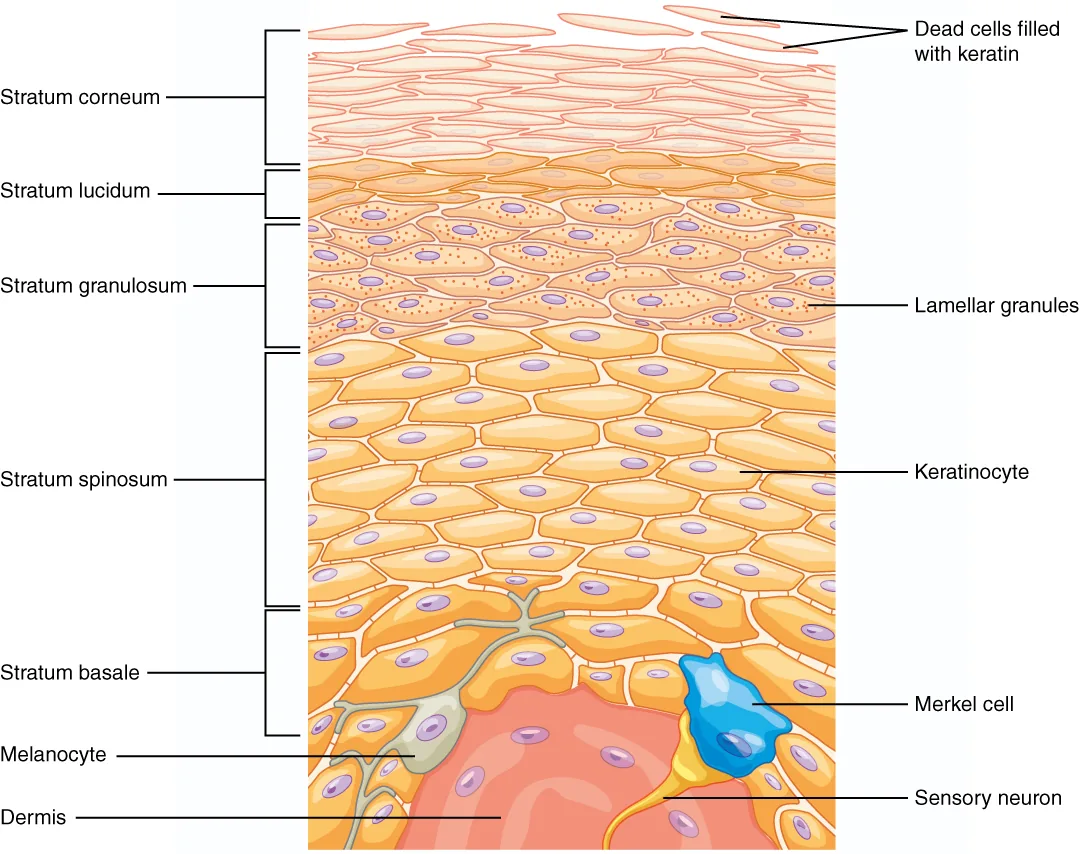
Your skin's waterproofing sits in a thin outer layer called the stratum corneum. Think of it as a brick wall: flattened dead cells are the bricks, and a mix of lipids — ceramides, cholesterol and fatty acids — is the mortar. When that mortar is depleted, water escapes from the skin into the air, and the surface turns dull, flaky and tight after every shower.
Winter attacks that barrier on three fronts at once. Cold air holds less moisture, so it pulls water from the skin faster. Central heating dries indoor air further still. And the long hot shower that feels so good in January dissolves the very lipids that hold water in.
The body loses this fight faster than the face does. The lower legs are among the least oily areas of skin you have, and they are usually covered all day by fabric that rubs, then exposed to the hottest water of the day. If you want the full picture of internal and external causes, I have set them out in what causes dry skin.
The shower routine: where winter body-dryness treatment really begins
The order of steps here is the treatment. The American Academy of Dermatology advises keeping showers and baths to 5–10 minutes in warm rather than hot water, closing the bathroom door to keep the humidity in, patting rather than rubbing dry, and moisturising straight away.
This is the sequence I walk patients through in clinic:
flowchart TD
  A[Short shower in warm water] --> B[Gentle cleanser only on armpits and groin]
  B --> C[Pat lightly with a towel - skin stays damp]
  C --> D[Thick moisturiser within minutes]
  D --> E[Loose cotton clothing next to the skin]
Your whole body does not need soap. Shins and forearms rarely get dirty enough to need daily lather; water alone usually does the job, with cleanser kept to the areas that genuinely need it. For many women this single change eases winter dryness without buying anything new. The logic of choosing a non-stripping wash is covered in choosing a gentle cleanser.
Timing matters as much as the product. Moisturiser applied to damp skin traps the water that is already there; applied to fully dry skin, it has very little to hold. The gap between the two is noticeable within days, and it costs nothing.
Which moisturiser works for dry body skin?
The brand name matters less than you might think. Texture and a short list of ingredients decide the outcome.
| Ingredient or texture | What it does | Where it suits the body |
|---|---|---|
| Ointment or petrolatum | Seals the surface and strongly limits water loss | Heels, elbows, cracks — best at night |
| Thick cream | Balance between sealing and comfort | Legs and arms, everyday use |
| Light lotion | Absorbs fast but seals least | Large areas with mild dryness |
| Glycerin | Draws water into the outer layer | Everywhere |
| Ceramides | Replace part of the barrier's own lipids | Sensitive, irritated skin |
| Urea or lactic acid | Hydrate and soften thick scale | Rough shins and heels |
Urea and lactic acid are the step most routines are missing. The rough skin on shins and heels carries a build-up of scale that ordinary cream sits on top of. These ingredients loosen that scale while pulling water in. The British Association of Dermatologists classifies medical emollients by their oil content and notes that ointments seal more effectively than lotions. One caution: urea can sting broken skin, so keep it off open cracks.
Fragrance-free is worth insisting on. Fragrance is one of the commonest skin irritants, and a dry, leaky barrier lets it in more easily.
Does drinking more water fix dry skin in winter?
Almost every winter-skin article tells you to drink two litres a day. The evidence is thinner than that. A 2018 systematic review pulled together the available studies, found them few in number and limited in method, and concluded that extra water may modestly raise hydration of the skin's outer layer — mainly in people who drank little to begin with — with no clear mechanism.
Water matters for your health in general, but it is not a treatment for winter body dryness. The dryness travels from the outside in, and what makes a visible difference is protecting the barrier from hot water, soap and dry air. If you are already drinking enough and your legs still flake, the answer is not another glass.
When does winter itch become eczema?
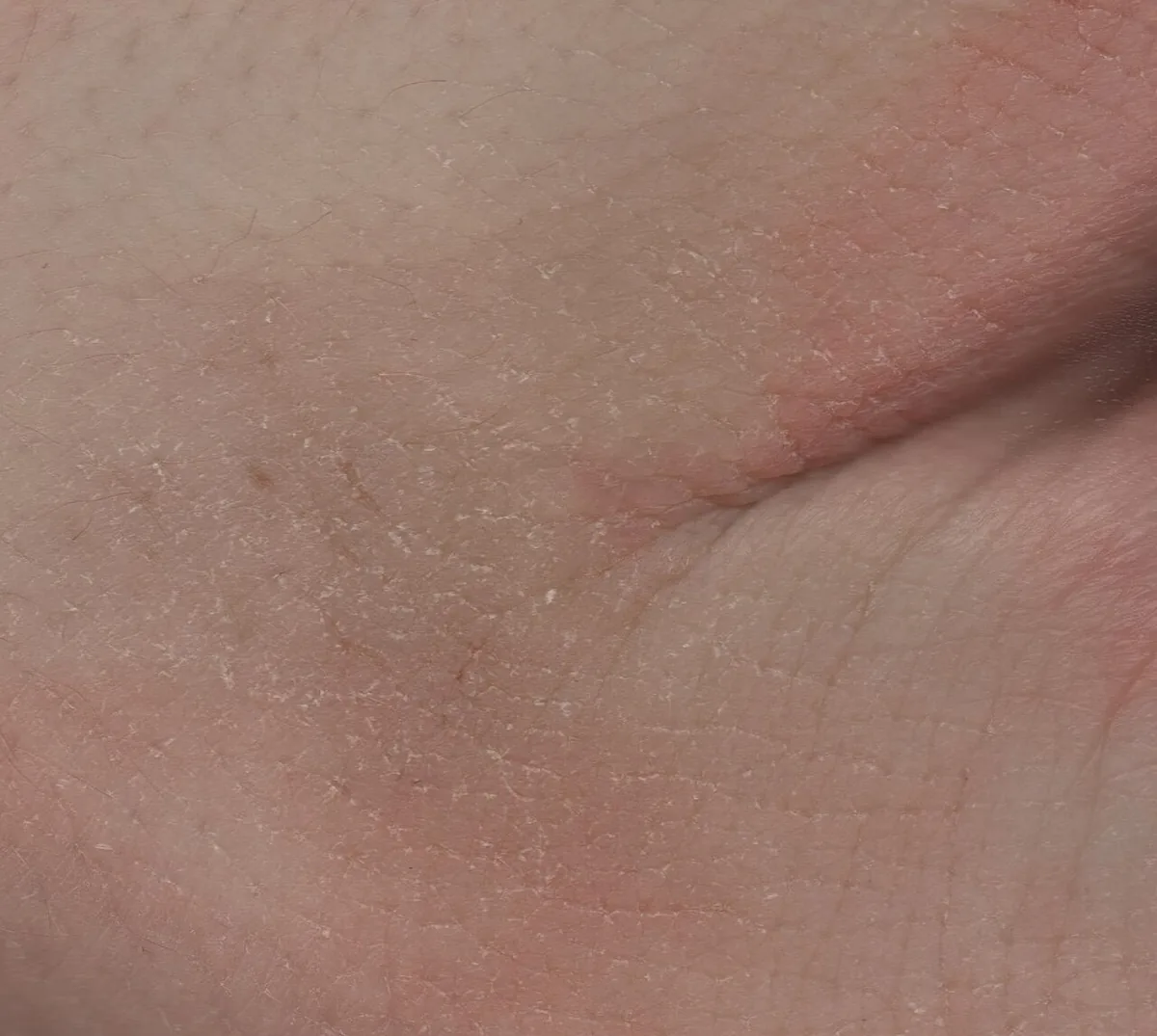
Simple dryness looks like fine white scale and a dull surface, often with very little redness — like the image below.
When dryness is left to deepen, the surface can split into a network of red lines that looks like the bottom of a dried-up pond. This is asteatotic eczema, also called eczema craquelé or winter eczema, and its favourite site is the shins. A review on the NCBI Bookshelf describes it as eczema developing on already dry skin, becoming more common with age and in low-humidity conditions.

What makes this published report worth knowing is that the eczema appeared as a sign of an internal disease in older patients. That does not mean winter dryness usually hides something serious — the overwhelming majority of cases do not. It does explain why a widespread, sudden rash is not something to treat with moisturiser alone.
Here is how I separate the two situations:
flowchart TD
  A[Dry, itchy body skin] --> B{Redness or criss-cross cracks?}
  B -->|No| C[Simple dryness - shower routine and moisturiser]
  B -->|Yes| D{Better after two weeks of consistent moisturising?}
  D -->|Yes| C
  D -->|No| E[Medical assessment for eczema]
  A --> F{General symptoms: fatigue, weight loss, night sweats?}
  F -->|Yes| G[Full medical check]
Habits that keep body skin dry
- Scrubbing cracked shins with a rough loofah or frequent exfoliation. Exfoliation assumes an intact barrier; on cracked skin it widens the damage.
- Wool directly against the skin. It irritates dry skin; wear a cotton layer underneath.
- Scented body lotions. Fragrance is a common irritant and dry skin absorbs it more readily.
- Relying on plant oils instead of a moisturiser. Not all oils seal in water as people assume, and research has shown that olive oil can weaken the skin barrier.
- Treating stubborn itch with over-the-counter anti-itch creams without advice. Some of them dry the skin further, and persistent itch needs a cause, not just a soother.
Frequently asked questions
Does drinking more water fix dry skin in winter?
Not on its own. A systematic review found that extra water intake may slightly raise hydration of the skin's outer layer, mainly in people who drank little to begin with, but the evidence was limited and of modest quality. Winter dryness is driven from the outside — dry air, hot water and harsh soap — so that is where treatment has to start.
Why does my body itch in winter when there is no rash?
The commonest reason is a dried-out outer skin layer. When it loses its lipids it develops microscopic cracks, and the nerve endings beneath become irritated, so itch appears before anything is visible. Itch that persists despite consistent moisturising, is severe at night, or arrives with fatigue or weight loss deserves a medical assessment.
What is the best body moisturiser for winter?
Texture matters more than brand. Thick creams and ointments seal in water better than light lotions. Useful ingredients include glycerin, ceramides and petrolatum, with urea or lactic acid for rough areas such as shins and heels. Choose fragrance-free and apply it to damp skin within minutes of leaving the shower.
When is dry body skin a sign of something else?
When it turns into a red, criss-crossed pattern like cracked mud, when cracks bleed, when itch stops you sleeping, when dryness persists after weeks of a correct routine, or when sudden all-over dryness comes with other symptoms. Those situations need an examination to rule out eczema, thyroid disease or kidney disease.
When to see a clinician
See a dermatologist if a network of red cracks appears on your shins or trunk, if cracks bleed or become red, hot and swollen in a way that suggests infection, if itch is keeping you awake, or if dryness has not improved after several weeks of a sensible routine. Sudden, widespread dryness together with tiredness, weight change or increased thirst also warrants a visit to your GP, because thyroid disease, diabetes and kidney disease are all recognised causes. Dryness on the face and hands follows different rules, which I cover in treating chapped, cracked skin.
Related articles
- How to treat dry skin
- Dry skin: symptoms and causes
- What causes dry skin
- Treating chapped, cracked skin on the face and hands
- Dry skin in children
Further reading
- How to treat dry winter skin — Vaseline
- Suffering from dry skin? Here's how to treat itchy dry skin in winter — Business Report
- How to Treat Dry Skin in Winter – 5 Tips to Help — Lierre
- Dermatologists' top tips for relieving dry skin — American Academy of Dermatology
Medical disclaimer: This article is for health education only and is not a substitute for professional medical advice. If you have a skin condition that concerns you, please consult a dermatologist.