

The fastest way to remove pigmentation from the face depends on its type: well-defined sun spots are removed fastest by laser or freezing treatment in clinic, acne marks fade over weeks to months with sunscreen and by stopping the inflammation, and melasma is the slowest of all. So the genuinely fastest step is working out the type, because the wrong treatment wastes months and some of it makes pigmentation worse.
The Arabic pages that rank for this search offer home mixes of lemon, onion and honey and promise results within weeks, without distinguishing one kind of spot from another. This article ranks the types from fastest to fade to slowest, and says what safely speeds up each one.
First: what type of pigmentation is it?
| Type | Look | Speed of improvement | Fastest safe route |
|---|---|---|---|
| Tan | Even colour on exposed areas | Fades on its own gradually | Sun avoidance and sunscreen |
| Acne and inflammation marks | Brown marks where spots or a wound were | Weeks to months | Stop the inflammation, sunscreen, a studied lightener |
| Sun spots | Well-defined brown spots on face and hands | Fast with clinic procedures | Laser or freezing |
| Melasma | Symmetrical patches on cheeks and forehead | Slowest, and returns | Long-term prescription plan |
For the shapes of brown spots and how to tell them apart, read what causes brown spots on the face.
A tan: the fastest to fade on its own
An even tan after the beach or summer isn't spots but the skin's normal response to sun, and it fades gradually once exposure stops. It doesn't need a lightening cream, just sunscreen and patience. Details are in getting rid of a sea tan.
Acne marks: stop the inflammation first
The brown marks that remain after spots, scratching or irritation are called post-inflammatory hyperpigmentation. They form when inflammation stimulates pigment cells, and some pigment can drop into the dermis, where it lingers longer. The diagram from a 2025 review shows this mechanism:
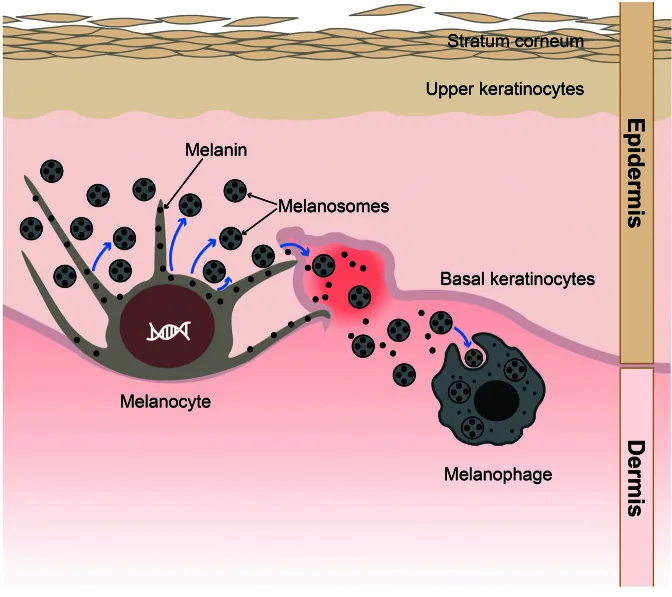
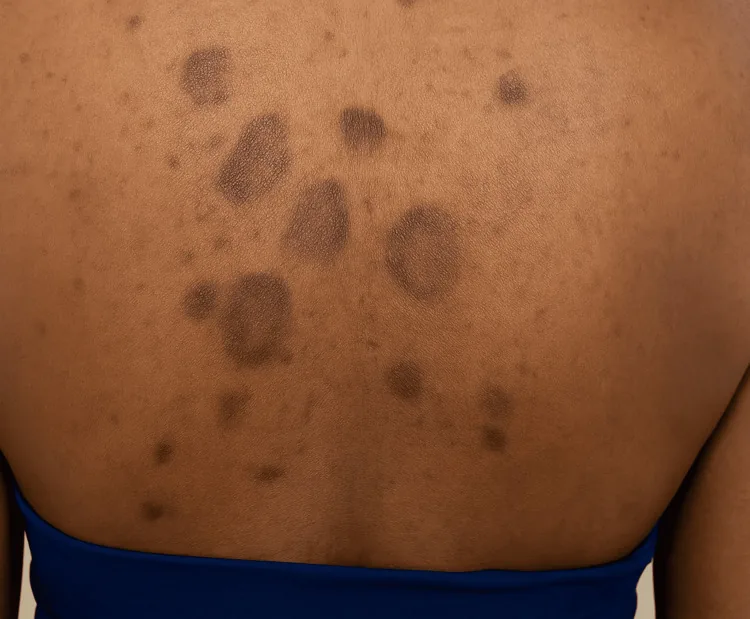
Pigment in the upper layer fades over weeks to months; pigment in the dermis fades much more slowly. These marks are more visible and last longer in olive, brown and dark skin, as in this image from a 2026 review:
The fastest route here is three steps together: treat the acne itself so new marks stop forming, use sunscreen daily, and add a studied lightener such as azelaic acid or a retinoid. Gentle over-the-counter options include alpha-arbutin and licorice, as in Alpha Plus lightening cream. Brown and red acne marks are covered in red acne marks.
The most common mistake with these marks is attacking them with scrubs and strong peels. Anything that irritates the skin creates more inflammation, and more inflammation means more pigment. Gentle and consistent beats aggressive here.
Sun spots: where speed genuinely works
Sun spots, or solar lentigines, are well-defined brown spots with clear edges that appear on the face and the backs of the hands over the years. These spots in particular respond quickly to clinic procedures. A 2026 systematic review comparing laser with freezing (cryotherapy) found both effective with similar side effects, and laser gave a higher proportion of patients with at least half improvement, though most of the studies were methodologically weak. The figure from a small 2021 study shows a spot on the face before and after treatment with one type of laser:
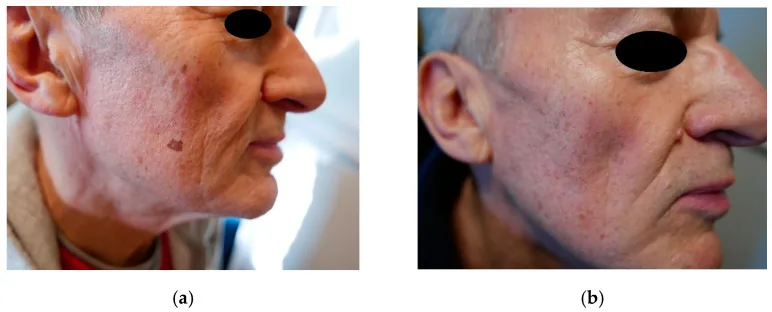
Before any removal, a doctor must confirm that the spot is a sun spot and not a changing mole, because a spot removed by laser can no longer be examined.
Freckles: darker in summer, lighter in winter
Freckles are small, light-brown spots that appear from childhood on the nose and cheeks, especially in fair skin, darkening with sun in summer and fading in winter. They aren't damage that needs treatment, and sunscreen clearly reduces how visible they are. If they bother you, laser in clinic may lighten them, but they usually return with sun unless protection continues.
Melasma: the slowest, and where rushing does most harm
Melasma doesn't clear quickly, and trying to clear it quickly does harm: aggressive lasers and peels can bring it back darker, and strong creams without supervision can cause permanent discolouration. Its treatment is a long-term plan that starts with tinted sunscreen; details are in melasma treatment for the face.
What makes any treatment work faster
Whatever the type, a few habits decide how quickly things improve. Sunscreen comes first: broad-spectrum, applied generously every morning and reapplied when you're outdoors, with a hat and shade on bright days. A tinted sunscreen adds protection against visible light, which matters most for melasma and for darker skin. Next is consistency: one well-chosen lightener used every day for months does more than three products rotated every fortnight. And finally, gentleness: irritation from too many actives at once sets off new pigmentation, which is the opposite of what you want. Progress photos taken in the same light every month are more reliable than the mirror, because day-to-day changes are too small to see.
Why "fast lightening" does harm
Creams that promise to clear pigmentation within days often contain steroids, mercury or an undeclared strong lightener; read Pakistani whitening creams. Lemon mixes can cause burns and new patches when the skin then meets the sun, adding pigmentation on top of pigmentation.
flowchart TD
  A[Pigmentation on the face] --> B{Well-defined spots on face and hands after years of sun?}
  B -->|Yes| C[Sun spots - examination, then laser or freezing]
  B -->|No| D{Where a spot or inflammation was?}
  D -->|Yes| E[Stop inflammation, sunscreen and a studied lightener]
  D -->|No| F{Symmetrical patches on cheeks and forehead?}
  F -->|Yes| G[Melasma - long-term prescription plan]
  F -->|No| H[Tan or another cause - assessment]
mindmap
  root((Removing pigmentation))
    Fastest
      Sun spots in clinic
    Weeks to months
      Acne marks
    Slowest
      Melasma
    Avoid
      Unknown creams
      Lemon and sun
Frequently asked questions
What is the fastest way to remove pigmentation from the face?
It depends on the type of pigmentation. Well-defined sun spots are removed fastest by laser or freezing treatment in clinic, acne marks fade over weeks to months with sunscreen and by stopping the inflammation, and melasma is the slowest and needs a long-term plan. So the fastest route starts with identifying the type.
Can pigmentation be removed from the face in a week?
Established pigmentation doesn't clear in a week with any safe cream. Creams that promise it often contain steroids, mercury or undeclared strong lighteners, and cause more damage than the spot. What can safely be sped up is removing sun spots in clinic.
What is the fastest cream for pigmentation?
There's no cream that is both fast and safe. Studied creams such as retinoids, azelaic acid and prescription lightening creams work over weeks to months, and their success depends on daily sunscreen.
Does laser remove pigmentation in one session?
Well-defined sun spots may lighten clearly after one or a few sessions, but not every kind of pigmentation responds to laser in the same way. Melasma in particular can return or darken after laser, so your doctor decides whether laser suits your type of spot.
When to see a clinician
See a dermatologist if you don't know what type of pigmentation you have, if it hasn't improved after months of sunscreen and care, or if you're considering laser. See one promptly if a new spot is changing in shape or colour, has irregular edges, or bleeds or itches, as it needs examining before any attempt to remove it.
Related articles
- What causes brown spots on the face
- Melasma treatment for the face
- Red acne marks: why they linger and how to fade them
- Getting rid of a sea tan: what fades and what doesn't
- Pakistani whitening creams
Further reading
- How to fade dark spots in darker skin tones — American Academy of Dermatology
- Treatment of Solar Lentigines: A Systematic Review of Clinical Trials — Journal of Cosmetic Dermatology
- Post-inflammatory Hyperpigmentation in Skin of Color: Emerging Therapies and Treatment Algorithms — Cureus
Medical disclaimer: This article is for health education only and is not a substitute for professional medical advice. If you have a skin condition that concerns you, please consult a dermatologist.