Alpha Plus lightening cream relies on two active ingredients, alpha-arbutin and licorice extract containing glabridin, both of which gently slow pigment production in the skin. So it may gradually fade spots and surface pigmentation over weeks to months, alongside sunscreen. But it doesn't change your natural skin colour, and on its own it won't treat severe melasma or darkening caused by friction or an underlying condition.
The Arabic pages that rank for this search are pharmacy pages and reviews listing "pros and cons" and user experiences. This article explains what each ingredient does, what studies say about it, and who the cream suits and who needs more than it can offer.
How pigment forms, and where the cream steps in
Pigment, or melanin, is made by specialised cells in the epidermis, and the key enzyme in that process is called tyrosinase. The diagram from a 2023 review shows the pathway of pigment production and where inhibitors act:
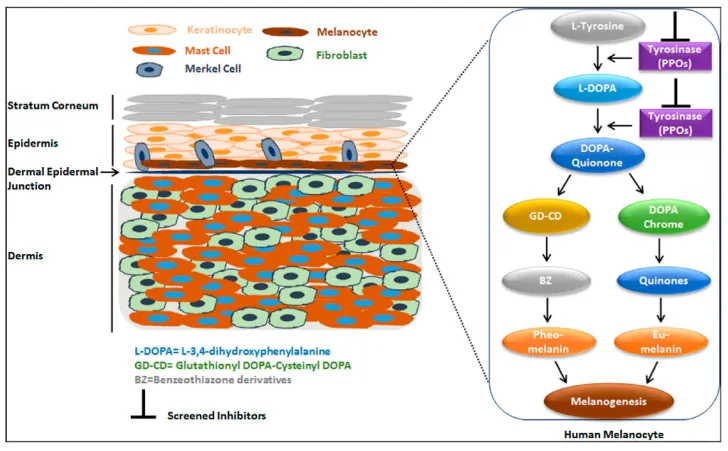
Alpha-arbutin and licorice act on this enzyme, slowing the production of new pigment. They don't remove existing pigment in one go; they let the skin renew itself with less pigment, which is why they need time. As the outer layers turn over, the darker cells are gradually replaced by lighter ones, provided sunlight isn't stimulating fresh pigment at the same time.
Alpha-arbutin: a gentle lightener
Alpha-arbutin is chemically related to hydroquinone but much gentler, and it's used in over-the-counter lightening products. In a 2025 randomised trial of thirty patients with melasma, a cream combining alpha-arbutin and kojic acid was applied to one half of the face and the benchmark triple combination cream to the other for twelve weeks. The pigment index didn't differ between the two sides, and redness, stinging and recurrence after stopping were lower on the arbutin side:
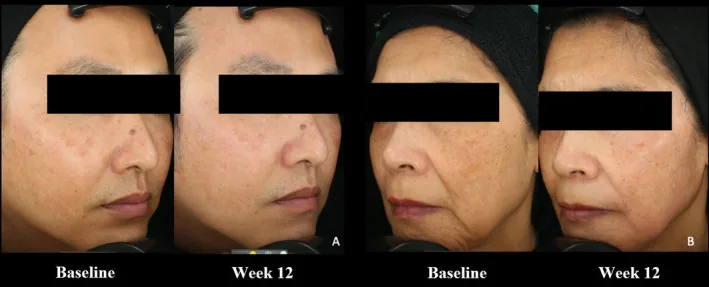
This was a small pilot study, and its cream isn't Alpha Plus's formula, so the result can't be transferred directly, but it shows arbutin is a genuine lightener rather than just a label.
Licorice and glabridin: mostly laboratory evidence
Glabridin is a compound from licorice root that slows pigment production and calms inflammation. Most of its evidence comes from the laboratory. In a 2026 study on pigment cells and skin cells in culture, glabridin reduced pigment production and its transfer to skin cells after ultraviolet exposure:
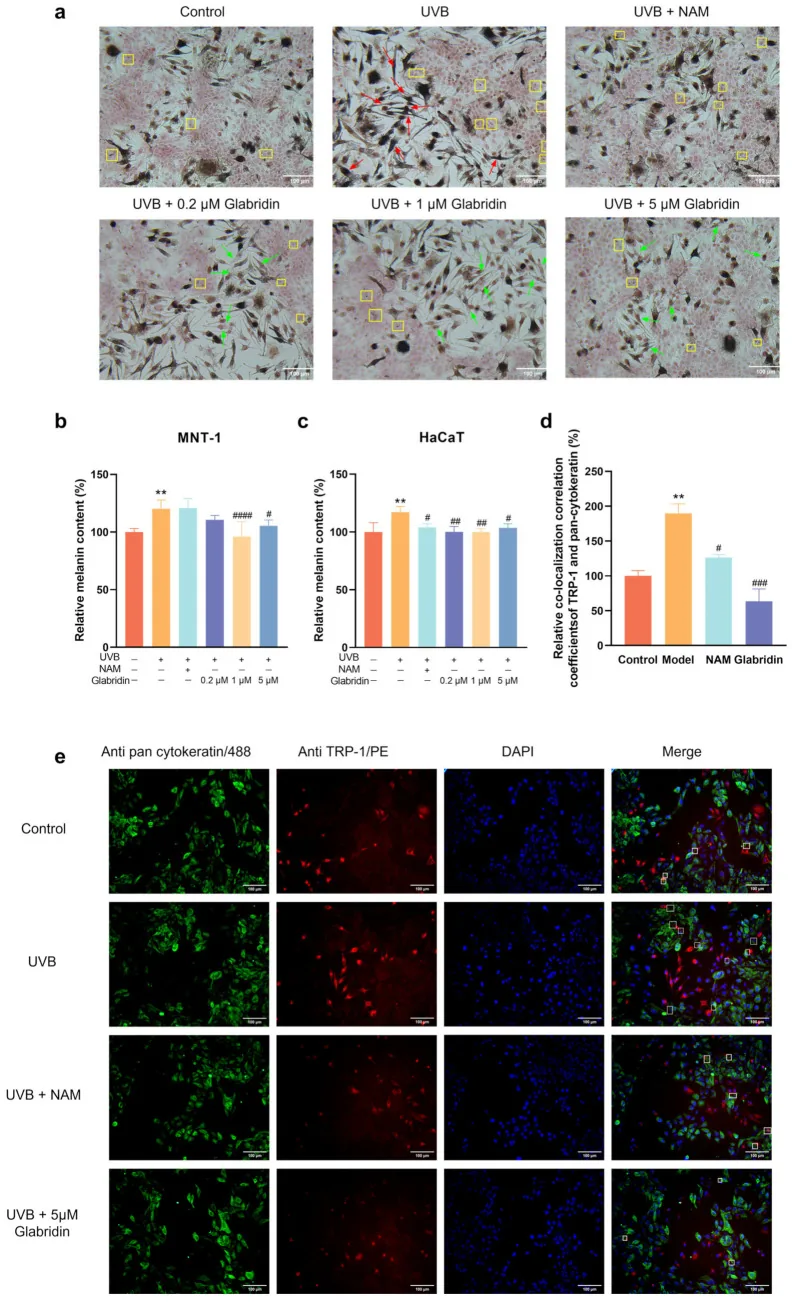
Laboratory results don't mean the same result on a face, because how well an ingredient crosses the skin and its concentration in a cream change the effect. But licorice is a calming ingredient that suits sensitive skin, which is part of why it pairs well with arbutin.
Alpha Plus versus stronger lighteners
The difference between Alpha Plus and prescription lighteners such as hydroquinone and triple combination cream is the difference between strength and tolerability. Stronger lighteners work faster on stubborn pigmentation, but they irritate more, need supervision and a limited course, and can leave new marks in darker skin if irritation is strong. Arbutin and licorice are slower but tolerable over long periods, so they suit mild pigmentation or the maintenance phase after a stronger treatment. Details of stronger options are in melasma treatment for the face. For another lightening range built around niacinamide, see ISIS Pharma lightening cream.
It's also worth knowing that "natural" doesn't automatically mean milder or safer. What matters is the ingredient, its concentration and how your skin responds, which is why a patch test is worth doing with any new lightener, gentle or not.
Reading the label of any lightening cream
The same principles apply to Alpha Plus and to any other lightener on the pharmacy shelf. Look for the active ingredients by name, not just the claims on the box. Prefer products with a full ingredient list, a manufacturer's name and a licence number, because unlabelled creams are where hidden steroids and mercury turn up. Be wary of any promise of results within days, and of products that combine many "active" extracts without saying what each does. A short, clear formula that you tolerate and use every day will do more than an impressive list you abandon after a week because it stings.
Who Alpha Plus suits, and who needs more
| Situation | Suitable? | What to add or prefer |
|---|---|---|
| Mild brown acne marks | May help | Treat the acne itself, plus sunscreen |
| Mild sun spots | May fade them slowly | Clinic procedures are faster |
| Mild melasma | Part of a plan | Tinted sunscreen and a dermatologist's assessment |
| Severe melasma | Not enough alone | Prescription treatment |
| Dark joints and underarms | Limited | Find the cause first |
| Lightening natural colour | No | — |
flowchart TD
  A[Considering Alpha Plus] --> B{Spots mild and superficial?}
  B -->|Yes| C[Try it with daily sunscreen]
  B -->|No| D{Obvious melasma or darkening in skin folds?}
  D -->|Yes| E[Assessment by a dermatologist before any cream]
  D -->|No| F[Identify the type of spot first]
  C --> G{No improvement after months?}
  G -->|Yes| E
How to use it safely
Patch-test it on a small area for a few days before applying it to your whole face, and stop if redness or itching appears. Use daily sunscreen with it, because any lightener used without sunscreen loses what it gains at the first sun exposure. Don't combine it with strong exfoliants in the same week without advice. If you're pregnant or breastfeeding, ask your doctor before using it.
Keep expectations realistic as well. If you've used it consistently for a few months with sunscreen and nothing has changed, the problem may not be the kind of pigmentation it can reach, which is a good reason to have the spots assessed rather than to switch to a stronger product from a shop.
mindmap
  root((Alpha Plus))
    Ingredients
      Alpha-arbutin
      Licorice and glabridin
    Helps
      Mild surface spots
      Brown acne marks
    Not enough for
      Severe melasma
      Darkening in folds
    Needs
      Sunscreen
      Patience
Frequently asked questions
Does Alpha Plus cream lighten the skin?
Alpha Plus is a gentle lightener containing alpha-arbutin and licorice extract, which slow pigment production. It may gradually fade spots and surface pigmentation alongside sunscreen, but it doesn't change your natural skin colour and doesn't treat severe melasma on its own.
What are the ingredients of Alpha Plus cream?
According to pharmacy listings, its two active ingredients are alpha-arbutin, described as derived from bearberry, and glabridin from licorice root extract, with other plant extracts. We couldn't find a full published list of the inactive ingredients, so check the pack before buying.
How long does Alpha Plus cream take to work?
Gentle lighteners work over weeks to months of regular use with sunscreen, not days. In studies of arbutin, results were measured after several weeks.
Can I use Alpha Plus with isotretinoin or in pregnancy?
Most people tolerate alpha-arbutin and licorice well, but skin is more sensitive during isotretinoin, and the product's retail listings advise against use in pregnancy and breastfeeding. Ask your doctor in either case.
When to see a clinician
See a dermatologist if you don't know what kind of spots you have before buying any lightener, if pigmentation hasn't improved after months of regular use with sunscreen, or if redness, itching and peeling appear after the cream. See one promptly if a new spot changes in shape or colour or bleeds, as it needs examining before any lightening.
Related articles
- The fastest way to remove facial pigmentation
- Melasma treatment for the face
- Pakistani whitening creams
- Isotretinoin and pigmentation
Further reading
- A comprehensive review on tyrosinase inhibitors — Journal of Enzyme Inhibition and Medicinal Chemistry
- The Efficacy of Topical Cosmetic Containing Alpha-Arbutin and Kojic Acid Compared With Triple Combination Cream for Melasma — Journal of Cosmetic Dermatology
- How to fade dark spots in darker skin tones — American Academy of Dermatology
Medical disclaimer: This article is for health education only and is not a substitute for professional medical advice. If you have a skin condition that concerns you, please consult a dermatologist.