Isotretinoin (Roaccutane) doesn't lighten your natural skin colour or treat melasma, but by stopping inflamed acne it stops the new brown and red marks that acne leaves, and existing marks fade gradually afterwards. That's why skin looks clearer after treatment. But it also makes the skin thinner and more sensitive to sun and irritation, so new patches can appear if protection is neglected.
The Arabic pages that rank for this search are pharmacy pages and short Q&As saying isotretinoin "lightens the skin" or that laser is forbidden for months afterwards, without separating the types of mark or mentioning what recent reviews have said about procedure timing. This article sets out the relationship precisely.
Why does acne leave marks in the first place?
Every inflamed spot stimulates the pigment cells around it, which release melanin, and some of it can drop into the dermis and stay for months. The diagram from a 2025 review shows this mechanism:
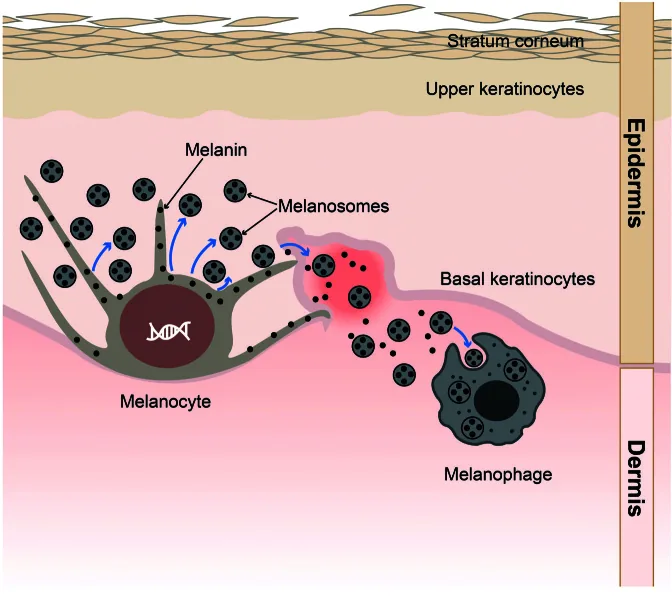
This is where isotretinoin comes in: it doesn't erase existing pigment, but it cuts off its source, so new marks don't form with every spot. That matters especially in olive and brown skin, where every spot tends to leave a mark.
Brown marks, red marks and scars: what isotretinoin does to each
| Type of mark | What isotretinoin does | What may be added |
|---|---|---|
| Brown marks after acne | Prevents new ones; old ones fade gradually | Sunscreen, and a gentle lightener after treatment |
| Red marks after acne | Fade as inflammation stops | Vascular laser in selected cases |
| Pitted scars | Doesn't remove them | Clinic procedures timed by your dermatologist |
| Melasma | Doesn't treat it | A separate melasma plan |
Red marks after acne improve too. In a 2024 trial of forty-eight patients with post-acne redness, the redness improved with isotretinoin alone and improved more when laser was added:
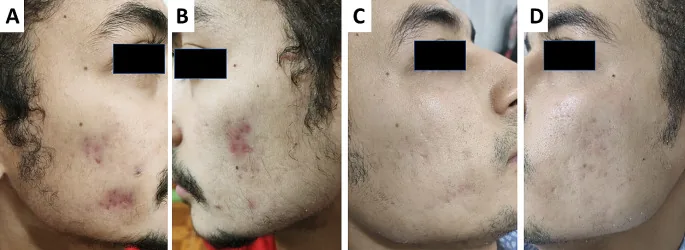
Brown and red acne marks are covered in more detail in red acne marks.
Sun during isotretinoin: the cause of new patches
Isotretinoin thins the outer layer of the skin and makes it more sensitive to sun and irritation. So daily sunscreen is part of the treatment, and long sun exposure, strong exfoliants and facial waxing are avoided during it, because inflamed skin leaves marks. If new dark patches appear during treatment, the cause is usually sun or irritation rather than the medicine itself.
Practical steps make a real difference here: a broad-spectrum sunscreen applied every morning and reapplied outdoors, a hat in strong sun, a bland moisturiser for the dryness isotretinoin causes, and avoiding picking at spots, which is as likely to leave marks during treatment as before it.
Laser and peels with isotretinoin: what has changed?
The traditional advice was to delay procedures for months after stopping isotretinoin, for fear of scarring or pigmentation. But a 2025 systematic review of thirty-four studies found insufficient evidence to support delaying laser hair removal, fractional lasers, superficial to medium peels and several other procedures, while caution remained for fully ablative procedures. A 2026 case series described combining isotretinoin with laser sessions to treat active acne and scars together:
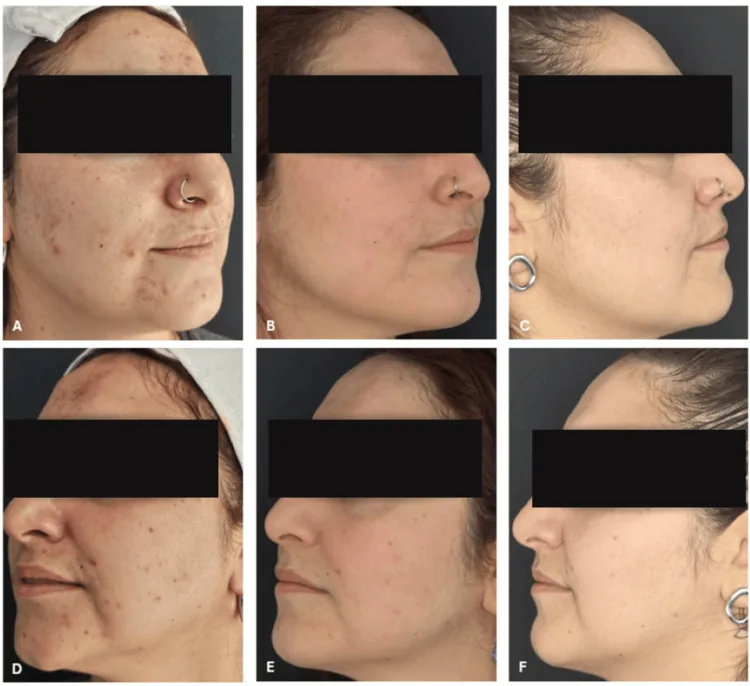
That is only five cases, and it doesn't mean every procedure is safe with isotretinoin. Timing is your dermatologist's decision, based on the procedure, your treatment plan and your skin.
flowchart TD
  A[Acne marks during or after isotretinoin] --> B{Brown or red marks?}
  B -->|Yes| C[Sunscreen and patience - they fade gradually]
  B -->|No: pitted scars| D[Clinic procedures timed by your dermatologist]
  C --> E{New patches during treatment?}
  E -->|Yes| F[Review sun protection and irritation]
After treatment: a plan for the marks
When the course ends, the acne has settled and the marks that came before it remain. This is the right moment for a plan: continuing daily sunscreen, then a gentle lightener for brown marks such as azelaic acid or a topical retinoid if your skin tolerates it, then clinic procedures for pitted scars and stubborn redness. Don't rush to judge brown marks, because they fade gradually on their own once inflammation has stopped, and what remains after that is what deserves treatment. To tell types of mark apart and how quickly each fades, read the fastest way to remove facial pigmentation.
Common myths about isotretinoin and skin colour
A few beliefs come up again and again. The first is that isotretinoin is a "whitening pill". It isn't: any lightening people notice is acne marks fading and redness settling, not a change in their natural colour, and taking it for that reason exposes you to real risks for no benefit. The second is that it causes permanent dark patches. Patches during treatment are usually from sun or irritation and respond to protection. The third is that marks must be treated aggressively the moment the course ends. In practice, giving brown marks time to fade first means you treat less, and treating less on sensitised skin is safer. Discussing these expectations before you start makes the whole course easier.
Isotretinoin safety: what is never compromised
Isotretinoin is a prescription medicine that needs monitoring, and it causes serious harm to an unborn baby, so it isn't used in pregnancy and needs reliable contraception during treatment and for the period afterwards your dermatologist specifies. It causes dry lips and skin, and needs monitoring of blood tests and mood. That is why it is never taken for "lightening".
mindmap
  root((Isotretinoin and pigmentation))
    Helps
      Prevents new marks
      Old marks fade
      Less redness
    Doesn't
      Lighten natural colour
      Treat melasma
      Remove pitted scars
    Watch for
      Sun
      Strong exfoliants
      Pregnancy
Frequently asked questions
Does isotretinoin lighten the skin?
Isotretinoin doesn't lighten your natural skin colour, and it doesn't treat melasma. What it does is stop inflamed acne, so new brown marks stop forming and existing ones fade gradually, which makes the skin look clearer and more even.
Does isotretinoin get rid of acne marks?
It prevents new marks because it stops the inflammation, and existing brown and red marks fade over time. It doesn't remove pitted scars, which need in-clinic treatments timed by your dermatologist.
Does isotretinoin cause pigmentation?
Isotretinoin itself doesn't usually cause pigmentation, but it makes the skin thinner and more sensitive to sun and irritation. So dark patches can appear if you're in the sun without protection, use strong exfoliants, or have irritating procedures without supervision.
When can I have laser after isotretinoin?
The traditional advice was to wait months after stopping it. But a recent systematic review found insufficient evidence that many procedures, such as laser hair removal, fractional lasers and superficial to medium peels, need to be delayed, while caution remains for fully ablative procedures. The decision is your dermatologist's.
When to see a clinician
See a dermatologist before starting isotretinoin, never take it without a prescription and monitoring, and tell them at once if you're pregnant or planning a pregnancy. See them if new dark patches or sunburn appear during treatment, or if you want laser or a peel during or after it. Seek urgent help if you experience severe low mood or thoughts of self-harm, a severe headache with vision changes, or severe abdominal pain.
Related articles
- Red acne marks: why they linger and how to fade them
- The fastest way to remove facial pigmentation
- Tretinoin for hyperpigmentation
- Melasma treatment for the face
Further reading
- Isotretinoin: Overview — American Academy of Dermatology
- Keloid Formation and Any Skin Complications in Patients Treated With Isotretinoin and Undergone Any Skin-Related Procedures — Journal of Cosmetic Dermatology
- Acne-induced Post-inflammatory Hyperpigmentation: From Grading to Treatment — Acta Dermato-Venereologica
Medical disclaimer: This article is for health education only and is not a substitute for professional medical advice. If you have a skin condition that concerns you, please consult a dermatologist.