Tretinoin for hyperpigmentation works slowly but steadily: it speeds the turnover of skin cells so surface pigment is shed faster, and it reduces melanin, fading brown acne marks and sun spots, and it is part of triple combination cream for melasma. But it is a prescription medicine that irritates the skin at first, and that irritation can itself worsen pigmentation in brown and dark skin if it isn't used carefully.
The Arabic pages that rank for this search are medicine and product pages that say it "lightens the skin", without explaining when it helps and when it harms, or why it needs months of patience. This article explains how it works, where it sits among pigmentation treatments, and how to avoid it becoming the cause of new marks.
How does tretinoin lighten the skin?
Tretinoin is an active form of vitamin A available on prescription. The diagram from a 2025 review shows its effects in the skin, including regulating cell turnover and reducing melanin in the epidermis:
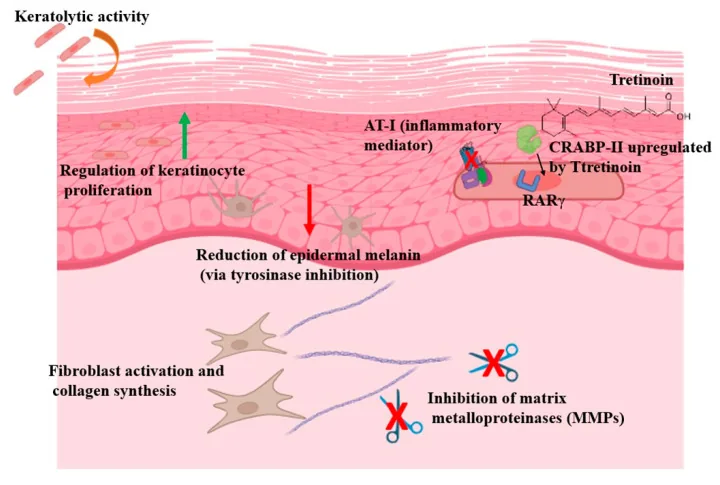
This means tretinoin works mainly on surface pigment, so it is more useful for marks in the epidermis than for deep pigment in the dermis. The same review concludes that the evidence is strong for acne and photoageing, and that smaller studies suggest benefit in melasma and post-inflammatory pigmentation.
Where tretinoin helps, and where it isn't enough
| Type of pigmentation | Tretinoin's role | Note |
|---|---|---|
| Brown acne marks | Fades them and treats the acne too | Useful because it prevents new marks |
| Sun spots | Fades them gradually | Clinic procedures are faster |
| Melasma | Part of triple combination cream | Not usually used alone |
| Tan | Not needed | Fades with protection |
| Deep dermal pigment | Limited effect | Needs assessment for other options |
To identify the type of pigmentation before choosing a treatment, read the fastest way to remove facial pigmentation.
For acne marks in particular, tretinoin has an advantage that lightening creams don't: it also treats the acne. Fading yesterday's marks while new spots keep forming is a losing game, and a treatment that does both at once is often the most efficient choice.
Tretinoin in triple cream for melasma
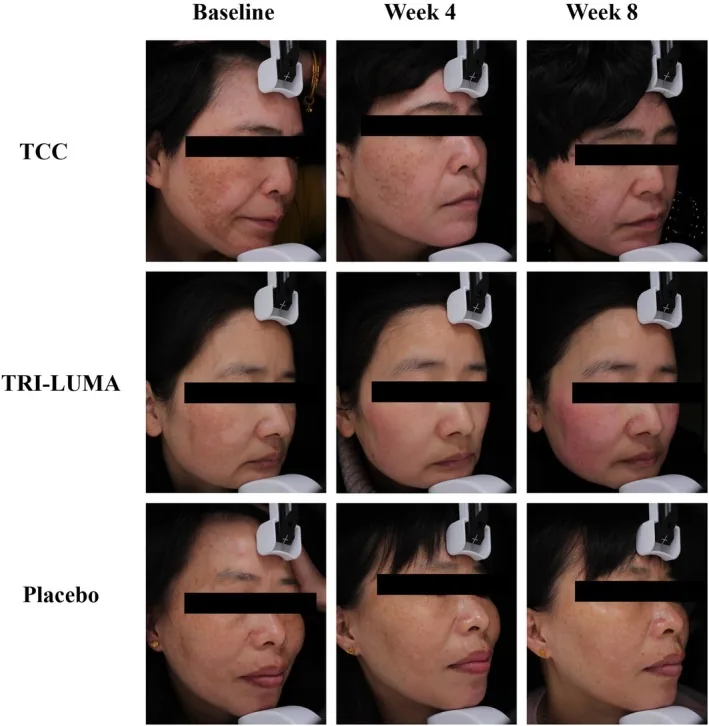
In melasma, tretinoin is usually used within triple combination cream alongside hydroquinone and a mild steroid. In a 2025 randomised trial, melasma improved more with triple cream than with placebo, but redness and irritation were common, an effect of the tretinoin and hydroquinone together:
The full melasma plan is in melasma treatment for the face.
The paradox: when irritation becomes the cause of marks
Tretinoin causes redness, peeling and stinging at first. In fair skin this usually settles without a trace, but in olive, brown and dark skin strong irritation can leave post-inflammatory pigmentation: new marks rather than lighter old ones. That is why your dermatologist introduces it cautiously and watches how your skin tolerates it, and pauses it if irritation becomes strong.
The figure from a 2025 letter shows how a facial procedure can turn into severe post-inflammatory pigmentation when irritation meets sun, and how it improved with a treatment protocol that included retinoic acid:
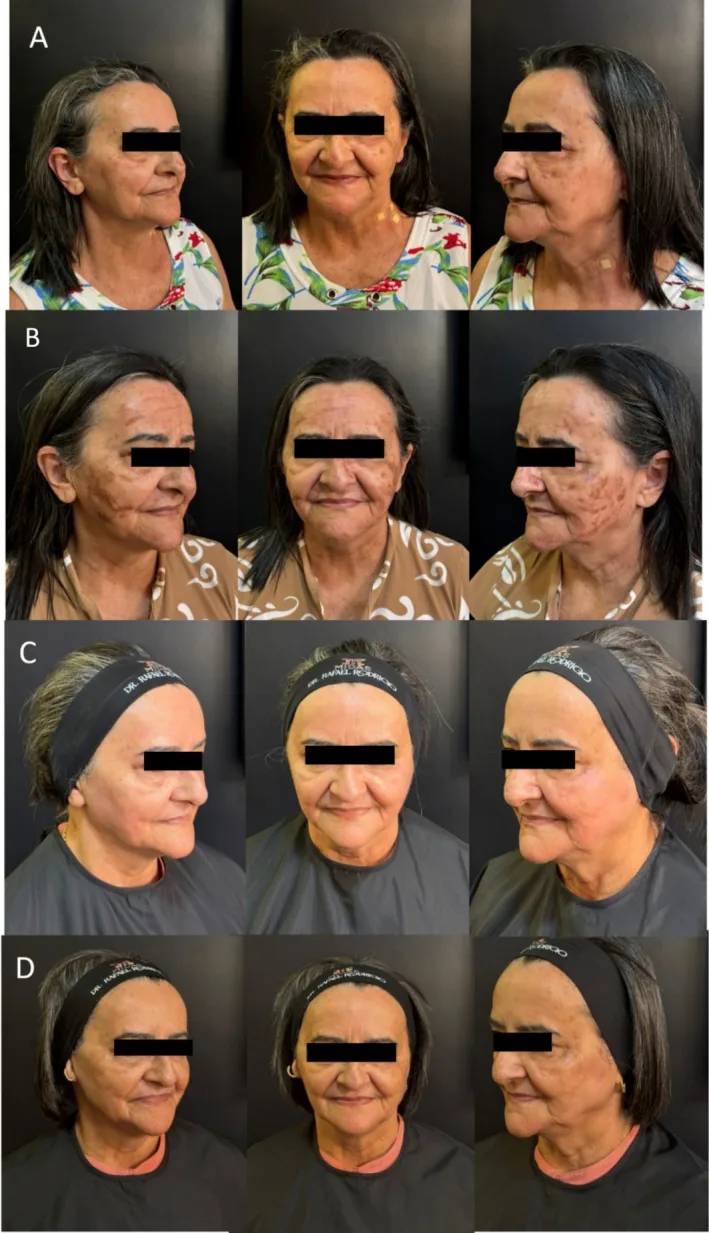
This is a single case with combined treatment, so it doesn't show the effect of tretinoin alone, but it illustrates two things: sun on inflamed skin creates pigmentation quickly, and improvement takes months.
Tretinoin or a gentler alternative?
Tretinoin isn't the first choice for every kind of pigmentation. Azelaic acid is gentler on sensitive skin and suits many people; niacinamide is a mild lightener that most people tolerate; and retinol, sold without prescription, is weaker but easier to tolerate. Your dermatologist chooses tretinoin when there is active acne that needs treating at the same time, when gentler options haven't been enough, or as part of triple cream for melasma. If your skin irritates easily, they may start with the gentler option first, because calm skin lightens faster than inflamed skin. Details on azelaic acid are in Skinoren (azelaic acid).
Safety rules
- Prescription only, and your dermatologist decides how to use it.
- Daily sunscreen, because the skin becomes more sensitive to the sun.
- A moisturiser to ease dryness and irritation.
- Don't combine it with strong exfoliants or irritating products without advice.
- Not used in pregnancy.
The difference between tretinoin and over-the-counter retinol is explained in how retinol actually works.
What to expect in the first weeks is worth knowing in advance. Dryness, flaking and some redness are common and usually settle as the skin adapts; this "adjustment" phase is when many people give up, or, at the other extreme, push through severe irritation that should have been a signal to pause. Neither helps. Tell your dermatologist how your skin is responding so the plan can be adjusted rather than abandoned.
flowchart TD
  A[Pigmentation I'm considering tretinoin for] --> B{Pregnant or planning a pregnancy?}
  B -->|Yes| C[Not used - alternatives with your dermatologist]
  B -->|No| D{Brown, dark or sensitive skin?}
  D -->|Yes| E[Very cautious start, watching for irritation]
  D -->|No| F[Gradual start on prescription]
  E --> G[Sunscreen and moisturiser daily]
  F --> G
mindmap
  root((Tretinoin for pigmentation))
    Helps
      Acne marks
      Sun spots
      Melasma within triple cream
    Needs
      Prescription
      Sunscreen
      Months of patience
    Watch for
      Irritation in darker skin
      Pregnancy
Frequently asked questions
Does tretinoin get rid of hyperpigmentation?
Tretinoin fades pigmentation gradually because it speeds cell turnover, so the skin sheds surface pigment faster, and it reduces melanin in the epidermis. It helps acne marks and sun spots, and for melasma it is usually used within triple combination cream. But it works slowly and needs daily sunscreen.
How long does tretinoin take to work on hyperpigmentation?
Results are slow, measured in months rather than days, and the skin may look worse in the first weeks because of redness and peeling. That is why your dermatologist assesses the response after a reasonable period rather than judging early.
Can tretinoin cause hyperpigmentation?
Tretinoin itself lightens, but the strong irritation it can cause, especially in brown and dark skin, can leave post-inflammatory pigmentation. That is why your dermatologist introduces it cautiously and watches how your skin tolerates it, alongside sunscreen and moisturiser.
Can tretinoin be used in pregnancy?
Tretinoin isn't used in pregnancy, and its use is discussed with your dermatologist when planning a pregnancy and while breastfeeding. There are better-suited alternatives for that time that your dermatologist can suggest.
When to see a clinician
See a dermatologist before starting tretinoin to identify the type of pigmentation and the right way to use it for your skin, especially if your skin is brown or sensitive, or you're pregnant or planning a pregnancy. See one promptly if redness, burning and peeling become severe and don't settle, if new dark patches appear where the skin was irritated, or if swelling and a rash suggest an allergy.
Related articles
- The fastest way to remove facial pigmentation
- Melasma treatment for the face
- What does tretinoin do? Uses and safety basics
- How retinol actually works on aging skin
- Red acne marks: why they linger and how to fade them
Further reading
- How to fade dark spots in darker skin tones — American Academy of Dermatology
- An Updated Review of Topical Tretinoin in Dermatology — Journal of Clinical Medicine
- A Comprehensive Review of the Strategies to Reduce Retinoid-Induced Skin Irritation — Dermatology Research and Practice
Medical disclaimer: This article is for health education only and is not a substitute for professional medical advice. If you have a skin condition that concerns you, please consult a dermatologist.