
No home remedy has been shown to remove dark lips, because lip darkening has different causes: an allergy to lipstick or toothpaste, frequent lip licking, smoking, sun, or natural, inherited colour. What actually helps is stopping the cause, then moisturising and protecting the lips from the sun. Lemon, cinnamon and harsh scrubs can irritate the thin skin of the lips and increase the darkening rather than reduce it.
The Arabic pages that rank for this search offer mixes of beetroot, lemon, turmeric and sugar, and mention causes in passing. But they don't explain that lipstick itself may be the cause, or that some ingredients in these mixes make the problem worse. This article starts with the cause, because the cause decides the treatment.
Lipstick may be the cause
One of the most overlooked causes is pigmented contact cheilitis: the lips react to an ingredient in lipstick, lip balm or toothpaste, first with dryness, peeling and itching, and then the inflammation turns into grey or dark patches. A 2024 systematic review gathered the published cases; most were women, and the culprits included ricinoleic acid, derived from castor oil, and some resins used in lipsticks. The figure shows a case caused by the dye carmine:
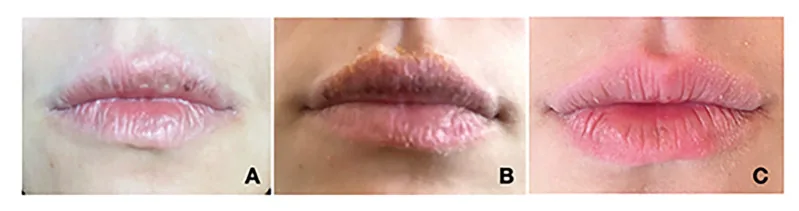
If dryness, itching and peeling came before the darkening, after a new product, stop that product first. You may need patch testing with a dermatologist to identify the exact substance, because it can turn up again in other products under a different name.
It helps to make a list of everything that touches your lips in a normal week: lipsticks and glosses, balms, toothpaste and mouthwash, and even the flavourings in chewing gum. When a reaction is suspected, stopping all of the non-essential ones at once, and then reintroducing them one at a time, is often more revealing than guessing. A dermatologist can shorten that process considerably with patch testing.
Lip licking: the dryness and darkening cycle
Licking your lips moistens them for a moment and then dries them further, so you lick again, the skin around the mouth becomes inflamed, and it darkens. The figure from a 2024 case shows dryness and irritation around the lips of a child who habitually licked them:
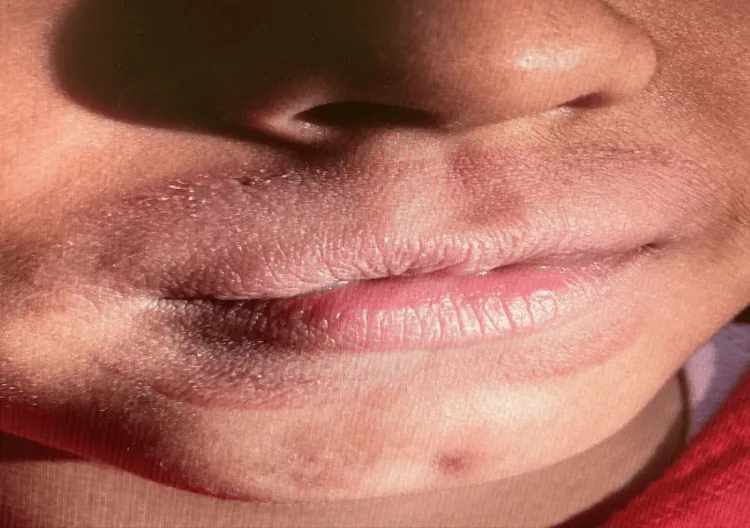
The treatment is stopping the habit, using a plain, fragrance-free balm whenever you feel the urge to lick, and having the inflammation treated by a dermatologist if it persists. All the causes of darkening in the skin around the mouth are covered in creams for dark skin around the mouth. The case report also notes that lip licking often has a stress component, which is worth addressing in its own right, especially in children, where a calm reminder works better than repeated scolding.
Smoking, sun and genetics
- Smoking: stimulates pigment in the lips and gums. In a Japanese study, gum pigmentation lessened after people stopped smoking, which makes quitting part of the treatment.
- Sun: lips are usually exposed with no protection; a lip balm with sunscreen protects them.
- Natural colour: in olive and brown skin, the lips or their borders are naturally darker, and that isn't a disease.
- Rarer causes: some medicines, and some inherited and hormonal conditions, cause dark spots on the lips and in the mouth.
Why home remedies don't work
| Ingredient | What it actually does | The problem |
|---|---|---|
| Lemon | An acidic irritant | Irritates the lips, and with sun may increase darkening |
| Sugar and salt scrubs | Removes flakes temporarily | Repeated rubbing irritates and increases pigment |
| Beetroot and berries | Temporary colour | A tint, not a treatment |
| Honey and petroleum jelly | Moisturise | Useful for dryness, but don't remove pigment |
| Essential oils and cinnamon | Irritation and a temporary flush | Can cause a new allergy |
A plain balm is useful, but it improves dryness, not pigment. And an ingredient that irritates the lips can turn a minor problem into pigmented contact cheilitis.
flowchart TD
  A[Dark lips] --> B{Dryness and itching after a new product first?}
  B -->|Yes| C[Stop the product and see a dermatologist for patch testing]
  B -->|No| D{Frequent lip licking or smoking?}
  D -->|Yes| E[Stop the habit and use a plain balm]
  D -->|No| F{New sudden spots, or in the mouth and nails too?}
  F -->|Yes| G[Examination by a dermatologist]
  F -->|No| H[Probably natural colour - sun protection]
A simple routine instead of a remedy
If your lip darkening is mild and has no obvious cause, this routine does more than any mix: a plain balm with no fragrance or flavouring several times a day, a lip balm with sunscreen before going out in daylight, and stopping licking your lips or picking at flakes. If you want to try a new lipstick or tinted balm, test it on a small part of the lip for a few days before using it fully, and stop at the first sign of itching or dryness. These steps don't bleach the lips, but they stop what keeps darkening them and give the lips a chance to return gradually to their natural colour.
Laser: when is it an option?
When the pigment is stable and its cause has gone, laser may remove it. In a 2021 study of eighty-five patients, most reported complete improvement and high satisfaction with mostly mild side effects, but the study had no comparison group. The figure shows the lips before a session, just after it, and after healing:
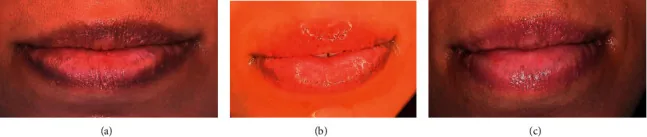
Laser isn't suitable while an allergy is active, and it doesn't stop darkening returning if the cause remains. It needs a doctor experienced with lip pigmentation.
mindmap
  root((Dark lips))
    Causes
      Product allergy
      Lip licking
      Smoking and sun
      Natural colour
    Helps
      Stop the cause
      Plain balm
      Lip sunscreen
    Harms
      Lemon
      Harsh scrubbing
      Essential oils
Frequently asked questions
What is the best home remedy to lighten dark lips?
No home remedy has been shown to remove lip darkening. A plain lip balm and a lip sunscreen improve dryness and stop the darkening getting worse, while lemon, cinnamon and harsh scrubs can irritate the lips and increase the darkness. The most important step is finding and stopping the cause.
Why do lips get darker?
Common causes include an allergy to lipstick, toothpaste or another product, frequent lip licking, smoking, sun, and natural or inherited pigmentation in darker skin, and occasionally medicines or rare conditions. New dark spots that appear suddenly are worth having examined.
Will my lip colour return after stopping the lipstick that caused it?
It usually improves gradually once the allergen is stopped. In a published case, lip darkening improved clearly five months after the person stopped using a dye in a lip product. That is why treatment starts with identifying the substance, which may need patch testing with a dermatologist.
Does laser remove dark lips?
Laser can remove pigment-based darkening of the lips, and in a study of eighty-five patients most improved markedly, but the study had no comparison group. Laser needs an experienced doctor because the lips are delicate, and darkening can return if its cause remains.
When to see a clinician
See a dermatologist if the darkening followed dryness, itching and peeling, if it hasn't improved after stopping suspect products, or if you're considering laser. See one promptly if a new dark spot on the lip grows or changes colour or outline, if dark spots also appear in the mouth or on the nails, or if a sore on the lip won't heal.
Related articles
- What causes darkening of the face and neck
- Types of skin spots in pictures
- The fastest way to remove facial pigmentation
- Pakistani whitening creams
Further reading
- How to Lighten Dark Lips: 16 Natural Home Remedies — Healthline
- Pigmented contact cheilitis: a systematic review — Medicina Oral, Patología Oral y Cirugía Bucal
- Er,Cr:YSGG 2780 nm Laser Treatment of Lip Melanin Hyperpigmentation — International Journal of Dentistry
Medical disclaimer: This article is for health education only and is not a substitute for professional medical advice. If you have a skin condition that concerns you, please consult a dermatologist.