
Dark skin around the mouth is mostly the aftermath of repeated inflammation: lip licking, perioral dermatitis, a steroid cream used on the face, or an allergy to toothpaste or lip products, and sometimes melasma on the upper lip. So treatment doesn't start with a lightening cream but with stopping whatever irritates the skin, followed by a gentle lightener and sunscreen. Some "lightening" creams, especially those containing steroids, make the problem worse.
The Arabic pages that rank for this search list many causes, from vitamin deficiency to toothpaste residue, and then suggest honey-and-lemon mixes. But they don't show what each condition looks like, or warn that the steroid creams some people use on this area may be the cause. This article separates the causes with pictures.
Why this area darkens so easily
The skin around the mouth is thin, moves constantly, and is exposed to more irritants than almost anywhere else on the face: saliva, food, toothpaste, lip products, shaving or waxing, and sun on the upper lip. Each of these can trigger low-grade inflammation, and in olive, brown and dark skin, inflammation tends to leave pigment behind. That is why the same few causes come up again and again, and why a lightening cream applied on top of ongoing irritation so often disappoints. The order matters: identify and stop the irritant, let the skin calm, then fade what remains.
Lip licking: a dark ring around the mouth
Saliva moistens for a moment and then dries the skin, so licking repeats, the skin around the lips becomes inflamed in a ring, and then darkens after the inflammation. The figure from a 2024 case shows this ring in a child who habitually licked his lips:
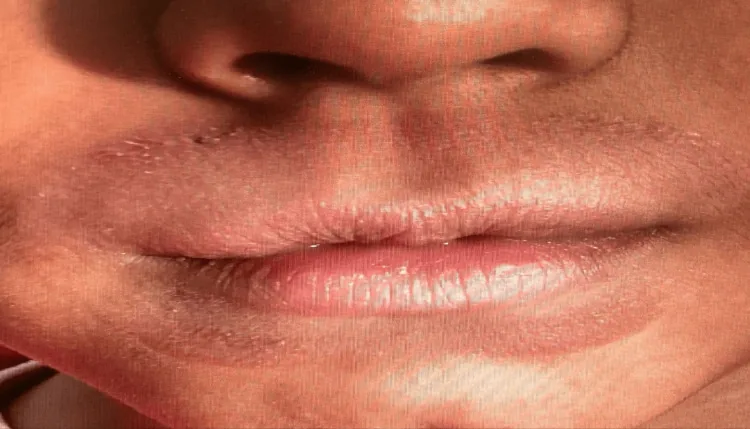
A lightener doesn't help here until the licking stops, because the inflammation makes new pigment every day. A plain, fragrance-free balm applied whenever you feel the urge to lick is the first step; the lips themselves are covered in home remedies for dark lips.
The habit is often unconscious, especially when concentrating, reading or in cold, dry weather. Keeping a balm within reach, and noticing the moments the urge appears, works better than simply trying to remember not to do it.
Perioral dermatitis: red bumps, then marks
Perioral dermatitis is small, uniform red bumps around the mouth and nose, typically sparing a thin rim of skin right next to the lip, sometimes with burning or itching. It recurs and worsens with heavy creams and steroids, and once it settles it often leaves pigmentation in olive and brown skin. The figure from a 2026 case shows how it progresses:
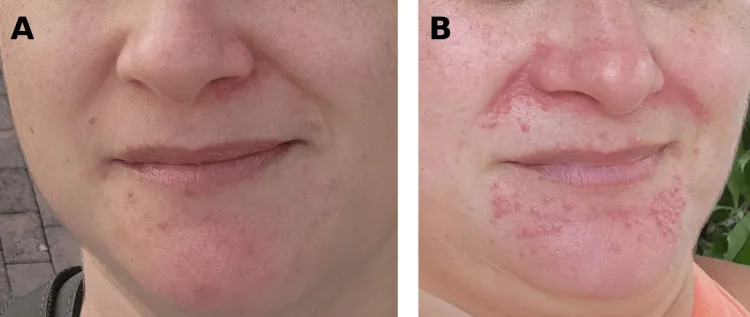
It's treated by a dermatologist, usually starting with stopping heavy creams and steroids. The pigmentation left behind fades gradually once the inflammation has settled, which is why controlling the rash is itself the first lightening step.
Steroids on the face: the treatment that becomes the cause
Steroid creams calm redness quickly, so they're sometimes used on the face without a prescription, or hidden in unlabelled lightening creams. With long use they can cause a rosacea-like inflammation around the mouth and nose that flares when the cream is stopped. The figure from a 2021 case report shows redness around the nose and mouth after a potent steroid cream on the face:
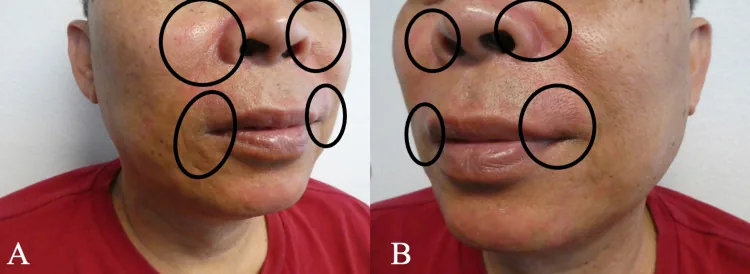
If you're using a cream containing a steroid around your mouth, don't stop it abruptly or increase it; see your dermatologist for a plan to come off it. The risks of unlabelled creams are covered in Pakistani whitening creams.
Other causes
- Melasma on the upper lip: a symmetrical, moustache-like patch that worsens with sun and hormones; the plan is in melasma treatment for the face.
- Allergy: to toothpaste, lip balm or lipstick, with itching and dryness before the darkening.
- Hair removal: waxing, threading and depilatory creams irritate the area, and hair shadow itself can look like darkening.
- General causes: acanthosis nigricans occasionally appears on the face, and vitamin B12 deficiency can cause pigmentation; these need blood tests.
The causes compared
| Cause | Look | Distinguishing sign | What helps |
|---|---|---|---|
| Lip licking | Dry, dark ring around the lips | The licking habit | Stop it, plain balm |
| Perioral dermatitis | Red bumps, then marks | Clear rim next to the lip | Medical treatment; stop heavy creams |
| Steroid cream | Redness, then pigmentation | Cream used on the face | Stop under a dermatologist's supervision |
| Melasma | Symmetrical brown "moustache" | Worse with sun | Tinted sunscreen and a melasma plan |
| Allergy | Darkening after itching and dryness | A new product | Stop it; patch test |
flowchart TD
  A[Dark skin around the mouth] --> B{Do you lick your lips a lot?}
  B -->|Yes| C[Stop the habit and use a plain balm]
  B -->|No| D{Small red bumps around the mouth and nose?}
  D -->|Yes| E[Perioral dermatitis - treatment by a dermatologist]
  D -->|No| F{Using a steroid cream on your face?}
  F -->|Yes| G[Don't stop suddenly - plan with your dermatologist]
  F -->|No| H[Melasma or allergy - assessment]
What helps once the cause has stopped
Once inflammation has settled, daily sunscreen and a gentle lightener such as azelaic acid or niacinamide help fade what remains. Avoid lemon, baking soda and strong exfoliation, because the skin around the mouth is thin and easily irritated, and irritation creates new darkening. Be patient, too: pigmentation left by inflammation fades over weeks to months, and the steadier the routine, the less likely you are to restart the cycle.
mindmap
  root((Dark skin around the mouth))
    Inflammation
      Lip licking
      Perioral dermatitis
      Steroid creams
    Pigment
      Melasma
      Allergy
    Treatment
      Stop the cause
      Gentle lightener
      Sunscreen
Frequently asked questions
What is the best cream for dark skin around the mouth?
It depends on the cause. If the darkening is left behind by inflammation from lip licking or an allergy, the most important steps are stopping the cause and using a plain moisturiser, then a gentle lightener such as azelaic acid or niacinamide. If perioral dermatitis is active, it's treated first; if it's melasma on the upper lip, it needs a melasma plan.
What causes dark skin around the mouth?
Common causes include frequent lip licking, perioral dermatitis, steroid creams used on the face, allergy to toothpaste or lip products, melasma on the upper lip, and waxing or threading. Occasionally it's linked to acanthosis nigricans or a vitamin deficiency.
Does steroid cream remove dark skin around the mouth?
No, it can cause the problem. Using steroid cream on the face for a long time can cause perioral dermatitis, which then leaves redness and pigmentation. Don't use it on the face except on prescription and for a short time.
Can dark skin around the mouth be removed in a week?
No. Pigmentation after inflammation fades gradually over weeks to months once the cause has stopped, and creams promising results within a week may contain strong, undeclared ingredients that make the problem worse.
When to see a clinician
See a dermatologist if small red bumps appear around your mouth and nose, if you're using a steroid cream on your face and want to stop it, or if the darkening hasn't faded months after stopping irritants. See one too if the darkening comes with tiredness or tingling, or also appears inside the mouth or on the gums, or if a changing spot or a sore that won't heal appears around the mouth.
Related articles
- Home remedies for dark lips
- Melasma treatment for the face
- Pakistani whitening creams
- Alpha Plus lightening cream
Further reading
- Topical Steroid-Induced Perioral Dermatitis (TOP STRIPED) — Cureus
- Lip-Lick Cheilitis and Its Connection to the Brain — Cureus
- How to fade dark spots in darker skin tones — American Academy of Dermatology
Medical disclaimer: This article is for health education only and is not a substitute for professional medical advice. If you have a skin condition that concerns you, please consult a dermatologist.