"Bacterial pimples" describes three different conditions: inflammatory acne, bacterial folliculitis and impetigo. And much of what looks like bacterial spots is actually fungal folliculitis, which resembles acne, doesn't respond to antibiotics and can get worse with them. So the first question isn't "which antibiotic?" but "is this bacterial at all?"
The Arabic pages that rank for this search go straight to topical antibiotics without mentioning fungal causes or resistance. This article helps you tell them apart before choosing a treatment.
What are bacterial pimples, really?
Inflammatory acne starts with pores blocked by sebum and dead cells; Cutibacterium acnes then multiplies inside and feeds the inflammation. Bacteria are part of the story, not its only cause, which is why killing them without treating the blockage isn't enough.
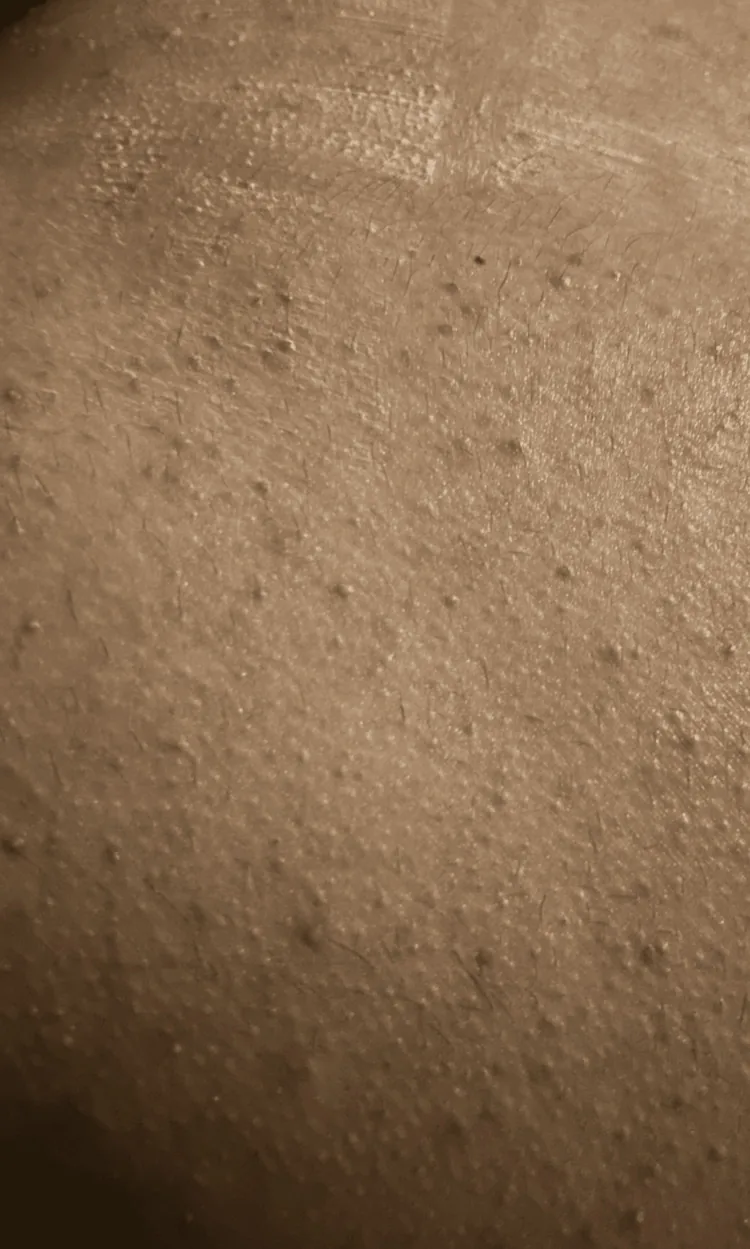
Bacterial folliculitis is an infection at the opening of a hair follicle, usually with staphylococci. It shows as small pustules, sometimes with a hair at the centre, and is common after shaving or hair removal, or with friction and sweat. The image below is from a published case of folliculitis on the lower back:
Impetigo is a superficial infection that leaves honey-coloured crusts, more common in children; it and its treatment are covered in Fusiderm ointment.
Bacterial vs fungal pimples: the most common mix-up
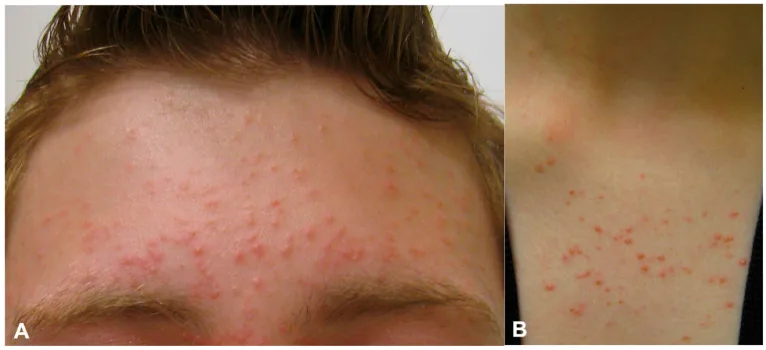
Fungal folliculitis is caused by Malassezia, a yeast that lives normally on the skin and multiplies with heat, sweat and tight clothing. A 2025 review describes it as common yet frequently misdiagnosed, because its uniform, itchy bumps mimic acne, often leading to inappropriate antibiotic use. The image below is from that review:
The irony is that an antibiotic can make fungal folliculitis worse, because it kills the bacteria competing with the yeast for the same space.
The same review notes that diagnosis is supported by magnified examination of the skin, a simple scraping looked at under the microscope, a Wood's lamp, and the response to antifungal treatment. Topical and oral antifungals are usually very effective, but relapse is common, because the yeast is a normal part of the skin and returns when its conditions return: heat, sweat and tight clothes. A good plan therefore includes prevention after the skin clears, not one course and then waiting for it to come back. If your spots have "not responded to anything" for months, that in itself is a reason to ask for an examination.
| Inflammatory acne | Bacterial folliculitis | Fungal folliculitis | |
|---|---|---|---|
| Appearance | Mixed sizes with blackheads and whiteheads | Small pustules around hairs | Small, uniform bumps |
| Itch | Rare | Sometimes | Common |
| Where | Face, chest, back | Shaved and rubbed areas | Forehead, hairline, chest, back |
| With antibiotics | Partly improves | Improves | May worsen |
| Main treatment | Treat blockage and inflammation | Antiseptic or a short antibiotic course | Antifungal |
The flowchart below puts the questions in order:
flowchart TD
  A[Spots you think are bacterial] --> B{Small, uniform and itchy on forehead or chest?}
  B -->|Yes| C[Possibly fungal - examination before any antibiotic]
  B -->|No| D{Blackheads and whiteheads with spots of mixed sizes?}
  D -->|Yes| E[Acne - a plan for blockage and inflammation]
  D -->|No| F{Pustules around hairs after shaving or friction?}
  F -->|Yes| G[Possible bacterial folliculitis - assessment]
  F -->|No| H{Honey-coloured crusts?}
  H -->|Yes| I[Impetigo - see a doctor]
  H -->|No| J[Diagnosis in clinic]
Bacterial acne treatment: why an antibiotic alone isn't enough
For acne, the NICE guideline says not to use a topical antibiotic on its own. A 2026 Japanese study shows why: clindamycin resistance in the acne bacteria of patients who used it with benzoyl peroxide was roughly half that of patients who used it alone, and in the laboratory resistant strains emerged with clindamycin alone but were not detected with the combination:
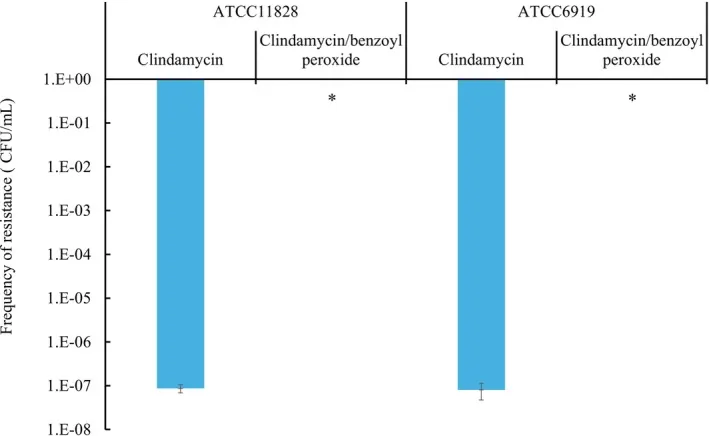
Benzoyl peroxide kills bacteria without them becoming resistant, which makes it the backbone of treatment for genuinely bacterial spots, together with something for blockage such as a retinoid. The details are in benzoyl peroxide for acne and Derma-T solution.
Mild bacterial folliculitis often settles once the trigger stops — shaving, tight clothing, a poorly maintained hot tub — together with an antiseptic wash, and your dermatologist decides whether an antibiotic is needed at all. Why wiping the face with alcohol and antiseptics doesn't clear acne is explained in antiseptic for acne. Hot-tub folliculitis is its own pattern: itchy bumps under where a swimsuit sat, a day or two after using a poorly chlorinated tub, caused by a different bacterium from ordinary folliculitis.
What a dermatologist looks at
Telling these apart in clinic is quicker than it sounds, and it rarely needs anything invasive. The first clues come from looking: whether there are blackheads and whiteheads at all, whether the bumps are all the same size, whether a hair sits at the centre of each pustule, and where on the body they cluster. Then come the questions: does it itch, did it start after a course of antibiotics, a holiday somewhere hot or a new gym routine, and does it get worse when you sweat? When the answer still isn't clear, a scraping looked at under the microscope can show yeast within minutes, and a swab can identify bacteria and their resistance when an infection keeps coming back.
That short assessment changes the treatment completely, which is why it is worth having before a second or third course of antibiotics, not after.
What makes bacterial pimples worse?
- Shaving with old blades and against the grain, and repeated hair removal.
- Sweating under tight clothing and staying in gym kit after exercise.
- Sharing towels and razors.
- Picking and squeezing spots; see the benefits and harms of popping pimples.
- Applying steroid creams to spots, which lower local defences and can cause spots themselves.
Frequently asked questions
How do I know if my pimples are bacterial?
You can't be sure from appearance alone. Inflammatory acne brings spots of different sizes alongside blackheads and whiteheads; bacterial folliculitis shows small pustules around hairs; and small, uniform, itchy bumps on the forehead and chest are often fungal. A dermatologist tells them apart by examination and sometimes a swab or microscopy.
What is the difference between bacterial and fungal acne?
Fungal spots are small and uniform, itch, and cluster on the forehead, hairline, chest and back; they often worsen with heat and sweat and after antibiotics. Bacterial spots or acne vary in size, come with blackheads, and rarely itch.
Do antibiotics treat bacterial pimples?
They help inflammatory acne and bacterial folliculitis, on conditions: alongside another treatment such as benzoyl peroxide, and for a limited period. If the spots are fungal, an antibiotic can make them worse, because it kills the bacteria that compete with the yeast.
Are bacterial pimples contagious?
Acne isn't contagious. Bacterial folliculitis and impetigo can spread through personal items such as towels and razors, so don't share them, and wash towels and pillowcases regularly while there is an infection.
When to see a clinician
See a dermatologist if your spots itch, haven't improved with acne treatment or got worse after an antibiotic, are deep and painful or leaving scars, or if pustules around hairs keep returning despite stopping shaving. See a doctor promptly for a fever, spreading redness and swelling around the spots, or spreading honey-coloured crusts. For spots on the body specifically, read red bumps on the body.
Related articles
Further reading
- Fungal Acne vs. Bacterial Acne: How to Spot the Difference — Dr. Su Formulations
- Fungal Acne vs Bacterial Acne: A Comprehensive Guide — Doctronic
- Malassezia Folliculitis: An Underdiagnosed Mimicker of Acneiform Eruptions — Journal of Fungi
Medical disclaimer: This article is for health education only and is not a substitute for professional medical advice. If you have a skin condition that concerns you, please consult a dermatologist.