An antiseptic for acne kills bacteria on the surface of the skin, but it doesn't treat acne, because a spot starts with a blockage inside the pore, where the bacteria are sheltered by sebum. A recent laboratory study found that adding sebum clearly weakened most antiseptics against acne bacteria. Strong antiseptics such as alcohol also irritate the skin barrier and increase redness. What genuinely works as an "antiseptic" for acne is benzoyl peroxide.
The Arabic pages that rank for "pimple antiseptic" offer general lists of acne treatments and never answer the actual question: does disinfecting help? This article does.
Where do acne bacteria live?
Skin isn't a sterile surface, and it isn't meant to be. It hosts a normal community of bacteria and yeasts, on its surface and inside its follicles, that helps protect it. Cutibacterium acnes is a normal part of that community, living deep in the follicle near the oil gland, where there is sebum and little oxygen. The diagram below shows where these organisms live:
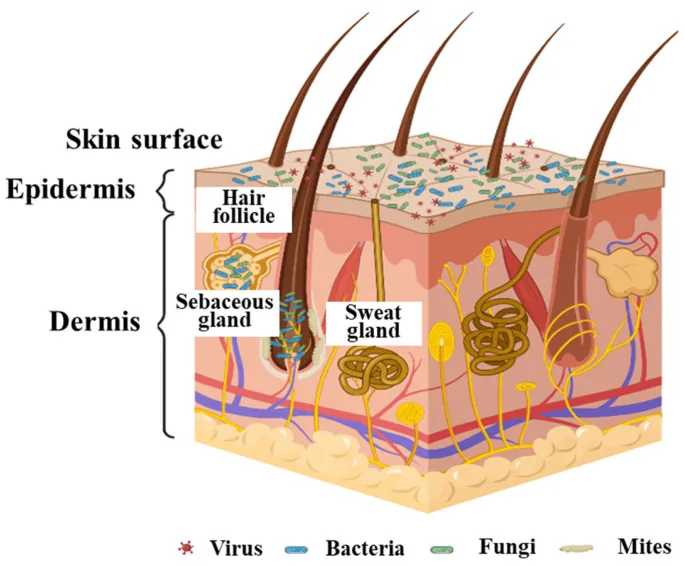
The antiseptic you wipe across your face reaches the surface first, and the surface isn't where a spot begins. In acne, a pore becomes blocked with sebum and dead cells, and bacteria multiply inside it and feed the inflammation. Getting there takes ingredients that dissolve in oil or that act on the blockage itself.
Antiseptics in the lab: what does sebum do?
In a 2025 Japanese laboratory study, researchers tested antiseptics commonly found in over-the-counter products, including chlorhexidine, against acne bacteria. On a model of ordinary skin, several of them killed the bacteria effectively. But when artificial sebum was added to mimic the conditions inside a spot, most of them lost much of their effect; only one, olanexidine, kept working. The chart below shows bacterial numbers after exposure to each antiseptic:
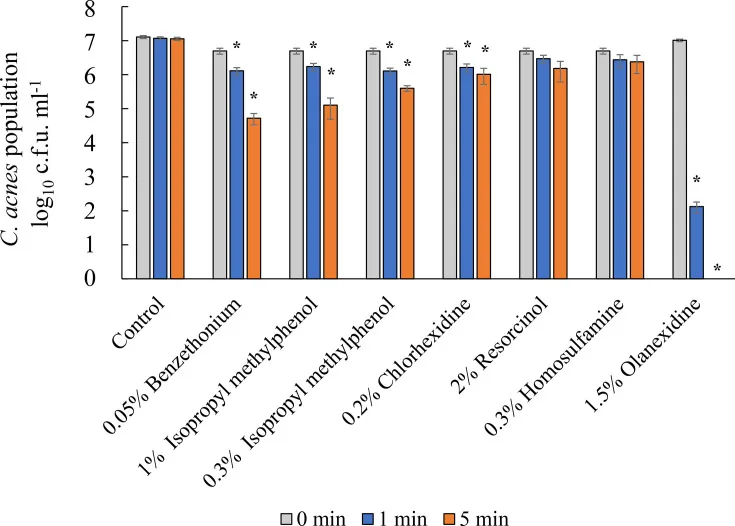
This is a laboratory result, not a trial in patients, so it doesn't prove anything about treatment. But it explains what many women notice: a "disinfected" face keeps producing spots.
Common antiseptics: what they do and what they cost
| Substance | What it does | What to watch for |
|---|---|---|
| Alcohol | Dries and briefly disinfects the surface | Irritates the barrier, increases redness |
| Chlorhexidine | A surgical antiseptic for wounds and skin | Not designed for daily facial use; can cause allergy |
| Liquid hydrogen peroxide | Cleans superficial wounds | Irritates intact skin |
| Tea tree oil | Mild antibacterial effect | Concentrated oil irritates and sensitises |
| Benzoyl peroxide | Kills bacteria by oxidation inside the pore | Dryness and bleached fabrics |
The decisive difference is that benzoyl peroxide has been studied in acne itself, it is among the options in the NICE guideline, and bacteria don't develop resistance to it. The details are in benzoyl peroxide for acne, and the tea tree oil evidence in pimple drying lotion.
Rubbing alcohol deserves a specific word, because it is the antiseptic most people already own. There are no studies of it as an acne treatment; the case for it is anecdotal. What is well established is that it strips oil and water from the outer layer of skin, which is why it stings on broken skin and leaves the face tight. On a spot, that can look like "drying it out", but the redness around it often ends up worse, and in olive and brown skin the extra irritation tends to leave a darker mark than the spot alone would have.
Why repeated disinfecting can make spots worse
The balance between the microorganisms on your skin is part of its health. When that balance is disturbed — what's called dysbiosis — it is linked with conditions including acne, eczema and psoriasis, as the diagram from the same review summarises:
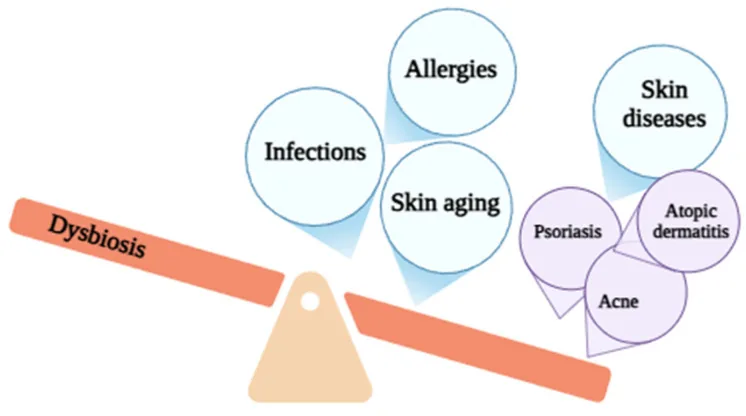
What I see in clinic is simpler than that: wiping the face with alcohol or antiseptics every day dries and irritates the skin, so it becomes redder, every spot leaves a more obvious dark mark, and oily skin may answer the dryness with more shine. Then a stronger antiseptic is added, and the cycle continues.
The flowchart below sets out the decision:
flowchart TD
  A[Considering an antiseptic for spots] --> B{An open spot or a wound after picking?}
  B -->|Yes| C[Gentle wash and cover - no alcohol]
  B -->|No| D{Recurring spots on the face?}
  D -->|Yes| E[An acne treatment such as benzoyl peroxide, not disinfection]
  D -->|No| F{Pustules around hairs or honey-coloured crusts?}
  F -->|Yes| G[Possible infection - medical assessment]
  F -->|No| H[A gentle cleanser twice a day is enough]
When disinfecting does make sense
Disinfection has its place: an open wound, a spot that has opened after being picked, or skin before a procedure in clinic. For superficial skin infections such as impetigo, a doctor may start with an antiseptic cream before an antibiotic, as explained in Fusiderm ointment. But spots that keep coming back every day are acne, and acne needs a plan, not disinfection. To check whether your spots are bacterial at all, or fungal, read bacterial pimples.
A routine instead of disinfecting
The map below summarises what helps and what harms:
mindmap
  root((Instead of an antiseptic))
    What helps
      Gentle cleanser twice daily
      A treatment for blockage and bacteria
      A light moisturiser
      Sunscreen
    What harms
      Wiping the face with alcohol
      Daily surgical antiseptics
      Scrubbing spots
      Many products at once
- A gentle cleanser morning and evening, without scrubbing.
- One well-studied topical treatment rather than layers of products.
- A light moisturiser, even for oily skin.
- Clean surroundings: a pillowcase changed regularly, a wiped phone screen, washed make-up brushes.
None of these sound as decisive as an antiseptic, and that is the point. Acne responds to steady, unglamorous treatment over weeks; the urge to "kill" it quickly with something that stings is usually what keeps the skin irritated enough for the next breakout to look worse.
Frequently asked questions
Does an antiseptic treat acne?
Not on its own. An antiseptic kills bacteria on the skin's surface, but acne starts with blocked pores, and the bacteria multiply inside them, protected by sebum. A laboratory study found that adding sebum clearly weakened most antiseptics against acne bacteria. Treatment needs something that works on blockage and inflammation.
Is putting rubbing alcohol on pimples a good idea?
It dries the surface of a spot and feels clean, but it irritates the skin and weakens its barrier, can increase redness and may leave a dark mark around the spot. Regularly disinfecting your face with alcohol isn't recommended.
What is the best antiseptic for facial spots?
The closest thing to a studied 'antiseptic' for acne is benzoyl peroxide, which kills bacteria by oxidation without resistance developing, and guidelines include it among treatment options. Surgical antiseptics such as chlorhexidine were designed for wounds and pre-operative skin, not daily use on the face.
Does disinfecting my face prevent breakouts?
No. Your skin hosts a normal community of bacteria and yeasts that helps protect it, and repeated disinfection unsettles that balance and irritates the barrier without preventing the blockage that spots start from. Gentle cleansing twice a day is enough.
When to see a clinician
See a dermatologist if your spots keep recurring, are deep and painful, or leave marks and scars; if your skin has become red and flaky after antiseptics; or if itching and a rash appeared after a new product. See a doctor promptly if redness, swelling and pain spread around a spot, or there is a fever or spreading honey-coloured crusts. For a complete treatment plan, read acne medicines.
Related articles
- Benzoyl peroxide for acne
- Bacterial pimples
- Pimple drying lotion
- The benefits and harms of popping pimples
- Acne medicines
Further reading
- Rubbing Alcohol for Acne: Does It Work? — Healthline
- Rubbing alcohol for acne: Does it work, safety, and alternatives — Medical News Today
- In vitro efficacy of disinfectants against Cutibacterium acnes — Journal of Medical Microbiology
Medical disclaimer: This article is for health education only and is not a substitute for professional medical advice. If you have a skin condition that concerns you, please consult a dermatologist.