Benzoyl peroxide is one of the oldest and most useful topical acne treatments: it kills acne-related bacteria by oxidation, so they don't develop resistance to it the way they do to antibiotics. It comes as a wash you rinse off and as a gel or cream that stays on, under brand names such as PanOxyl and Benzac. But it irritates when misused, bleaches towels and pillowcases, and — contrary to what many people believe — does not lighten skin.
How does benzoyl peroxide work?
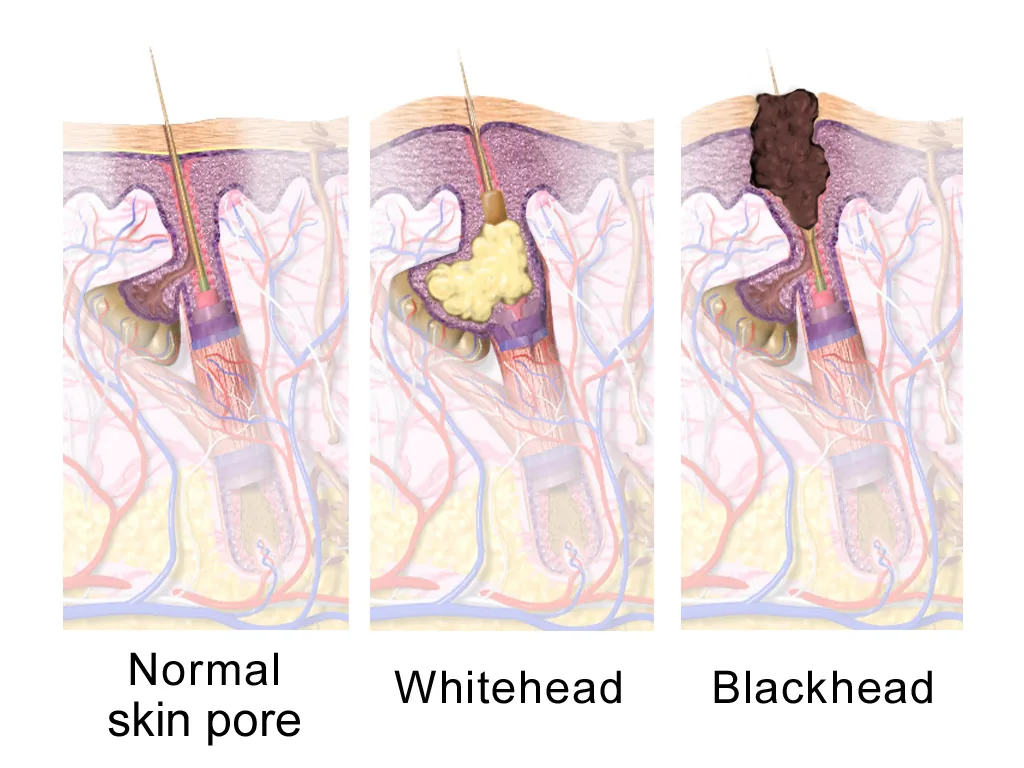
Acne starts with blocked pores: sebum and dead cells collect in the follicle to form a whitehead or blackhead, then bacteria multiply inside and inflammation begins. The diagram below shows the difference between a normal pore, a whitehead and a blackhead.
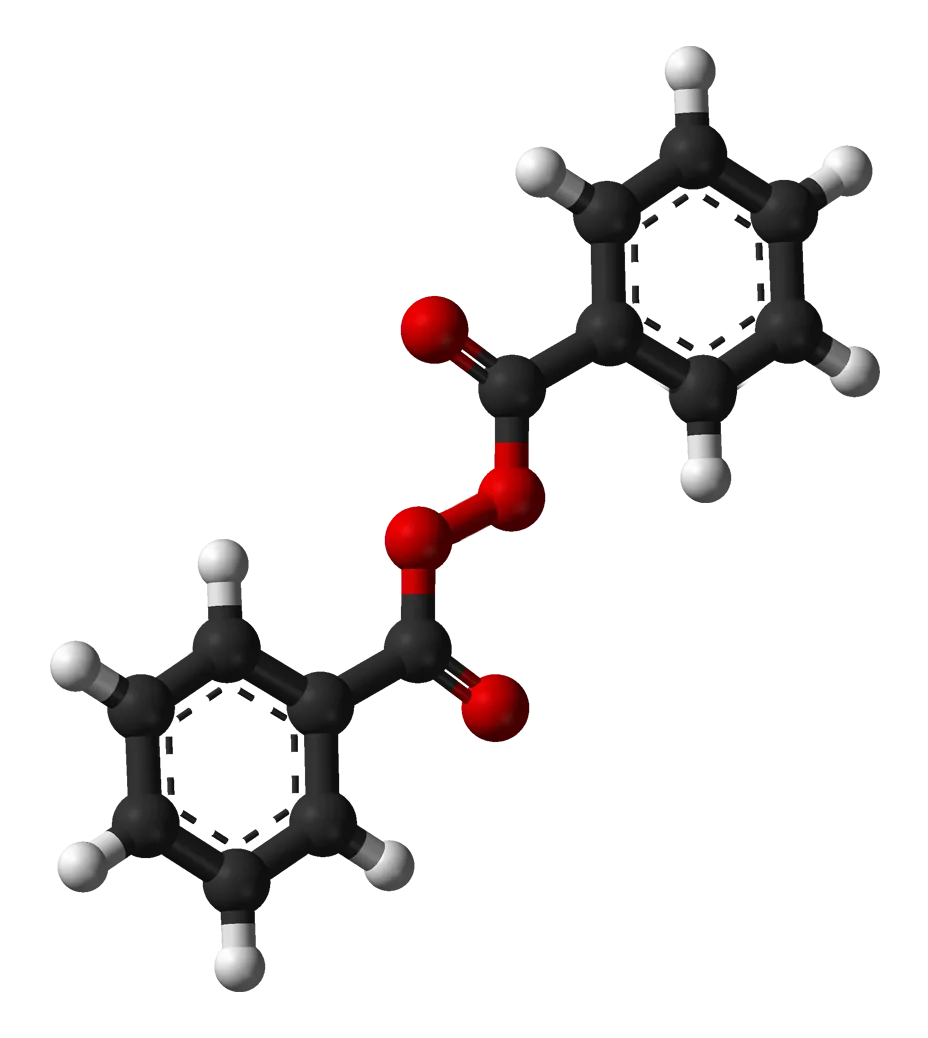
Benzoyl peroxide is an oxidising agent. On contact with the skin it releases reactive oxygen that kills bacteria inside the follicle, and it helps a little with loosening blockages. Its biggest advantage is that bacteria don't become resistant to it, which is why it is combined with topical antibiotics in many prescriptions to protect them from losing their effect.
Wash or gel? How to choose
This is the question pharmacy pages rarely answer, and it is what decides whether your experience ends in clearer skin or irritation:
| Wash (e.g. PanOxyl wash) | Gel or cream (e.g. Benzac) | |
|---|---|---|
| Contact time | Minutes, then rinsed | Stays on the skin |
| Irritation | Lower | Higher |
| Best suited to | Back and chest, sensitive skin | Limited facial spots |
| Fabric bleaching | Less, because it's rinsed | More, especially pillowcases |
| Common mistake | Rinsing straight away before it can work | Applying thickly over the whole face |
The American Academy of Dermatology, in its back-acne advice, explains that leaving a wash on the skin for a few minutes before rinsing helps it work, that rinsing protects fabric from bleaching, and that gentler strengths are less likely to cause dryness and peeling. The highest strength isn't necessarily the best; it is often just the most irritating.
Don't use a wash and a gel from the same range on the same area at the same time unless you have been advised to; doubling up raises the risk of irritation without a matching gain.
Using it on the back and chest
Body acne is where a wash earns its place. The skin on the back is thicker and the area is large, so a leave-on gel quickly becomes messy and bleaches clothes, while a wash can be applied in the shower, left briefly and rinsed. The AAD also suggests a long-handled lotion applicator for reaching the middle of the back. Showering soon after sweating, and wearing loose, breathable fabric, removes some of the friction and trapped sweat that keep body acne going.
"Benzac for whitening": a myth worth correcting
People search for benzoyl peroxide for lightening because it bleaches towels, pillowcases and hair. But what bleaches fabric does not lighten skin; surface oxidation doesn't change skin colour. What you may notice is dark acne marks fading because fewer new spots are forming, not because the product lightens. If dark marks are what bothers you, the treatment is different — see Skinoren (azelaic acid).
A practical tip: use white towels and pillowcases, and let the product dry completely before it touches clothing.
The benzene story: what do we actually know?
In 2024, a study in Environmental Health Perspectives reported that benzoyl peroxide products can form benzene, a known carcinogen, when stored at elevated temperatures, as the chart below shows.
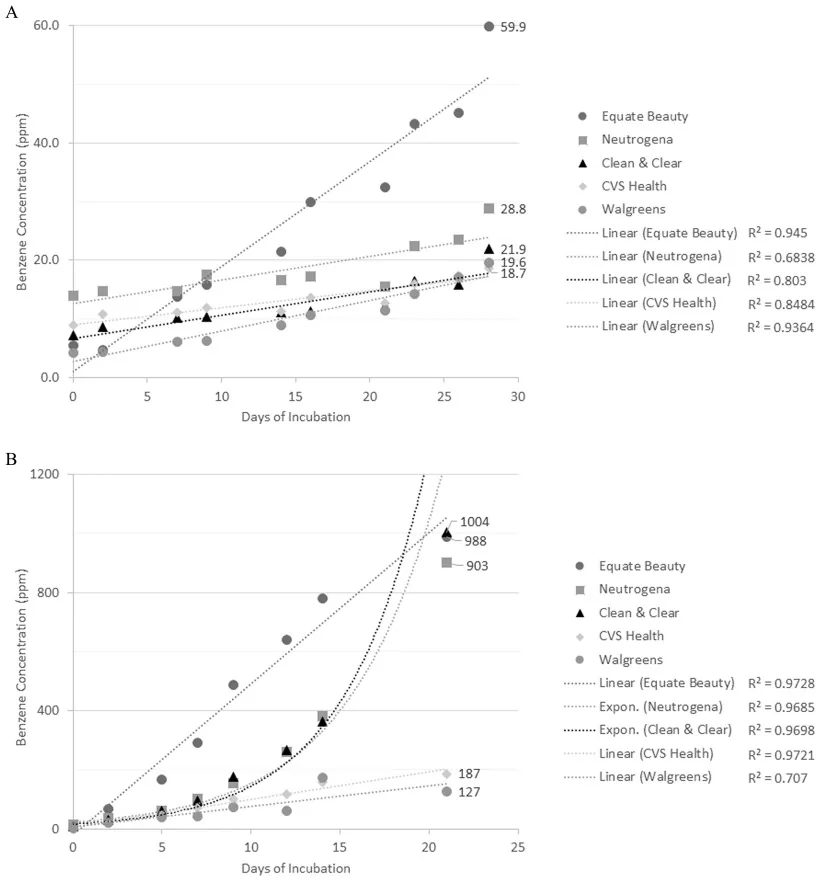
That was not the end of the story. A 2025 review looked at subsequent evidence and found that the investigations so far have not shown an increased risk of blood cancers in users, while calling for more research. The practical takeaway: no need to panic and no reason to ignore it. Store the product somewhere cool and out of the sun, don't leave it in a hot car or a steamy bathroom, and throw away old tubes.
This flowchart shows how to start sensibly:
flowchart TD
  A[Considering benzoyl peroxide] --> B{Spots on back and chest, or sensitive skin?}
  B -->|Yes| C[A wash is usually better - leave on briefly, then rinse]
  B -->|No| D{Limited spots on the face?}
  D -->|Yes| E[Gel or cream on affected areas - with guidance]
  D -->|No| F[Deep or widespread acne - medical assessment]
  C --> G{Severe irritation, swelling or itch?}
  E --> G
  G -->|Yes| H[Stop and see your doctor - possible allergy]
  G -->|No| I[Continue and review after several weeks]
When should you judge the result?
Benzoyl peroxide doesn't clear existing spots overnight; it reduces new ones forming. So it is judged after several weeks of regular use rather than days, and by the number of new spots rather than the one in front of you. In clinic, the commonest reason I see it "fail" isn't weakness — it's stopping because of irritation that could have been avoided by choosing a wash instead of a gel, or by using less product over a smaller area.
Side effects and who should be careful
Common effects are dryness, peeling, redness and stinging at first. Less often there is a true allergy: swelling, intense itching and redness spreading beyond where it was applied, which means stopping. Don't combine it on your own with oral isotretinoin, or with retinoids and strong exfoliants, because irritation builds up. Combination products that pair it with other actives in one tube have their own logic, which your doctor decides.
In pregnancy and breastfeeding, talk to your doctor before starting, and avoid applying it to the breast area while breastfeeding. For a comparison with other spot treatments, see creams for facial spots.
Frequently asked questions
Does benzoyl peroxide lighten the skin?
No. Benzoyl peroxide is an oxidising agent that bleaches fabric and hair it touches, but it doesn't lighten skin colour. Dark acne marks may improve because fewer new spots form, not because the product lightens. That is why it shouldn't be used as a 'whitening cream'; it is an acne treatment.
What is the difference between a benzoyl peroxide wash and a gel?
A wash stays on the skin for a few minutes and is then rinsed off, so it is less irritating and better for large areas like the back and chest or for sensitive skin. A gel or cream stays on, so it acts more strongly but irritates and bleaches fabric more. The choice depends on where your acne is and how sensitive your skin is.
Is it true that benzoyl peroxide turns into benzene?
A 2024 study found that benzoyl peroxide products can form benzene when exposed to high heat. A later review found no evidence of an increased risk of blood cancers in users. The practical takeaway: store it somewhere cool and don't leave it in a hot car.
Can I use benzoyl peroxide with isotretinoin?
Don't combine them on your own. Oral isotretinoin dries the skin markedly, and adding benzoyl peroxide can increase irritation and peeling. Any topical treatment during isotretinoin should be decided by the doctor supervising it.
When to see a clinician
See a dermatologist if your spots are deep and painful or leaving scars, if they haven't improved after several weeks of consistent topical treatment, or if swelling and intense itching after use suggest an allergy. The same applies if you are pregnant or breastfeeding before starting. For back and body acne specifically, see treating body acne, and for the bigger picture, acne treatment.
Related articles
- Acne treatment
- Creams for facial spots
- Skinoren (azelaic acid)
- Treating body acne
- Pimple patches and creams
Further reading
- Benzac Wash vs Benzac AC 5 Gel for acne treatment — MD Derm Outlet
- Acnecide Wash and Gel — Chemist Click
- Benzac AC Wash and Gel data sheet — Medsafe
- Back acne: how to get rid of it — American Academy of Dermatology
Medical disclaimer: This article is for health education only and is not a substitute for professional medical advice. If you have a skin condition that concerns you, please consult a dermatologist.