
The benefits of popping pimples are very limited: brief relief and quick flattening of a surface spot, against the risk of deeper inflammation, a dark mark or a permanent scar. When you squeeze a spot, some of its contents come out, but some is often pushed deeper, prolonging the inflammation. That is why the American Academy of Dermatology advises leaving extraction to a dermatologist.
Search in Arabic for "the benefits of popping pimples" and not a single result is about skin; every page is about edible grains. The closest pages either say "don't pop" without explaining why, or offer a "correct way to pop" without distinguishing one kind of spot from another. This article explains what actually happens under the skin.
What happens inside a spot when you squeeze it?
A spot is a pore blocked by sebum and dead cells that has then become inflamed. The diagram below shows the stages: a normal pore, a closed whitehead, and an open blackhead.
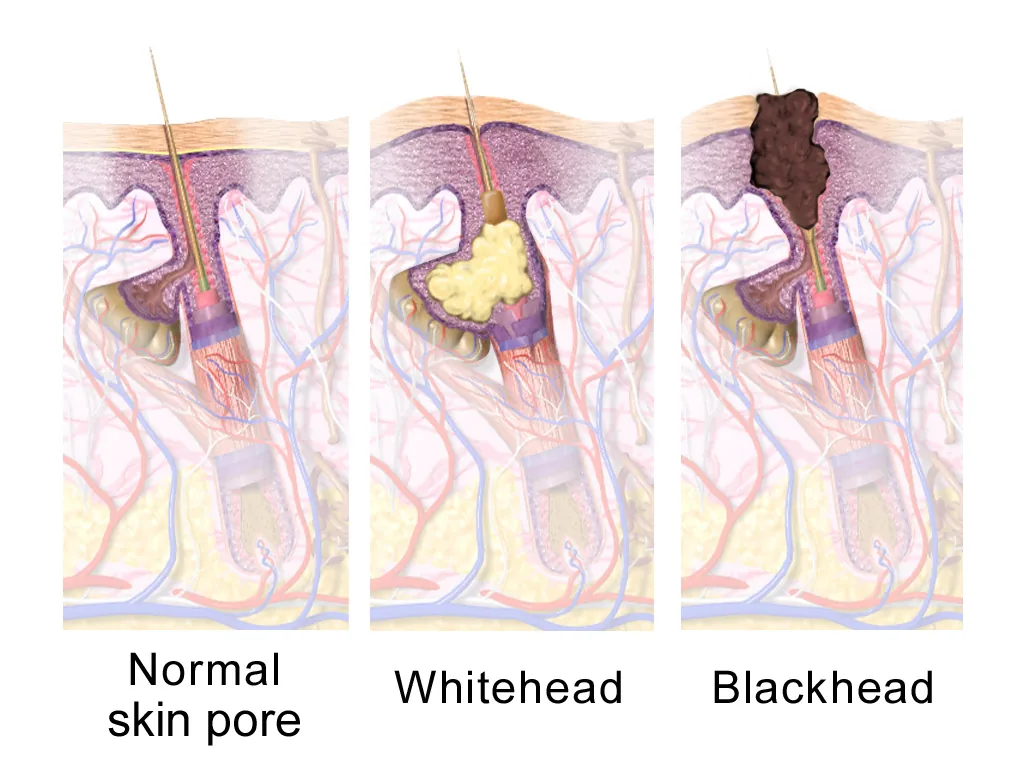
The wall of the pore is thin. When you press from both sides with your fingers, not all the force goes upwards towards the opening; part of it goes down and sideways. If the pore wall ruptures deep down, sebum and bacteria leak into the dermis, and the body mounts a bigger inflammatory response than the original spot ever had. That explains the spot you popped in the morning that is larger and redder by the evening.
Your nails and fingertips also add bacteria from outside, raising the risk of infection, and a nail can scratch the skin, leaving a surface wound on top of the inflammation. The AAD makes both points: pushing contents deeper increases inflammation, and the bacteria on your hands bring a risk of infection.
Benefits of popping pimples versus the harms
| What you hope for | What usually happens |
|---|---|
| A smaller spot straight away | Temporary flattening, sometimes followed by more swelling |
| Faster healing | Longer inflammation plus a wound on top |
| Getting the "root" out | Contents pushed deeper |
| Clearer skin | A brown or red mark that outlasts the spot |
| Preventing new spots | No effect on the spots to come |
The only situation where extraction may be reasonable is a very superficial spot with an obvious white head that is about to open on its own. Even then, gentle pressure with clean hands, or letting it open by itself, is better than squeezing with your nails. Multiple blackheads and whiteheads are a different matter: extracting them with sterile instruments is a procedure a dermatologist offers when other treatments haven't cleared the skin.
It is worth being honest about why popping is so tempting. A spot is visible, it feels like it is "trapped", and squeezing gives an immediate sense of having done something. That feeling is real — it just isn't the same as healing. Recognising it for what it is makes it easier to reach for a patch instead of a mirror.
Why does popping pimples leave a dark mark?
The extra inflammation caused by squeezing stimulates pigment cells. They release more melanin, and some of it can drop into the dermis, where cells called melanophages take it up and hold on to it for a long time. The diagram below, from a 2025 review, shows this mechanism:
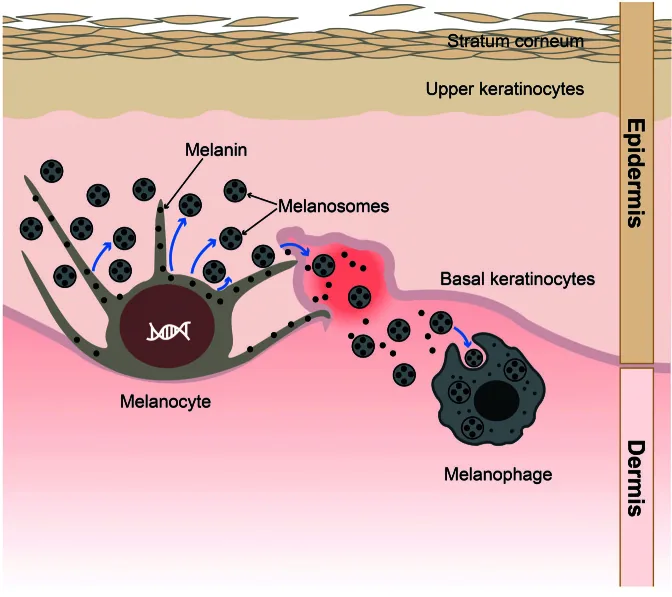
A mark in the upper layer fades over weeks to months; a mark in the dermis fades far more slowly. That is why popping costs most in olive and brown skin, where pigment cells are more reactive. Red marks, which come from widened blood vessels rather than pigment, behave differently again and are covered in red acne marks.
When does popping turn into a permanent scar?
When inflammation is deep and the squeezing is repeated, collagen in the dermis is damaged. After healing, the skin doesn't return to its original level, leaving a depressed scar. The diagram below shows the three common shapes of acne scar:
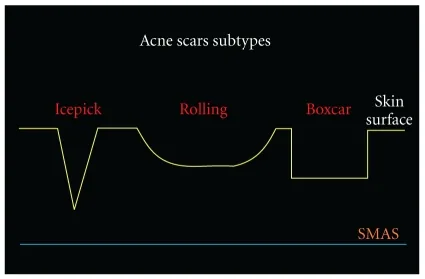
A brown mark fades with time; a depressed scar doesn't go away on its own and needs in-clinic procedures, and which pit responds to which procedure is explained in pitted acne scars. That is why deep, painful spots are the very last ones to squeeze.
Which spots can you leave, and which need a dermatologist?
The flowchart below sets out the decision you face at the mirror:
flowchart TD
  A[A spot you want to pop] --> B{Red, painful, no head, or deep under the skin?}
  B -->|Yes| C[Don't squeeze - warm compress, treatment, assessment if recurring]
  B -->|No| D{An obvious superficial white head?}
  D -->|Yes| E[Let it open on its own, or use a pimple patch]
  D -->|No| F{Lots of blackheads and whiteheads?}
  F -->|Yes| G[A treatment for blockage, or extraction in clinic]
  F -->|No| H[Watch it without touching]
What a dermatologist can do instead
For a single large, painful spot, a dermatologist has options that don't involve squeezing. The AAD describes acne extraction with sterile instruments for blackheads and whiteheads when other treatment hasn't worked, a corticosteroid injection to settle a single deep cyst or nodule more quickly, and incision and drainage for a large, painful cyst. These are done with sterile tools and controlled pressure, by someone who can see how deep the inflammation runs, which is exactly what fingers in front of a bathroom mirror cannot do. If the spots are frequent enough that you often face this choice, the more useful step is treatment that reduces how many spots form at all.
What to do instead of squeezing
- A clear pimple patch on a spot that has opened; it absorbs fluid and keeps your fingers off. How patches compare with lotions is covered in pimple drying lotion.
- A clean warm compress on a painful spot to ease discomfort.
- A treatment applied to the whole area if spots keep coming back, because the spot you see today began weeks ago.
- Short nails, and hands away from your face while working or on the phone.
- A mirror further away; magnifying mirrors turn every pore into a "spot" that needs squeezing.
If you've already popped it
Clean the area gently with water and a mild cleanser, apply a pimple patch or a thin layer of a plain ointment, and don't squeeze again. Keep scrubs and fragrance off the spot for a few days, and use sunscreen so the mark doesn't darken.
The flowchart below summarises what happens next and what needs a review:
flowchart TD
  A[After popping a spot] --> B{Increasing pain, swelling and redness, or a fever?}
  B -->|Yes| C[See a doctor - possible infection]
  B -->|No| D{A brown mark once the spot settles?}
  D -->|Yes| E[Sunscreen, patience, and treatment if it lingers]
  D -->|No| F{A dip in the skin where the spot was?}
  F -->|Yes| G[A scar - assessment in clinic]
  F -->|No| H[The skin is healing]
Frequently asked questions
Is there any benefit to popping pimples?
The only real benefit is short-lived relief and quick flattening of a surface spot full of pus. Against that, squeezing often pushes the contents deeper into the skin, increasing and prolonging inflammation and raising the chance of a dark mark or a scar. That is why dermatology bodies advise leaving extraction to a dermatologist with sterile instruments.
Does popping big pimples make them heal faster?
No. Large, red, painful spots with no head are deep inflammation under the skin, and squeezing them brings almost nothing out while spreading the inflammation. These settle with treatment or need a procedure in clinic, not pressure from your fingers.
Does popping pimples leave marks?
Often, yes. The extra inflammation stimulates pigment cells and leaves a brown mark that can last weeks or months, especially in olive and brown skin. If collagen is damaged deeper down, a permanent depressed scar can form.
What should I do after popping a pimple?
Clean the area gently, cover it with a clear pimple patch or a thin layer of a plain ointment, and don't squeeze it again. Keep scrubs and fragrance off the spot, use sunscreen, and see a doctor if the redness, pain and swelling increase or you develop a fever.
When to see a clinician
See a dermatologist if your spots are deep and painful or numerous, if they leave dark marks or scars, or if you find you can't stop squeezing them despite trying — that is worth talking about too. See a doctor promptly if redness, swelling and pain increase after squeezing, or you develop a fever, especially in the area between the nose and the corners of the mouth. To understand which spots are superficial and which are deep, read types of acne.
Related articles
Further reading
- Is It Bad to Pop Pimples? (And How Else to Get Rid of Acne) — We Derm
- Pimple popping: Why only a dermatologist should do it — American Academy of Dermatology
- Acne-induced Post-inflammatory Hyperpigmentation: From Grading to Treatment — Acta Dermato-Venereologica
Medical disclaimer: This article is for health education only and is not a substitute for professional medical advice. If you have a skin condition that concerns you, please consult a dermatologist.