
Smile lines are two different things: the fold that runs from the side of the nose to the corner of the mouth, and the crow's feet that fan out from the eye when you smile. The first exists in every face and deepens over the years with cheek volume loss, sagging and sun; the second is made by the muscle around the eye. Each has its own treatment, and holding back your smile helps neither.
The Arabic pages that rank for this search put both under one name and recommend facial exercises and home remedies, without explaining why the line deepens or what actually softens it. This article separates the two and puts each treatment in its place.
The nose-to-mouth fold: an anatomical boundary, not a flaw
The nasolabial fold is what most people mean by "laugh lines". It is the boundary between the cheek and the upper lip, and it shows in children's faces when they smile, so it isn't a sign of age in itself. What changes with age is its depth: when the cheek loses some of its volume and what remains descends, tissue gathers above the fold so it looks deeper and longer. Why this happens across the layers of the face is explained in causes of a sagging face.
Studies grade the depth of the fold on a five-point scale, from almost no line to a deep, long fold with excess skin. The figure from a 2026 randomised trial shows these grades on different faces:
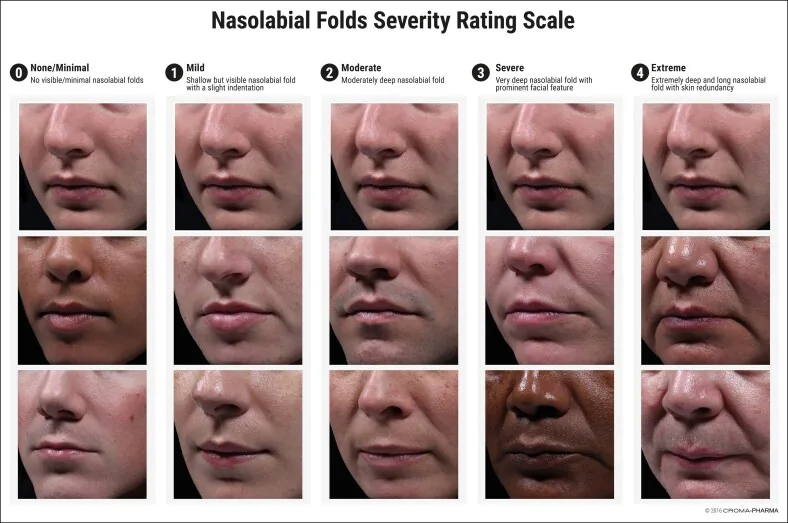
Grades one and two are normal in most adult faces, and need no treatment unless they bother you. It is easy to over-read them in a phone camera under overhead light, which deepens every shadow on the face.
Why do they appear early in some women?
Age isn't the only factor. In a 2026 study of more than four thousand young ethnic Chinese adults, nasolabial folds were common, and among those with regular sun exposure they were associated with a particular genetic variant. In other words, genetics, face shape and sun act together.
Other factors deepen the fold too: rapid weight loss that empties the cheeks, smoking, and unprotected sun exposure. Sleeping on one side can make the line more visible on that side in the morning.
Face shape matters more than people expect. A face with full cheeks and a less projecting cheekbone may show a defined fold earlier, simply because there is more soft tissue sitting above the boundary. That is structure, not damage, and it is one reason two friends of the same age can look so different here.
Crow's feet when you smile
The second kind of smile line is the set of lines that branch from the outer corner of the eye when you smile. They are made by the circular muscle around the eye, helped by the cheek muscles that lift the cheek as you laugh. The illustration from a 2026 anatomical study shows where these muscles sit:
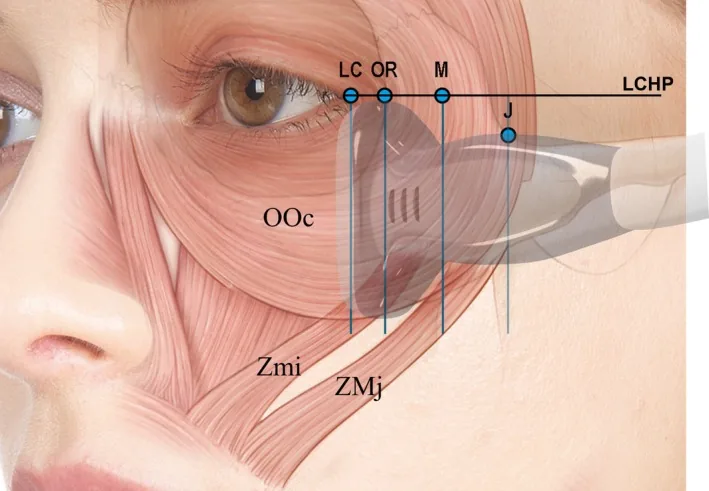
These are dynamic lines at first, and they may then stay when the face is at rest as collagen declines. Details and treatment are in eye wrinkle exercises.
The two types compared
| Nose-to-mouth fold | Crow's feet | |
|---|---|---|
| Where | From the side of the nose to the mouth corner | Branching from the eye corner |
| Main cause | Volume loss, sagging and sun | Contraction of the muscle around the eye |
| Visible at rest? | Deepens with age | In later stages |
| Best in-clinic tool | Filler or restoring cheek volume | The toxin |
| What helps at home | Retinoid and sunscreen | Sunscreen and sunglasses |
Treating the nose-to-mouth fold
Hyaluronic acid filler is the best-studied treatment for this fold. In the same trial, the fold improved by at least one grade in about eight in ten participants at twenty-four weeks with both products tested. But the effect is temporary, as the photographs of one participant show:
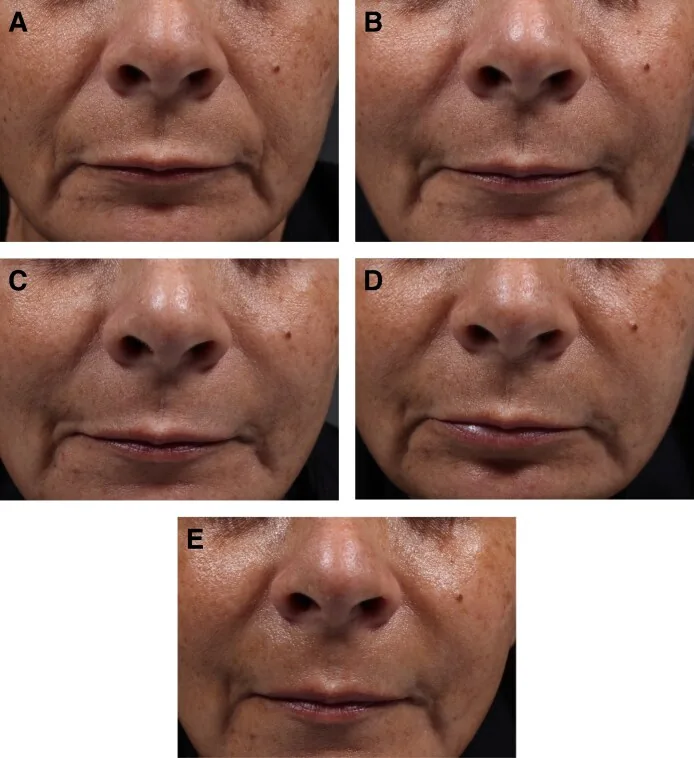
Filling the fold itself isn't always the best answer. If the cause is cheek descent, your clinician may treat the cheek volume instead, so the line softens without the fold being filled on its own and looking heavy. For other in-clinic options, read how to reduce wrinkles.
A good assessment looks at your face from the front and the side, at rest and smiling, because a fold that is deep at rest behaves differently from one that only appears in expression. That is also how you avoid the over-filled look that sends many people searching for "natural" alternatives.
What helps at home?
- Daily sunscreen, because the sun speeds collagen breakdown and contributes to the fold deepening.
- A retinoid at night to improve skin quality and the fine lines around the fold; read best serum for wrinkles.
- Avoiding large, rapid weight loss where possible.
- Facial exercises: there's no good evidence that they soften these lines.
flowchart TD
  A[Smile lines] --> B{Where is the line?}
  B -->|Nose to mouth corner| C{Visible at rest and bothers you?}
  B -->|Around the eye corner| D[Dynamic lines - the toxin in clinic]
  C -->|No| E[Normal - sunscreen and a retinoid]
  C -->|Yes| F[Assessment: filler for the fold or cheek volume]
mindmap
  root((Smile lines))
    Nasolabial fold
      Cheek volume loss
      Sun and genetics
      Filler
    Crow's feet
      Muscle contraction
      The toxin
    At home
      Sunscreen
      Retinoid
Frequently asked questions
How do I get rid of smile lines?
It depends on which kind. A deepened fold between the nose and mouth is treated in clinic with filler or by restoring cheek volume, and crow's feet that appear when you smile are softened with the toxin. At home, a retinoid and sunscreen improve skin quality and slow the deepening, but they don't remove the lines.
Does smiling cause wrinkles?
Repeated movement contributes to crow's feet, but the fold between the nose and mouth exists in every face and is visible even in children when they smile; with age, volume loss, sagging and sun deepen it more than smiling itself. So holding back your smile won't help.
Does filler get rid of smile lines?
Filler reduces the depth of the fold between the nose and mouth and is the best-studied treatment for it, but it is temporary and its effect fades over months. Sometimes the better approach is restoring cheek volume rather than injecting the fold itself, which is what an assessment decides.
At what age do smile lines appear?
The fold itself is there from childhood, but it starts to show at rest at different ages. In a study of young ethnic Chinese adults the fold was common, and it was linked to regular sun exposure and a genetic factor together.
When to see a clinician
See a dermatologist if the fold is deep and bothers you and you want to know whether filler or restoring cheek volume suits it, or if it deepened quickly after significant weight loss. Seek urgent care straight away if one side of your face changes suddenly, so that the fold flattens on one side or the corner of the mouth droops: that isn't a wrinkle, it is a sign that needs immediate assessment.
Related articles
- Facial lines
- Causes of a sagging face
- Eye wrinkle exercises
- How to reduce wrinkles
- Botox alternatives for wrinkles
Further reading
- Nasolabial Folds: Causes, Treatment & Prevention — Eucerin
- Smile Lines (Nasolabial Folds): Causes & Treatment Options — Wave Plastic Surgery
- A genome-wide association study identifies that SAMD5 interacts with regular Sun exposure to influence nasolabial folds development — Journal of Physiological Anthropology
Medical disclaimer: This article is for health education only and is not a substitute for professional medical advice. If you have a skin condition that concerns you, please consult a dermatologist.