The best serum for wrinkles is the one with a studied active ingredient, not the one with a famous name: retinoids such as retinol at night have the strongest evidence, followed by vitamin C in the morning and niacinamide, with hyaluronic acid for hydration. None of them works without daily sunscreen, because the sun breaks down collagen faster than any product builds it.
The Arabic pages that rank for this search are product lists with brand names and prices, many of them shop pages. But a brand changes nothing if the active ingredient is missing or weak. This article teaches you to choose by ingredient, so you can judge any serum yourself.
What's the difference between a serum and a cream?
A serum is a light liquid that delivers a higher concentration of an active in a small volume, applied to clean skin before moisturiser. A cream is heavier; its first job is hydration and protecting the barrier, and it may contain actives too. A serum isn't stronger by nature; it's a vehicle for one ingredient. If your moisturiser already contains retinol, you don't need a retinol serum on top. For choosing a cream, read best anti-aging creams.
That also means the number of steps in a routine isn't a measure of how well it works. Three serums with overlapping ingredients cost more and irritate more than one well-chosen serum and a good moisturiser.
Ingredients ranked by evidence
| Ingredient | What it does | Strength of evidence | When |
|---|---|---|---|
| Retinol and retinoids | Renews skin, stimulates collagen | Strongest | Night |
| Vitamin C | Antioxidant, involved in collagen synthesis | Moderate | Morning |
| Niacinamide | Supports the barrier, improves texture and pigment | Moderate | Morning or night |
| Hyaluronic acid | Hydrates the surface | Hydration only | Any time |
| Peptides | Hydration, better texture | Weak to moderate | Any time |
Retinol: the strongest evidence
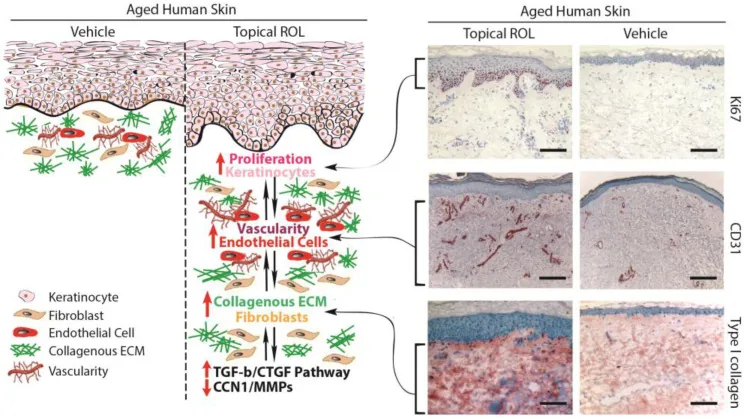
Retinol is converted in the skin to the active form of vitamin A. A 2023 review summarises its effect on aged skin: it stimulates the proliferation of epidermal cells, increases the small blood vessels, and activates the fibroblasts that make collagen:
Retinol irritates at first, so start every other night and build up as your skin tolerates it, and don't use it in pregnancy. The difference between retinol and prescription tretinoin is explained in how retinol works. If your skin is dry or sensitive, applying retinol over a moisturiser rather than under it softens the irritation without stopping it from working.
Vitamin C: an antioxidant that needs care
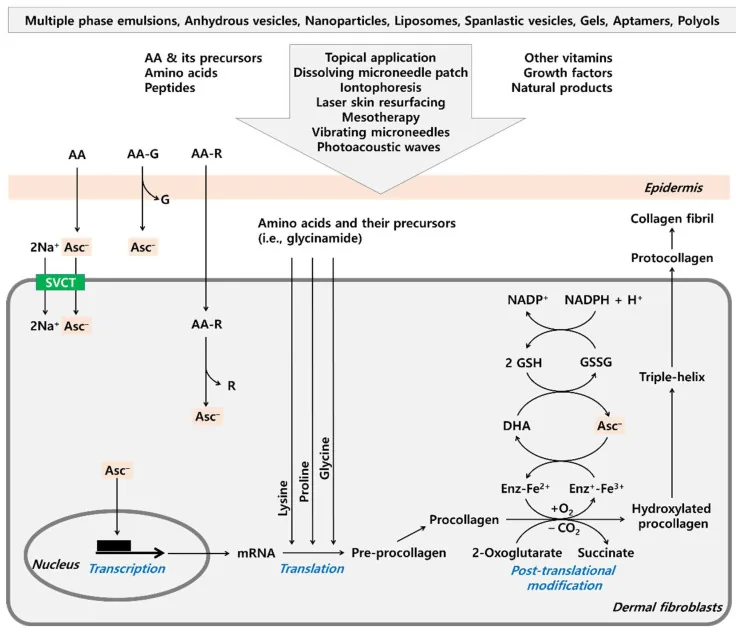
Ascorbic acid, or vitamin C, is an antioxidant that limits part of the damage the sun causes, and the skin needs it to make and mature collagen. The diagram from a 2022 review shows how vitamin C and its derivatives enter fibroblasts and take part in the stages of collagen production:
Its weakness is instability: it oxidises with light and air, so the serum turns yellow, then brownish, and loses its effect. Choose an opaque, airtight bottle, keep it away from heat, and throw it out if its colour has clearly changed. Many products use more stable derivatives, which are gentler in effect.
Vitamin C fits the morning because its antioxidant role is most useful during the day, under sunscreen. It doesn't replace sunscreen; it adds a second line behind it.
Niacinamide and hyaluronic acid
Niacinamide, a form of vitamin B3, supports the skin barrier and improves texture and pigmentation, and most people tolerate it well. Hyaluronic acid is a humectant that draws water to the surface. In a 2024 study, forty-four women applied a product combining the two for two months, and their scores for radiance, smoothness and fine lines improved:
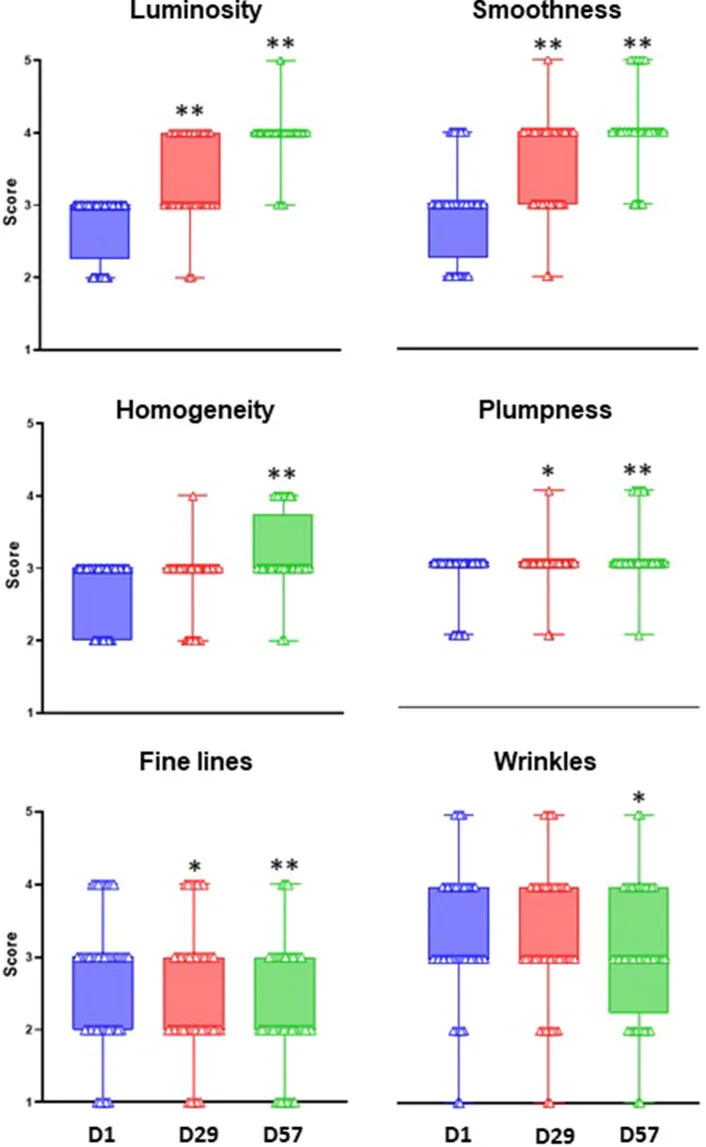
But the study was open-label with no comparison group, and most of its authors were employees of the manufacturer, so the improvement is real within what was measured but can't be separated from the effect of hydration alone.
Peptides and marketing language
Peptides are everywhere in wrinkle serums, and some are sold as "Botox-like". Their evidence is weaker than for retinoids; the details are in Botox alternatives for wrinkles. Phrases such as "instant lift" and "erases wrinkles" usually describe hydration, or a silicone film that fills lines for a few hours.
How to read a serum label
- Look for the active's name near the top of the ingredient list, not just in the claims on the box.
- Packaging matters for vitamin C and retinol: opaque and airtight.
- Fragrance and essential oils raise the risk of a reaction, so avoid them if your skin is sensitive.
- Price doesn't indicate effectiveness; the same ingredient appears in cheap and expensive products.
How to combine serums
You don't need more than two serums. The simple rule: vitamin C in the morning under sunscreen, retinol at night, and niacinamide or hyaluronic acid with either. Don't start two new actives in the same week, so that if your skin reacts you know which one did it.
flowchart TD
  A[Anti-wrinkle serum routine] --> B[Morning]
  A --> C[Evening]
  B --> D[Vitamin C]
  D --> E[Moisturiser, then sunscreen]
  C --> F[Retinol - every other night at first]
  F --> G[Moisturiser]
Choosing for your skin
flowchart TD
  A[Which serum should I start with?] --> B{Sensitive skin that irritates easily?}
  B -->|Yes| C[Niacinamide or hyaluronic acid first]
  B -->|No| D{Is your goal fine lines?}
  D -->|Yes| E[Retinol at night]
  D -->|No: radiance and marks| F[Vitamin C in the morning]
Frequently asked questions
What is the best serum for wrinkles?
The best serum is one that contains an ingredient with evidence on wrinkles, not one with a particular brand name. The best-evidenced ingredients are retinoids such as retinol at night, then vitamin C in the morning and niacinamide, and daily sunscreen remains a condition for any of them to work.
Does vitamin C serum get rid of wrinkles?
It doesn't remove them, but it is an antioxidant that protects the skin from part of the sun's damage and takes part in making collagen, so it can help improve fine lines and radiance over time. It complements sunscreen rather than replacing it, and it oxidises easily and loses its effect.
Does hyaluronic acid serum get rid of wrinkles?
Hyaluronic acid in a serum is a humectant that draws water to the skin's surface, so fine lines look softer while the skin stays hydrated. But it doesn't reach deep into the dermis the way filler does and doesn't restore collagen, so its effect is hydrating and temporary.
How long does an anti-wrinkle serum take to work?
Hydration shows within days, but an improvement in lines needs months of regular use. In the studies this article cites, results were measured after two months or more, so don't judge or switch a serum before then.
When to see a clinician
See a dermatologist if a new serum causes severe redness, burning and peeling that won't settle, or a rash and itching that suggest an allergy, or if you're pregnant or planning a pregnancy and want to know what suits you. See one too if your lines are deep and fixed: a serum won't fix them, and they need an assessment for in-clinic options.
Related articles
- Best anti-aging creams
- How retinol works
- Botox alternatives for wrinkles
- How to reduce wrinkles
- Best oils for wrinkles
Further reading
- The 10 Best Anti-Wrinkle Serums for Anti-Aging — Dermstore
- Best Serum for Face Wrinkles: Top Picks for Youthful Skin — Yon-Ka
- Human Skin Aging and the Anti-Aging Properties of Retinol — Biomolecules
Medical disclaimer: This article is for health education only and is not a substitute for professional medical advice. If you have a skin condition that concerns you, please consult a dermatologist.