
The best oils for wrinkles are simply oils that moisturise the skin and support its barrier, so fine lines look softer while the skin stays hydrated. But there is no evidence that a plant oil restores collagen or removes wrinkles. What has stronger evidence on wrinkles are ingredients such as retinoids and, to a lesser degree, bakuchiol, together with sunscreen.
The Arabic pages that rank for this search recommend coconut, castor and almond oils, plus essential oils such as lemon, and promise tighter skin. This article puts each oil in proportion.
What do oils actually do to the skin?
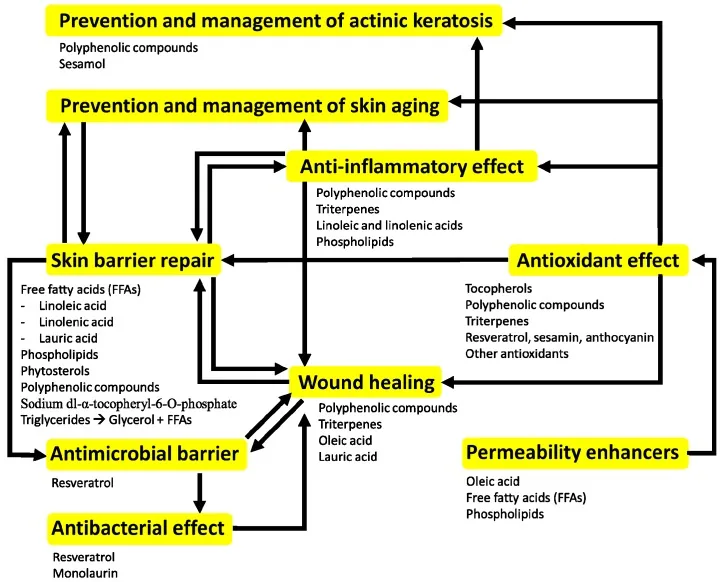
Plant oils form a layer on the skin's surface that reduces water evaporation, and some of their components, such as linoleic acid, contribute to building the skin barrier. The diagram from a review of topical plant oils summarises their possible effects, from barrier repair to antioxidant action:
Hydration makes fine lines less visible because dry skin shows lines more. That effect is real, but it is temporary and fades as the skin dries, and it doesn't restore collagen lost from the dermis.
It helps to separate two kinds of line. Fine, crinkly lines that look worse when the skin is dry — on the cheeks in winter, or under the eyes in the morning — are partly a hydration problem, and oils and moisturisers genuinely soften them. Deeper creases that are there whatever the weather, and lines that follow expression, are a structural problem, and no amount of oil reaches that.
Olive oil: what did a direct trial find?
In a 2025 randomised trial of fifty-four volunteers, extra virgin olive oil and petroleum jelly were applied to areas of the forearm. Both improved skin hydration and reduced redness, and only petroleum jelly clearly reduced water loss through the skin. The wrinkle measure fell with both, but not significantly:
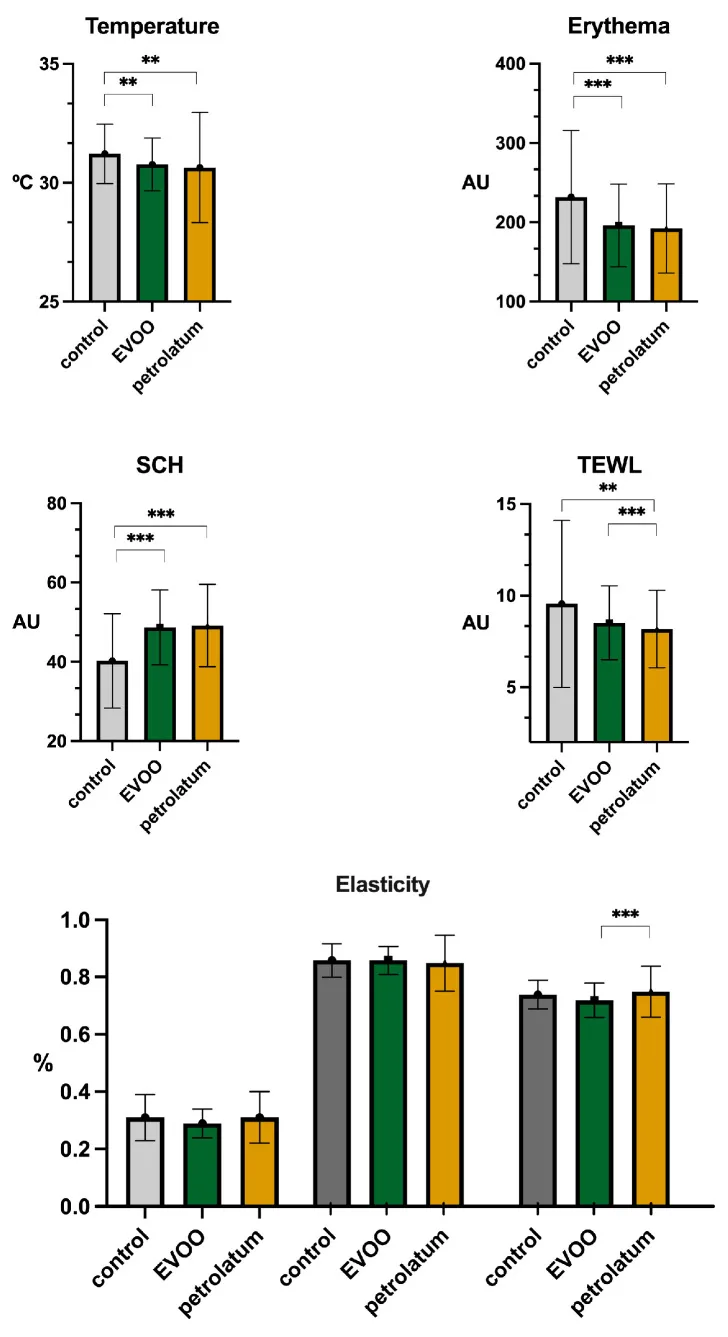
The message: oil is a good moisturiser, not a wrinkle treatment, and in this trial it did no better than plain petroleum jelly.
Which oil suits your skin?
| Oil | Expected effect | Note |
|---|---|---|
| Jojoba | Light moisturising | Suits most skin types |
| Rosehip seed | Moisturising, rich in fatty acids | Limited evidence on wrinkles |
| Argan | Moisturising | Suits dry skin |
| Olive | Moisturising | Rich in oleic acid; may weaken the barrier in some skin |
| Coconut | Heavy moisturising | May add spots in oily skin |
| Castor | Heavy and sticky | Best for lips and very dry areas |
| Citrus essential oils such as lemon | No proven effect on wrinkles | Some cause allergy or sun-related irritation |
Be careful with citrus essential oils on the face before going out in the sun, as some can cause burns and pigmentation. Contact allergy from undiluted essential oils is among the commonest problems we see, as covered in best herbs for wrinkles.
How to use an oil if you want one
If you like the feel of an oil, the right way is simple: a few drops over your moisturiser at night, pressed into the skin rather than rubbed. Oil over a moisturiser locks in the water the moisturiser added, whereas oil alone on dry skin hydrates less than you might expect. In the morning, sunscreen comes first, because ultraviolet light is the strongest external factor breaking down collagen, and no oil makes up for it. Alongside a night-time retinoid, an oil can ease dryness, but start with a small amount to see whether your skin tolerates it without new closed comedones.
Bakuchiol: an "oil serum" ingredient with better evidence
Bakuchiol is a plant compound often added to oil serums and marketed as an alternative to retinol. In a 2026 double-blind randomised trial of seventy-three adults, wrinkle severity improved slightly after twelve weeks of a bakuchiol cream, with a significant difference from the placebo cream by the end of the study; the trial was funded by the manufacturer:
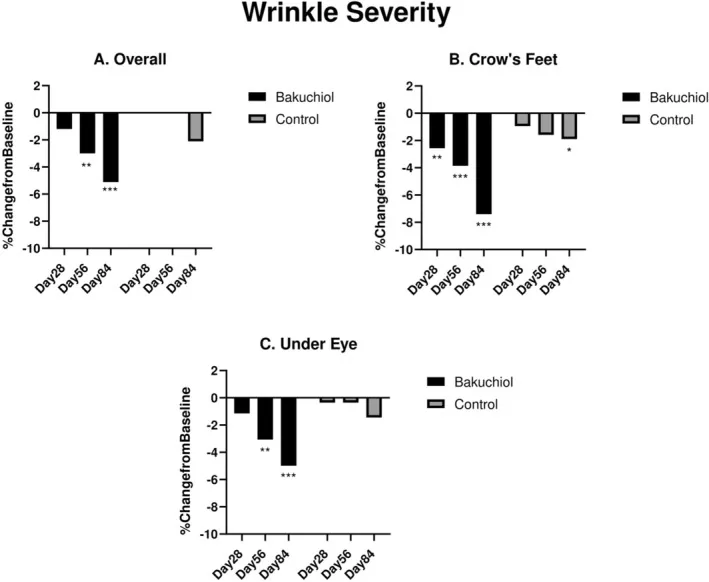
The improvement is modest, but it is more than an oil on its own offers. The best-evidenced ingredient remains a retinoid, as in how retinol works.
The flowchart below sets out the decision:
flowchart TD
  A[Looking for an oil for wrinkles] --> B{Want hydration and softness?}
  B -->|Yes| C[A light carrier oil over moisturiser at night]
  B -->|No: want fewer wrinkles| D[A retinoid or bakuchiol, plus sunscreen]
  C --> E{Oily, acne-prone skin?}
  E -->|Yes| F[A light oil on a small patch first]
  E -->|No| G[Argan, rosehip or jojoba]
  D --> H{Deep, fixed lines?}
  H -->|Yes| I[In-clinic assessment]
Oils around the eyes and mouth
The two areas where people most often reach for an oil are the thin skin around the eyes and the lines around the mouth. Around the eyes, keep to a tiny amount of a plain, fragrance-free carrier oil, kept away from the lash line; oil that migrates into the eye blurs vision and can irritate, and heavy oils can encourage milia in this area. Around the mouth, a simple balm or a light oil protects against the dryness that makes lip lines look sharper, especially in cold or dry weather. Neither area is improved by essential oils, and both are where contact allergy shows up first.
Common mistakes
- Applying neat essential oils around the eyes or mouth.
- Lemon mixes on the face before going out in daylight.
- Relying on oil alone and skipping sunscreen, the single most important step against wrinkles.
- A thick layer of oil on oily skin prone to closed comedones; see oils for acne.
Frequently asked questions
What is the best oil for wrinkles?
No oil removes wrinkles. Plant oils moisturise the skin and support its barrier, so fine lines look softer while the skin stays hydrated. Lighter oils rich in linoleic acid suit most skin types, and jojoba and rosehip are popular choices, but the effect is hydrating, not corrective.
Do oils tighten the skin and restore collagen?
There is no evidence that a plant oil restores lost collagen in the skin. What has been shown to improve wrinkles are ingredients such as retinoids and, to a lesser degree, bakuchiol, which is sometimes added to oil serums, together with daily sun protection.
Is olive oil good for wrinkles?
Extra virgin olive oil hydrated the skin and supported its barrier in a forearm trial, but the improvement in the wrinkle measure wasn't statistically significant and it did no better than petroleum jelly. It is also rich in oleic acid, which may weaken the barrier with continued use in some skin.
What is the best oil for wrinkles around the mouth?
Lines around the mouth come from lip movement and loss of collagen and fat, and an oil only moisturises them. A light oil or a simple balm protects the lips and surrounding skin from dryness; deeper lines need an assessment for in-clinic treatments.
When to see a clinician
See a dermatologist if your wrinkles are deep and fixed and you want to know which options suit them, if redness, itching or a rash appeared after an oil or home mix, or if dark patches appeared after essential oils and sun exposure. For the full range of wrinkle treatments, read how to reduce wrinkles.
Related articles
- How to reduce wrinkles
- Best herbs for wrinkles
- How retinol works
- Eye wrinkle exercises
- Oils for acne
Further reading
- Which Is the Best Oil for Face Wrinkles? — Yon-Ka
- What Oils Are Good for Face Wrinkles? Top Picks for Skin — Yon-Ka
- Effects of Extra Virgin Olive Oil and Petrolatum on Skin Barrier Function and Microtopography — Journal of Clinical Medicine
Medical disclaimer: This article is for health education only and is not a substitute for professional medical advice. If you have a skin condition that concerns you, please consult a dermatologist.