No oil treats acne the way well-studied ingredients such as benzoyl peroxide and retinoids do. The closest thing is tea tree oil, and its evidence is limited. Moisturising plant oils, meanwhile, differ a great deal in what they do to the skin barrier: some help repair it, some weaken it, and some can add closed comedones in oily skin.
The Arabic pages that rank for "rose oil for spots" list the benefits of rose oil without distinguishing rose essential oil from rosehip seed oil, and without evidence on spots. This article separates the types and puts each in its place.
Essential oils and carrier oils: a basic distinction
An essential oil is a highly concentrated extract from flowers or leaves, such as tea tree oil or Damask rose oil. It isn't applied neat to the skin; it is used in small, diluted amounts, and it can cause irritation or contact allergy. This is the kind that has been studied for antibacterial and anti-inflammatory effects.
A carrier oil is a fatty plant oil used for moisturising, such as rosehip seed, jojoba, sunflower, olive or coconut oil. These don't kill bacteria; their main effect is on the skin barrier.
Mixing up the two is the source of most confusing advice. "Rose oil for acne" may mean the concentrated essential oil or the seed carrier oil, and the difference between them in safety and use is large.
Tea tree oil: the only oil with evidence in acne
Essential oils are credited with antibacterial and anti-inflammatory actions in the laboratory, as the diagram from a 2023 review summarises:
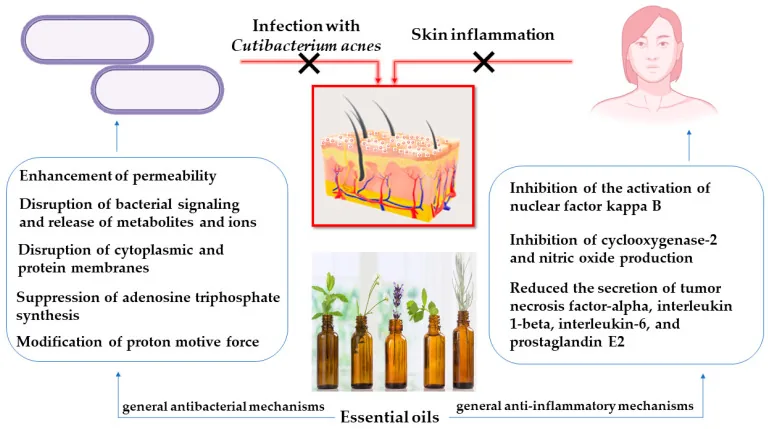
But an effect in a dish isn't an effect on a face. Among essential oils, only tea tree oil has enough clinical trials for a pooled analysis. A 2026 systematic review linked it to a modest improvement in acne severity, with mostly mild local side effects such as itching, dryness and burning, and stressed the need for larger trials:

If you choose it, use a product formulated for skin, not a neat essential oil. How to use it on a single spot is covered in pimple drying lotion.
Rose oil and rosehip oil, specifically
Because rose oil is the version most searched in Arabic, it deserves its own word. Damask rose essential oil is expensive, intensely fragrant and, like other essential oils, a potential sensitiser; fragrance compounds are among the commoner causes of allergic contact dermatitis on the face. Rosehip seed oil is a different product altogether: pressed from the seeds, unscented, and used as a moisturising oil. If a product says "rose oil", check whether it means the flower essence or the seed oil before you put it near a breakout.
Moisturising oils: which support the barrier?
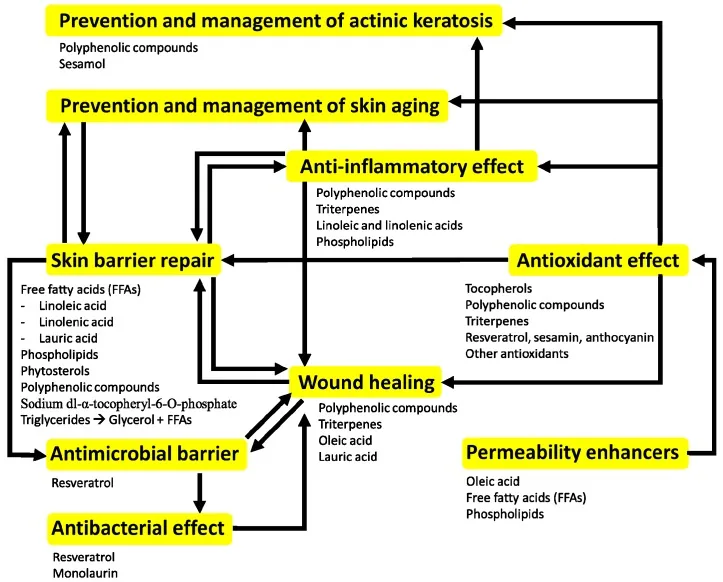
Plant carrier oils differ in their fatty acid make-up. A review of topical plant oils describes linoleic acid as supporting the skin barrier, while describing oleic acid as potentially harmful to the barrier with continued use, and notes that olive oil, which is rich in oleic acid, weakened the outer layer of skin in studies. The diagram from the same review summarises the possible effects of plant oils:
| Oil | Type | Note for acne-prone skin |
|---|---|---|
| Tea tree | Essential | Limited evidence in acne; always diluted |
| Damask rose | Essential | No strong evidence in acne; can irritate |
| Rosehip seed | Carrier | Rich in fatty acids; limited evidence |
| Jojoba | Carrier (liquid wax) | Light; the review mentions it for barrier repair |
| Sunflower | Carrier | Rich in linoleic acid |
| Olive | Carrier | Rich in oleic acid; may weaken the barrier |
| Coconut | Carrier | Heavy; many people with oily skin avoid it |
The response is individual. What suits dry skin may add closed comedones to oily skin, and the safe approach is to test on a small patch.
You will often see "comedogenic ratings" quoted for oils, from zero to five. They are a reasonable starting point, but they come mostly from older rabbit-ear tests and don't always predict what happens on a human face, where the rest of your routine, your skin type and how much you apply all matter. Treat a low rating as a reason to try an oil carefully, not as a guarantee.
If you are using a drying acne treatment, such as a retinoid or benzoyl peroxide, an oil can look like the answer to the dryness. But a moisturiser designed for acne-prone skin is easier to get right than a neat oil, because its formula has been tested not to clog pores. If you want an oil, a few drops of a light one over your moisturiser at night carry less risk than a thick layer.
The flowchart below sets out the decision:
flowchart TD
  A[Considering an oil for acne] --> B{Want to treat the spots themselves?}
  B -->|Yes| C[An oil isn't the treatment - studied ingredients first]
  C --> D{Prefer a plant-based option?}
  D -->|Yes| E[A skin-formulated tea tree oil product]
  B -->|No: moisturising| F{Oily, acne-prone skin?}
  F -->|Yes| G[A light oil on a small patch for two weeks]
  F -->|No| H[A carrier oil that suits dryness]
  G --> I{New closed comedones?}
  I -->|Yes| J[Stop it]
Common mistakes
- Applying essential oil neat to a spot or the face.
- Home mixes of lemon and oil; lemon irritates the skin and increases pigmentation in the sun.
- Adding a heavy oil to oily skin that already has closed comedones.
- Dropping studied treatment and relying on oils alone for moderate or deep acne.
For other popular home remedies, read home remedies for acne.
Frequently asked questions
Is there an oil that treats acne?
No oil treats acne the way well-studied medicines do. The closest is tea tree oil, which a 2026 systematic review linked to a modest improvement with mostly mild side effects, but the evidence is limited. Moisturising oils support the barrier; they don't treat spots.
Is rose oil good for acne?
Rose essential oil, distilled from the flowers, is concentrated and must be diluted, and there is no strong evidence that it treats spots. Rosehip seed oil is a carrier oil rich in fatty acids that may support the barrier, but its evidence on spots themselves is limited too.
Do oils clog pores and cause breakouts?
Some can in some women, especially heavier oils on oily, acne-prone skin, but the response is individual. Try any oil on a small patch for two weeks, and stop if new closed comedones appear in that area.
Is tea tree oil safe on the face?
Products formulated for skin at a suitable strength are tolerated by many people, but neat, concentrated essential oil can burn the skin or cause contact allergy. Don't apply it undiluted to your face, and stop if you get redness or itching.
When to see a clinician
See a dermatologist if your acne is moderate, deep or scarring; if it hasn't improved after several weeks; if itching, redness or a rash appeared after an oil or a home mix; or if closed comedones increased after adding a new oil. For a complete treatment plan, read acne medicines.
Related articles
- Pimple drying lotion
- Home remedies for acne
- Small skin-coloured bumps on the face
- Oily skin problems
- Acne medicines
Further reading
- The 5 Best Oils for Acne-Prone Skin — Soko Glam
- Does Oil Cause Acne? — Leslie Baumann MD
- Anti-Inflammatory and Skin Barrier Repair Effects of Topical Application of Some Plant Oils — IJMS
Medical disclaimer: This article is for health education only and is not a substitute for professional medical advice. If you have a skin condition that concerns you, please consult a dermatologist.