Small skin-coloured bumps on the face are most often closed comedones: tiny pore blockages that haven't opened or become inflamed yet. But small bumps the colour of your skin can also be milia, fungal folliculitis, flat warts or enlarged oil glands, and each is treated completely differently. That is why a single acne cream doesn't solve them all.
The Arabic pages that rank for this search are individual questions with short answers. This article brings the main possibilities together in one place and explains how to tell them apart.
Closed comedones: the most common cause
A closed comedone is a pore blocked with sebum and dead cells whose opening has stayed shut, so it shows as a small bump the colour of the skin or slightly paler, easier to see when you stretch the skin or look under side lighting. They usually cluster on the forehead, chin and cheeks, sometimes alongside blackheads and the odd red spot.
These bumps are an early stage of acne, and they are treated by treating the blockage: salicylic acid or a topical retinoid, and avoiding heavy products. Their causes are covered in what causes whiteheads, and exfoliant choices in exfoliator for acne.
Closed comedones are also the type that most often follows a change in products: a richer moisturiser, a new foundation, a hair oil that runs down onto the forehead at night. If a crop of tiny bumps appeared a few weeks after you started something new, that product is the first suspect.
Milia: firm white bumps that won't squeeze out
Milia are tiny cysts filled with keratin. They look pearly white or skin-coloured, feel firm like a grain of sand under the surface, and usually cluster around the eyes and on the cheeks. They aren't an oil blockage, so they don't respond to acne creams and don't come out when squeezed. They can appear for no reason, after heavy eye creams, or after damage to the skin.
In a 2026 case report, multiple milia appeared on the temples during isotretinoin treatment and resolved after extraction:
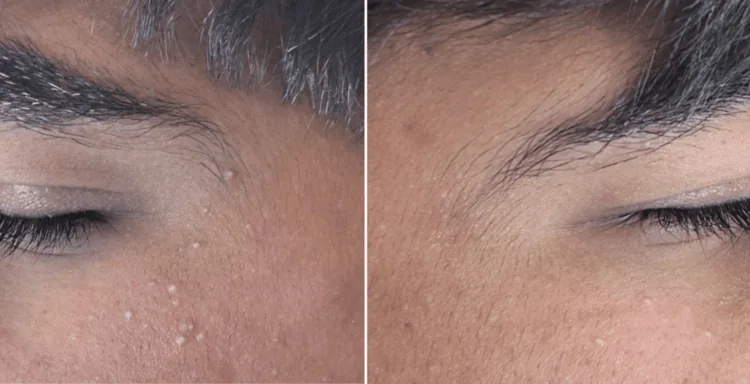
Milia are extracted in clinic with a sterile needle, not with fingernails; pressing on them injures the skin and leaves a mark without getting them out.
Fungal folliculitis: uniform bumps that itch
When the bumps are very small and all the same size, cluster on the forehead, hairline and chest, itch, and get worse with heat and sweat, they may be folliculitis caused by Malassezia yeast. A 2025 review describes it as common and frequently misdiagnosed as acne:
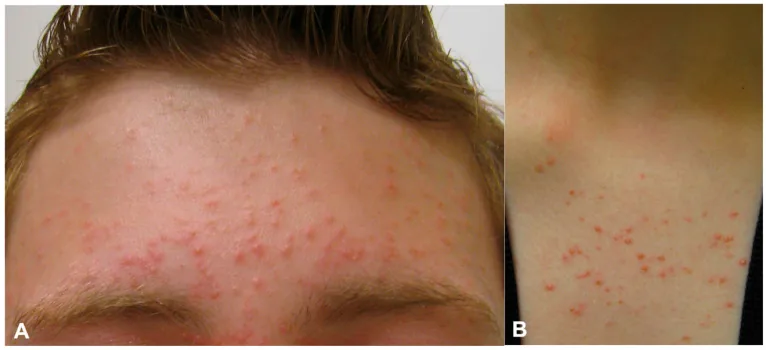
It is treated with an antifungal, not an acne cream, and antibiotics can make it worse. The details are in bacterial pimples.
Flat warts: flat bumps that spread with shaving
Flat warts are small, flat-topped bumps, skin-coloured, pinkish or light brown, caused by human papillomavirus. They appear on the face, forehead and hands, and may line up along a scratch or shaving line, because the virus is spread to new skin by picking. The image below, from a published case, shows flat warts on the cheek and their improvement after peel sessions:
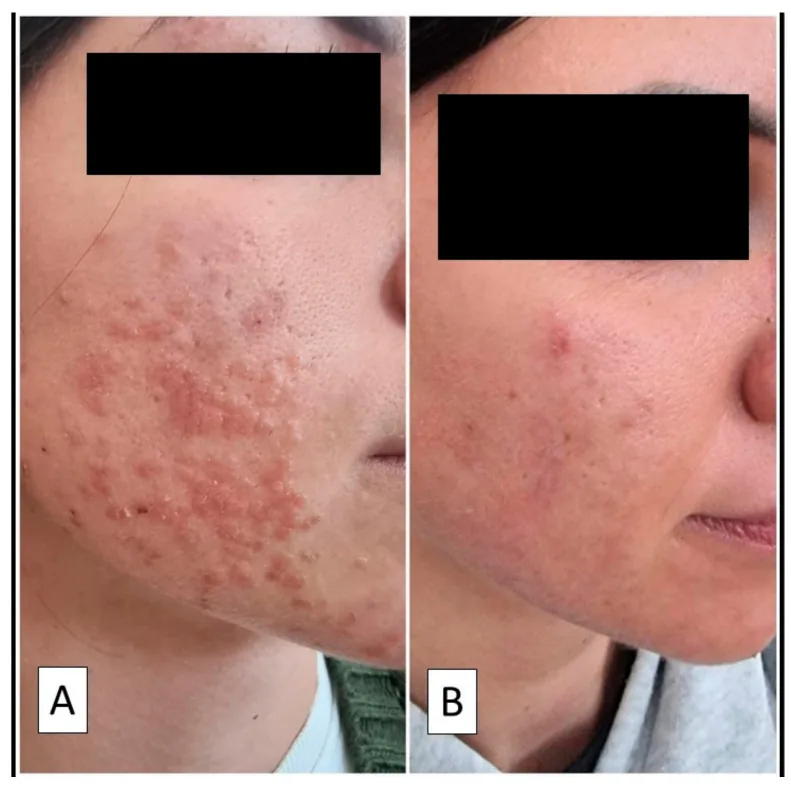
Warts are the contagious exception on this list, so don't scratch them or shave over them, and leave their treatment to your dermatologist.
Why the label matters before you treat
It is tempting to treat every small bump as acne, because acne products are the easiest thing to buy. But the five conditions above respond to five different things. Salicylic acid and retinoids help closed comedones and can gently help flat warts, but they do nothing for milia under the surface and can irritate skin that is actually reacting to a product. Antifungals clear Malassezia folliculitis and do nothing for comedones. Heavy "repair" creams can soothe irritated skin and, around the eyes, may encourage milia. A few minutes of examination, sometimes with a magnifier or a simple scraping, usually tells them apart, and it saves months of trying the wrong product. If you are already on an acne treatment and new bumps appear, mention it, because the treatment itself can occasionally be part of the story.
Less common possibilities
- Sebaceous hyperplasia: yellowish or skin-coloured bumps with a small central dip, on the forehead and nose, usually in older skin. Because it can resemble a skin cancer, a new or changing bump like this should be checked.
- Syringoma: small firm skin-coloured bumps under the eyes, from sweat glands, harmless.
- Contact allergy: small bumps with itch and redness after a new product.
How to tell them apart
| Look | Where | Distinguishing sign | Main treatment | |
|---|---|---|---|---|
| Closed comedone | Small smooth bump | Forehead, chin | Sometimes with blackheads | Treat the blockage |
| Milia | Firm white bump | Around eyes and cheeks | Won't squeeze out | Extraction in clinic |
| Fungal folliculitis | Uniform bumps | Forehead, hairline, chest | Itch | Antifungal |
| Flat warts | Flat top | Face, hands | Line up along a scratch | Dermatologist treatment |
| Sebaceous hyperplasia | Yellowish with central dip | Forehead, nose | Older skin | In-clinic procedures |
The flowchart below puts the questions in order:
flowchart TD
  A[Small skin-coloured bumps] --> B{Itchy and worse with heat?}
  B -->|Yes| C[Possibly fungal - examination and an antifungal]
  B -->|No| D{Firm and white around the eyes, won't squeeze out?}
  D -->|Yes| E[Milia - extraction in clinic]
  D -->|No| F{Flat-topped, increasing, or in a line?}
  F -->|Yes| G[Possible warts - don't pick, get assessed]
  F -->|No| H[Probably closed comedones - treat the blockage]
Frequently asked questions
What are the small skin-coloured bumps on my face?
The most common are closed comedones, small blockages in the pores. But they can also be milia, which are firm white keratin cysts; fungal folliculitis, which itches; flat warts, caused by a virus; or enlarged oil glands in older skin. Shape, location and itch help tell them apart, and an examination settles it.
How do I get rid of small skin-coloured bumps?
It depends on the type. Closed comedones respond to treatments for blockage such as salicylic acid and retinoids; fungal bumps to an antifungal; milia are extracted in clinic; and warts need their own treatment. Using an acne cream on every type wastes time and can irritate the skin.
Are small skin-coloured bumps contagious?
Most aren't. The exception is flat warts, because they are caused by a virus that can spread to new skin through shaving or scratching. So don't pick at flat bumps that are increasing in number, and see your dermatologist.
Can I squeeze small skin-coloured bumps?
It isn't advisable. Closed comedones have no opening, so their contents get pushed deeper; milia are firm and won't come out with pressure; and warts spread when picked. If extraction is needed, it is done in clinic with sterile instruments.
When to see a clinician
See a dermatologist if the bumps itch, keep increasing or spreading, are flat and line up along a scratch, haven't improved after several weeks of a treatment for blockage, or are firm white bumps around the eyes that bother you. Have any new, growing, bleeding or changing bump checked promptly, and mention it if new bumps appeared during an oral acne treatment. To understand the types of acne, read types of acne.
Related articles
- What causes whiteheads
- Types of acne
- Bacterial pimples
- Exfoliator for acne
- The benefits and harms of popping pimples
Further reading
- 8 reasons you may have little bumps on your face — Curology
- Isotretinoin-Associated Eruptive Milia: A Rare Adverse Effect — Cureus
- Malassezia Folliculitis: An Underdiagnosed Mimicker of Acneiform Eruptions — Journal of Fungi
Medical disclaimer: This article is for health education only and is not a substitute for professional medical advice. If you have a skin condition that concerns you, please consult a dermatologist.