
The causes of a sagging face go beyond the skin: sagging is the sum of changes in four layers — receding bone, shrinking and sliding fat pads, loosening ligaments, and then weaker collagen and elasticity in the skin. Sun, smoking and rapid weight loss speed this up, and in women so do the hormonal changes after menopause. Understanding which layer is responsible decides whether a cream can help or whether the answer lies in clinic.
The Arabic pages that rank for this search list age, sun and genetics, and treat sagging as purely a skin problem. This article explains what happens beneath the skin, because that is why creams don't lift a face.
What changes in the face with age?
A 2019 study analysed three-dimensional scans of adult faces aged twenty-six to ninety. Ageing was associated with a flatter face, sagging soft tissue with a "broken" jawline, deeper nasolabial folds and thinner lips. The diagram from the study marks these signs on a single face:
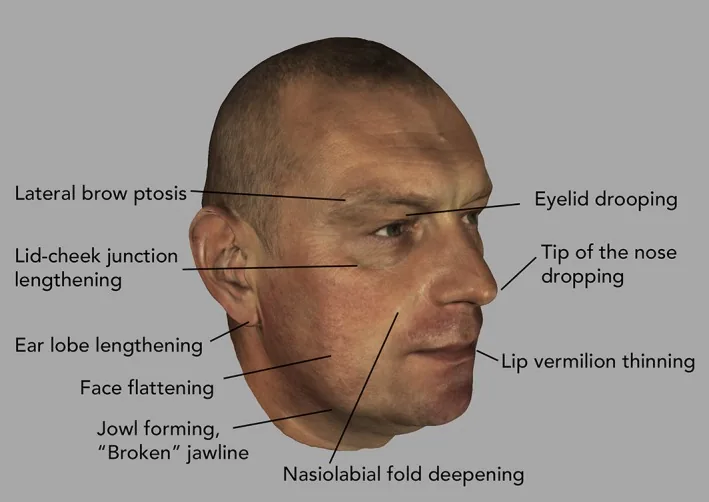
Not all of these signs are "sagging skin". A broken jawline, for instance, is shaped more by sliding fat and receding bone than by the skin itself.
The four layers: from bone to skin
| Layer | What happens | What shows on the face |
|---|---|---|
| Bone | Gradual recession, especially of the jaw and eye socket | A softer jawline, deeper-set eyes |
| Fat pads | Some shrink, others slide down | A flatter cheek, jowls along the jaw |
| Ligaments and fascia | The supports that anchor tissue loosen | Tissue drifts downwards |
| Skin | Less collagen and elasticity | Wrinkles, thinning, skin that gathers |
The order of the layers explains the limits of creams. A cream reaches the skin and may improve its texture and fine lines, but it can't restore bone or lift a fat pad that has slipped. That is why a woman using excellent creams can still look saggy despite glowing skin.
Think of the face as a tent. The bone is the frame, the fat pads are the padding over it, the ligaments are the ropes, and the skin is the canvas. When the frame shrinks and the padding slips, the canvas has less to rest on and gathers in folds, however good its condition. Most of what women call sagging is the frame and padding changing underneath a canvas that is merely following.
Menopause: a turning point for women
The same study found that the course of facial ageing was similar in men and women until about fifty, then turned sharply in women and was fastest in the early years after menopause. In postmenopausal women, facial ageing was best predicted by the years since the last period and was mainly attributed to bone resorption in the jaw. The models below show the average change in women's face shape with age:
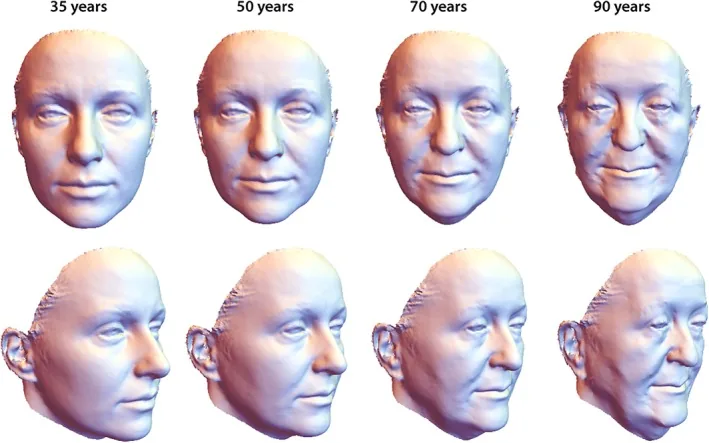
This explains why so many women feel their face "changed suddenly" after fifty. The change isn't entirely sudden, but it does speed up.
External factors that speed up sagging
Internal ageing can't be stopped, but a large part of skin ageing is accelerated by external factors, collectively called the exposome. The diagram from a 2026 review summarises how external factors such as ultraviolet light, pollution and tobacco smoke meet internal ageing in breaking down the skin's structure:
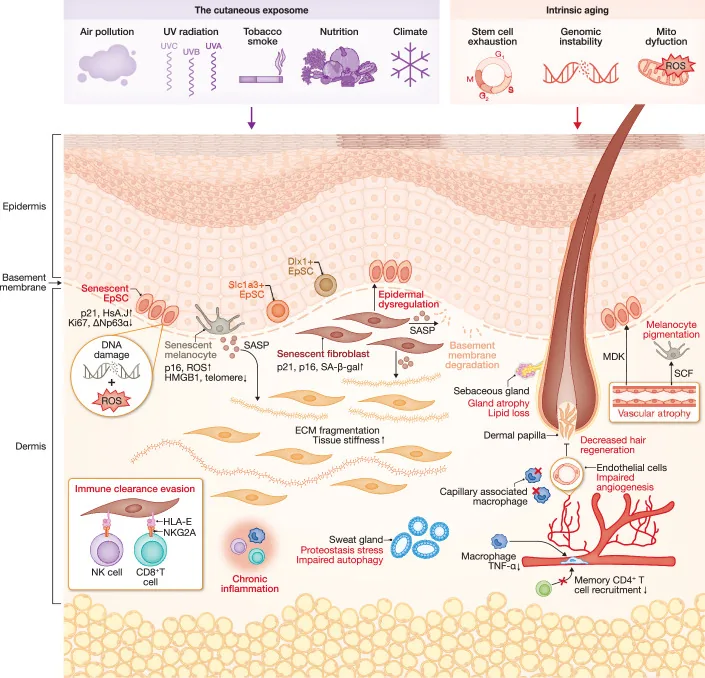
- Sun: ultraviolet light breaks down collagen and elastic fibres, and it is the strongest external factor. More in how to prevent facial wrinkles.
- Smoking: speeds collagen breakdown and reduces blood supply to the skin.
- Rapid weight loss: the face loses some of the fat pads that filled out the skin.
- Repeated weight swings: stretch the skin and let it shrink back again and again, weakening its elasticity.
Genetics and face shape
Two women of the same age with the same habits can age quite differently, and much of that is inherited: the shape and projection of the facial skeleton, how much fat the cheeks carry to begin with, and how thick the skin is. A strong cheekbone and jawline hold soft tissue up for longer; a face that starts with fuller cheeks may show volume shift sooner. None of that is a fault in your routine, and it is why comparing your face with a friend's, or with a celebrity's, says little about what you are doing right or wrong.
Early facial sagging: when is it unexpected?
Obvious sagging in your twenties or early thirties is worth asking about: large weight loss, smoking, or long sun exposure without protection. Rarely, sagging is linked to connective-tissue conditions or medicines, which a dermatologist can tell apart from your history and examination.
The flowchart below helps read what you're seeing:
flowchart TD
  A[Noticing sagging in the face] --> B{After large or rapid weight loss?}
  B -->|Yes| C[Lost fat pads - volume treatment, not cream]
  B -->|No| D{After fifty or menopause?}
  D -->|Yes| E[Accelerated bone and fat change - in-clinic assessment]
  D -->|No| F{Long sun exposure or smoking?}
  F -->|Yes| G[Photoageing - protection and skin treatment]
  F -->|No| H[Early sagging - ask your dermatologist about the cause]
What this means for treatment
Each layer has its own tool: studied creams such as retinoids for the skin itself, sun protection to slow the damage, injectables and devices for fat volume and tightening, and surgery for what goes beyond them. What works, and why results vary from woman to woman, is covered in sagging face treatment.
Frequently asked questions
What causes a sagging face?
Sagging is the sum of changes in several layers: the facial bones recede, especially the jaw; fat pads shrink and slide; the ligaments that anchor the tissues loosen; and the skin loses collagen and elasticity. Sun, smoking, rapid weight loss and the hormonal changes after menopause speed this up.
At what age does the face start to sag?
The first signs of facial ageing usually appear between twenty and thirty and build gradually. In a three-dimensional study of adult faces, the course of facial ageing in women changed clearly from around fifty and was linked to the years since menopause.
Does weight loss make the face sag?
Yes, especially when it is fast or large, because the face loses some of the fat pads that filled out the skin, so the skin looks excess and droops. Gradual loss gives the skin a better chance to adapt, though it doesn't prevent the change entirely.
Can facial sagging be prevented?
Ageing can't be stopped, but the part that external factors speed up can be slowed: daily sunscreen, not smoking, avoiding big swings in weight, and skincare with studied ingredients such as retinoids. Bone and fat loss, however, are treated in clinic, not with creams.
When to see a clinician
See a dermatologist if obvious sagging appeared at a young age with no clear reason, if your face changed quickly after significant weight loss, or if you are considering treatment and want to know which layer is responsible in your face. Seek urgent care straight away if one side of your face droops suddenly: that isn't sagging, it is a sign that needs emergency assessment.
Related articles
- Sagging face treatment
- How to prevent facial wrinkles
- How to reduce wrinkles
- How retinol works
- Excess skin removal after weight loss
Further reading
- Facial Sagging: Causes and How to Improve It — Germaine de Capuccini
- Sagging Skin: Causes, Symptoms and Treatments — Caudalie
- Facial aging trajectories: A common shape pattern in male and female faces is disrupted after menopause — AJPA
Medical disclaimer: This article is for health education only and is not a substitute for professional medical advice. If you have a skin condition that concerns you, please consult a dermatologist.