
La Roche-Posay Effaclar Duo+ is a dermocosmetic cream for mild to moderate acne that combines gentle exfoliants such as salicylic acid with soothing ingredients such as niacinamide. Small recent studies have shown fewer spots on the treated side of the face than on the untreated side. But it isn't a medicine, and it isn't enough for deep, numerous or scarring spots.
The Arabic pages that rank for this product are pharmacy listings showing prices and pack sizes. This article answers the question they skip: what do the studies show, and who is it for?
What is La Roche-Posay Effaclar Duo?
Effaclar Duo+ belongs to the "dermocosmetic" category: cosmetic products designed for skin with a particular problem, sold without a prescription. Its formula varies between versions and markets, but the listed ingredients of the "+" version include salicylic acid, which dissolves in sebum and loosens pore blockages; niacinamide, which calms inflammation and helps with brown marks; zinc; and plant extracts.
Be aware that the same name is used for different formulas. The product sold in the United States under a similar name, Effaclar Duo Dual Action, lists benzoyl peroxide as its active ingredient, while the versions sold in Europe and the Gulf rely on salicylic acid and niacinamide. Reviews and experiences of one version don't automatically apply to the other, and someone who reacted to benzoyl peroxide won't necessarily react to Duo+. Read the ingredient list on the pack you bought before comparing it with other people's experiences.
The difference from medicines is in strength and regulation, not in the idea. Prescription retinoids and benzoyl peroxide act on blockage and bacteria more strongly, with effects proven in larger and longer trials. Dermocosmetics are gentler, their effects are smaller, and their evidence is thinner.
La Roche-Posay Effaclar Duo for acne: what do the studies show?
In a 2026 study of sixteen participants with darker skin and mild to moderate acne, a cream containing salicylic acid, niacinamide, zinc and pomegranate extract was applied to one half of the face, while the other half was left untreated, for about eight weeks. Spot counts fell on both sides, but more on the treated side, especially inflammatory spots:
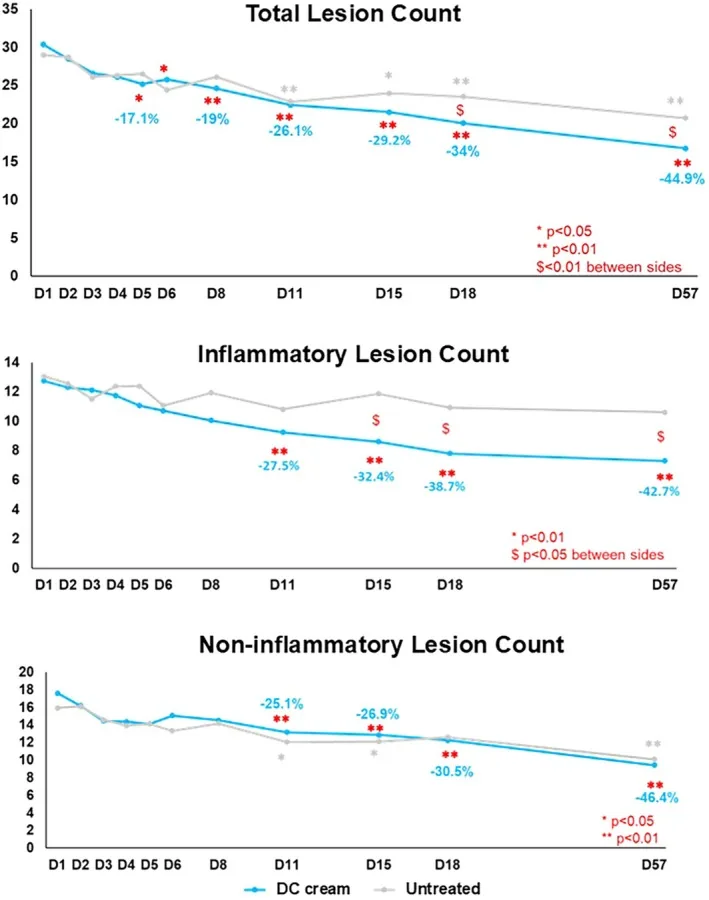
Notice that the untreated side improved too. Acne fluctuates on its own, which is why studies comparing against an untreated side are more honest than before-and-after photos in adverts.
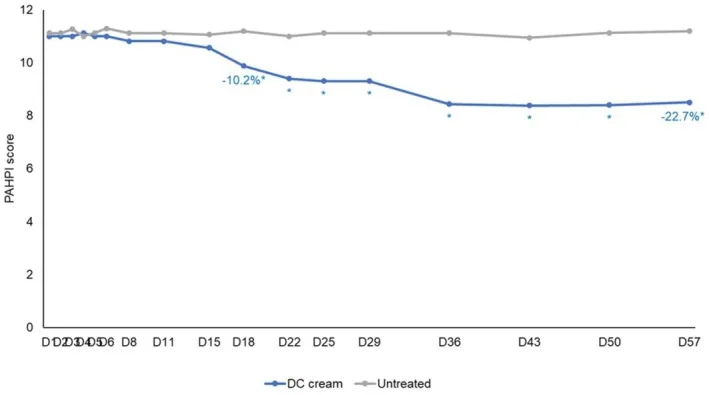
In the same study, the score for dark marks left after acne fell on the treated side while staying flat on the other — which matters for olive and brown skin:
A similar 2026 study on fair skin, also of sixteen participants but over two weeks, found a difference in favour of the treated side by the end:
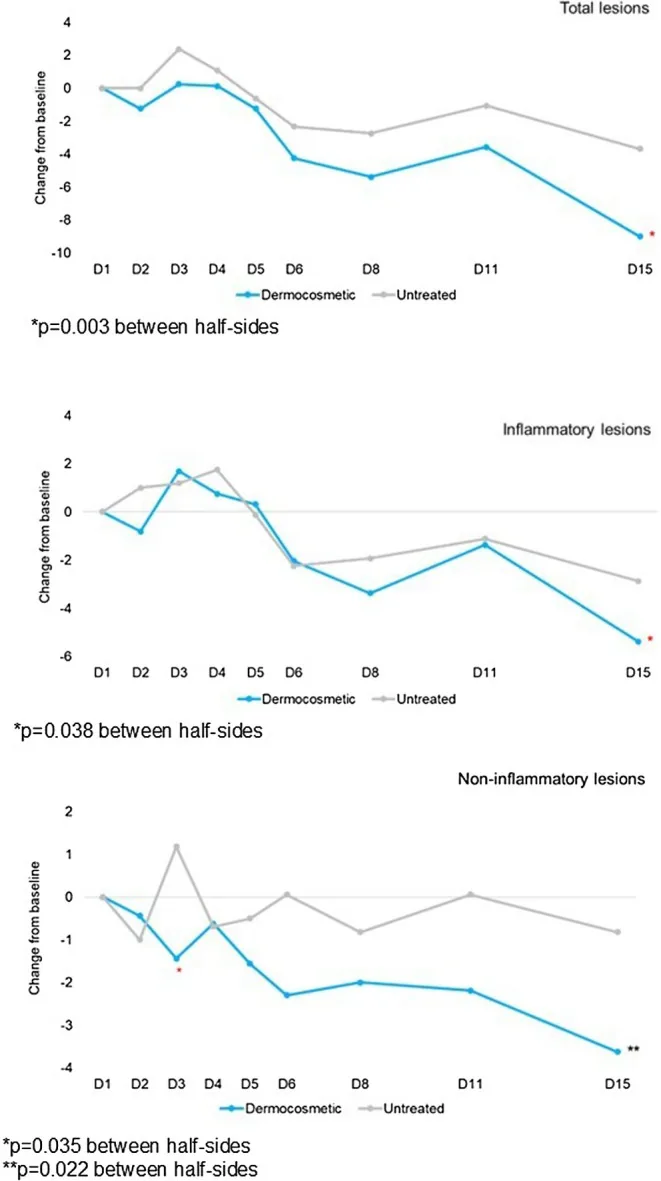
Both studies are small and short, and neither compared the cream with a medical treatment, so they don't mean it is equivalent to retinoids or benzoyl peroxide. They do support using it where it fits: mild acne in someone who wants a gentle first step.
Who is Effaclar Duo for?
| Situation | Suitable? | Note |
|---|---|---|
| Mild spots and blackheads on oily skin | Usually yes | A reasonable first step |
| Brown marks after spots | May help | With daily sunscreen |
| Many moderate spots | Not enough alone | Needs medical treatment |
| Deep spots or scars | No | Medical assessment |
| Very sensitive skin | With care | Introduce it gradually |
| Alongside a retinoid or benzoyl peroxide | Your dermatologist's call | Irritation may double |
In a 2026 Korean study of more than three hundred patients, tolerance and quality of life were better with the dermocosmetic alone than combined with medication among patients with sensitive skin. The message isn't "give up your medicine"; it is that sensitive skin needs a plan built around what it can tolerate.
The flowchart below lays out the decision:
flowchart TD
  A[Considering Effaclar Duo] --> B{Mild spots and blackheads on oily skin?}
  B -->|Yes| C[A reasonable option, with sunscreen]
  B -->|No| D{Many spots, deep spots or scars?}
  D -->|Yes| E[Medical treatment - the cream alone isn't enough]
  D -->|No| F{Already using a retinoid or benzoyl peroxide?}
  F -->|Yes| G[Ask your dermatologist before combining]
  F -->|No| H[Introduce it gradually and watch for irritation]
Fitting it into a routine
A dermocosmetic works best in a short, boring routine: a gentle cleanser, the cream, and sunscreen in the morning. Adding it on top of a crowded shelf of serums, toners and masks makes it hard to tell what is helping and what is irritating. If you are new to it, start on a small area or less often than the pack suggests, and build up as your skin allows; stinging that lasts, visible redness or flaking are signs to step back. Give it several weeks before judging it, and take a photo in the same light at the start, because gradual change is easy to miss in the mirror.
Common mistakes
- Expecting results in days; even in the studies, the difference took weeks to show.
- Layering it with other exfoliants and acids, so irritation builds up.
- Staying on it for months despite recurring deep spots instead of getting assessed.
- Skipping sunscreen, even though brown marks darken in the sun.
- Judging it by reviews of the other formula; check which version a review is about.
To understand its key ingredient, read Stridex pads on salicylic acid, and benzoyl peroxide for acne for the next, medical step.
Frequently asked questions
Does La Roche-Posay Effaclar Duo treat acne?
It helps mild to moderate acne, and small studies have shown fewer spots on the treated side of the face than on the untreated side. But it is a dermocosmetic, not a medicine, and it doesn't replace medical treatment for deep, numerous or scarring spots.
Does Effaclar Duo fade acne marks?
It may gradually fade brown marks, because it contains ingredients that act on pigmentation, and in a study on darker skin the marks score fell on the treated side. But it doesn't remove depressed scars, and deep marks need a different treatment.
What is the difference between Effaclar Duo+ and other versions?
Versions differ in their added ingredients, and some include sunscreen. The basis is broadly similar: gentle exfoliants and soothing ingredients. Read the ingredient list on the pack in your hand, because names change between markets.
Can I use Effaclar Duo with a prescription acne treatment?
Sometimes, but combining them can double the dryness and irritation because it contains exfoliants. In a large Korean study, patients with sensitive skin tolerated the dermocosmetic alone better than in combination with medication. Whether to combine them is a decision for your dermatologist.
When to see a clinician
See a dermatologist if your spots haven't improved after several weeks of regular use; if they are deep, painful, numerous or leaving scars or dark marks that keep accumulating; or if redness, burning and peeling don't settle. If your spots sit along the jaw and chin and follow your cycle, there may be a hormonal component that needs assessment. For a complete treatment plan, read acne medicines.
Related articles
Further reading
- La Roche Posay Effaclar Duo (+) and Effaclar Purifying Foaming Gel review — Daily Vanity
- Comparing La Roche-Posay Effaclar Duo+ vs Effaclar H — McCabes Pharmacy
- La Roche-Posay Effaclar Duo Dual Action Acne Treatment Review — DermFnd
Medical disclaimer: This article is for health education only and is not a substitute for professional medical advice. If you have a skin condition that concerns you, please consult a dermatologist.