

Bioderma's Sébium range is designed for oily, acne-prone skin and includes a cleanser, a micellar water, creams with exfoliating ingredients such as salicylic acid, and a moisturiser for people using drying treatments. These products help as part of a routine for mild spots and oily skin, and as support alongside medical treatment, but they don't treat moderate or severe acne on their own, and we found no independent published trials of most of them.
The Arabic pages that rank for this search are shop pages and a promotional review of the cleanser, without explaining what each product does or who it suits. This article sorts the range by need and explains the evidence on its ingredients. We have no connection with the manufacturer.
What does a routine for acne-prone skin need?
Acne has four drivers: excess oil, pores blocked by dead cells, acne bacteria, and inflammation, alongside a skin barrier that treatment can disturb. A 2026 review groups dermocosmetic ingredients by the driver they target:
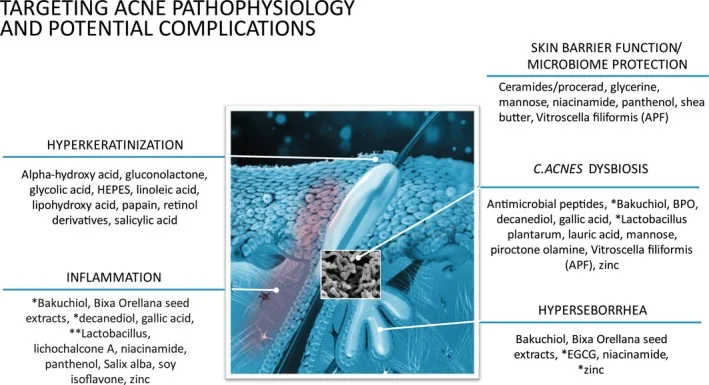
The review was funded by a competing company, and its authors consult for cosmetics firms, but it's useful for understanding the principle: each product targets part of the problem, and no cosmetic product targets all of it with the strength of a medicine. Knowing which driver matters most for your skin makes it easier to pick one product rather than a whole range.
Sébium products by need
| Product | What it does | Suits |
|---|---|---|
| Sébium cleanser | Removes oil; contains zinc and copper sulfates | Daily cleansing of oily skin |
| Sébium micellar water | Removes make-up and oil without rubbing | People who wear make-up daily |
| Sébium Kerato+ | A cream with exfoliating ingredients such as salicylic acid | Blackheads, whiteheads, mild spots and their marks |
| Sébium Global | An exfoliating cream for more spots | Mild to moderate spots, with a dermatologist |
| Sébium Hydra | A moisturiser for skin dried by treatment | People using a retinoid or isotretinoin |
Names and formulations vary between countries and change over time, so read the ingredient list on the pack itself. Some Arabic retailers list salicylic acid in the sunscreen version of Kerato+; it's a well-studied ingredient explained in Stridex pads. If the active ingredient isn't clear from the label, it's hard to know what you're buying, and a pharmacist can help you compare.
What about "microbiome balance"?
Bioderma markets some Sébium products as rebalancing the skin's bacteria. The idea has a scientific basis: in acne, the diversity of normal skin bacteria falls and particular strains of the acne bacterium dominate, as a 2026 expert consensus illustrates:
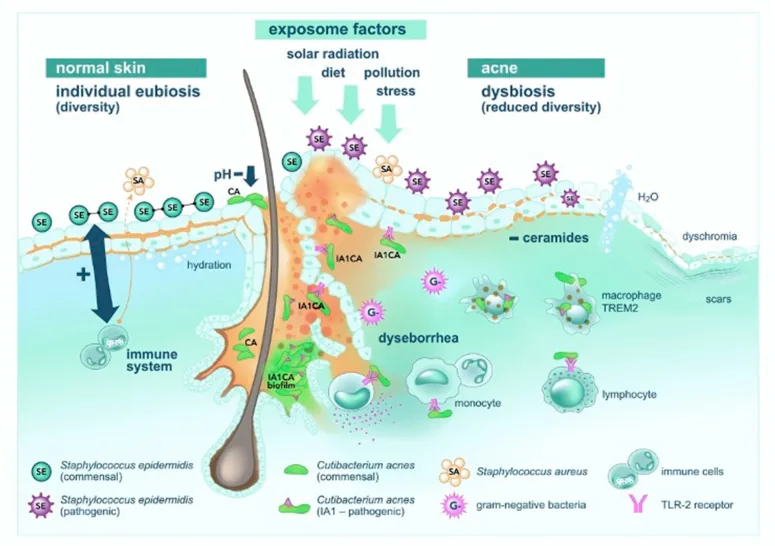
The consensus was funded by another cosmetics company, understanding of the microbiome is still developing, and there's no strong evidence yet that any particular cosmetic product restores this balance in a way that treats acne.
Supporting products alongside medical treatment
The most important role for products like Sébium Hydra is making medical treatment tolerable. In a 2025 observational study of more than two thousand patients on medical acne treatment, a supporting routine of cleanser and moisturiser was added, and itching, tingling and burning eased for most within three months:
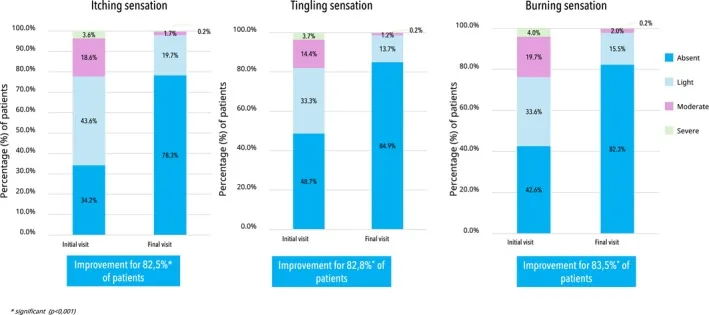
The study was observational with no comparison group and was funded by a competing company that makes the products tested, but the principle is general and applies to any gentle cleanser and moisturiser, as explained in dry skin with acne.
flowchart TD
  A[Acne-prone skin] --> B{Using a drying medical treatment?}
  B -->|Yes| C[Gentle cleanser and a moisturiser such as Hydra]
  B -->|No| D{Blackheads and mild spots?}
  D -->|Yes| E[Cleanser plus one exfoliating cream]
  D -->|No| F{Many or deep inflamed spots?}
  F -->|Yes| G[See a dermatologist]
  F -->|No| H[Gentle cleanser and sunscreen]
A simple routine with Sébium products
Morning: a gentle cleanser, then a light moisturiser if you need it, then a non-comedogenic sunscreen. Evening: micellar water to remove make-up if you wear it, then the cleanser, then one exfoliating cream a few times a week to start with, then a moisturiser if your skin feels tight. If your dermatologist has prescribed a treatment, it takes the place of the exfoliating cream, while the cleanser and moisturiser stay. Give the routine several weeks before judging it, and don't change more than one product at a time, so you can tell what helps and what irritates.
How Sébium compares with similar ranges
Most big pharmacy brands sell a near-identical lineup for acne-prone skin: a gentle cleanser, a micellar water, one or two exfoliating creams, and a soothing moisturiser. The differences between them are usually smaller than the marketing suggests. What matters is the active ingredient and how your skin tolerates the formula: salicylic acid, azelaic acid, niacinamide or a retinoid for the treatment step, and ceramides or glycerin for the moisturiser. A product that's well tolerated and used every day will beat a theoretically stronger one that stings so much you abandon it. If you already have a cleanser and moisturiser that suit you, there's no need to switch to a whole new range; adding one well-chosen treatment product is usually the more useful change. Price is not a reliable guide to strength either, so compare labels rather than brands.
Common mistakes
Buying the whole range and starting it all at once, which adds to dryness. Combining an exfoliating Sébium cream with a retinoid or benzoyl peroxide without asking your dermatologist. Expecting the cleanser alone to clear spots, when it's on the skin for seconds. And buying from unreliable sources: counterfeits are common among more expensive skincare products, so buy from a pharmacy or the brand's authorised sellers.
mindmap
  root((Bioderma Sébium))
    Cleansing
      Cleanser
      Micellar water
    Mild treatment
      Kerato+
      Global
    Support
      Hydra with medical treatment
    Watch for
      Don't stack exfoliants
      Not a substitute for a dermatologist
Frequently asked questions
Is Bioderma good for acne?
Bioderma's Sébium range offers supporting products for oily skin and mild spots: a gentle cleanser, creams with exfoliating ingredients such as salicylic acid, and a moisturiser for people using drying treatments. They help as part of a routine, but they don't treat moderate or severe acne on their own.
Which Bioderma Sébium product should I choose?
For daily cleansing: the cleanser or the micellar water. For blackheads, whiteheads and mild spots: a cream with an exfoliating ingredient, such as Kerato+ or Global. If a medical treatment is drying your skin: the Hydra moisturiser. Read the ingredients on the pack, because names and formulas change.
Does the Bioderma cleanser treat acne?
The cleanser removes excess oil and, according to published ingredient lists, contains zinc and copper sulfates, but a cleanser stays on the skin for seconds, so its effect on spots is limited. Its main benefit is gentle cleansing that doesn't damage the skin, while real treatment comes from a product that stays on.
Can I use Bioderma alongside acne treatment from my dermatologist?
Usually yes; a gentle cleanser and moisturiser ease the dryness and irritation of medical treatments. But don't combine an exfoliating Sébium cream with a retinoid or benzoyl peroxide without asking your dermatologist, because it increases irritation.
When to see a clinician
See a dermatologist if spots are red and numerous or deep and painful, if they leave dark marks or scars, if they haven't improved after several weeks of a consistent routine, or if strong irritation follows any product. Dermocosmetics help, but they don't replace treatment when it's needed.
Related articles
Further reading
- Integrating Dermocosmetics Into Acne Care in Latin America — Journal of Cosmetic Dermatology
- A Global Delphi Consensus on Acne and the Microbiome — Pharmaceuticals
- Acne: Diagnosis and treatment — American Academy of Dermatology
Medical disclaimer: This article is for health education only and is not a substitute for professional medical advice. If you have a skin condition that concerns you, please consult a dermatologist.