
Yes, your skin can be dry and have acne at the same time: acne happens inside pores, while dryness affects the skin's surface and barrier. Often the dryness comes from the acne treatment itself, or from harsh cleansers and too many products. The answer is a routine that treats spots with one product introduced gradually, alongside a gentle cleanser and a non-comedogenic moisturiser, rather than drying the skin out further.
Most pages that rank for this search are in English and come from companies selling moisturisers, and Arabic pages are rare. This article explains why dryness and spots occur together and how to treat both, drawing on published studies.
Why dryness and spots go together
Many people assume acne is only for oily skin, but spots begin inside pores, as they block with oil and dead cells and then become inflamed, and that can happen beneath a dry surface. More often the dryness is a result of treatment: retinoids, benzoyl peroxide and salicylic acid all dry and peel the skin, especially in the first weeks or when combined. Foaming harsh cleansers, hot water, cold weather and air conditioning add to it. In adult women particularly, the skin may be dry or sensitive while hormonal spots appear on the chin and jawline.
There's another twist: when the barrier is damaged, skin can feel tight and flaky yet look shiny, because irritation can make oil glands more active. That's why "dehydrated but oily" is such a common description in clinic, and why stripping the skin further rarely helps.
Too many products damage the barrier
In a 2026 study of four hundred and eight people with acne in Turkey, damage to the skin barrier was much more common among those who bought products under the influence of social media, and knowing more cosmetic buzzwords went along with more barrier damage and later visits to a doctor:
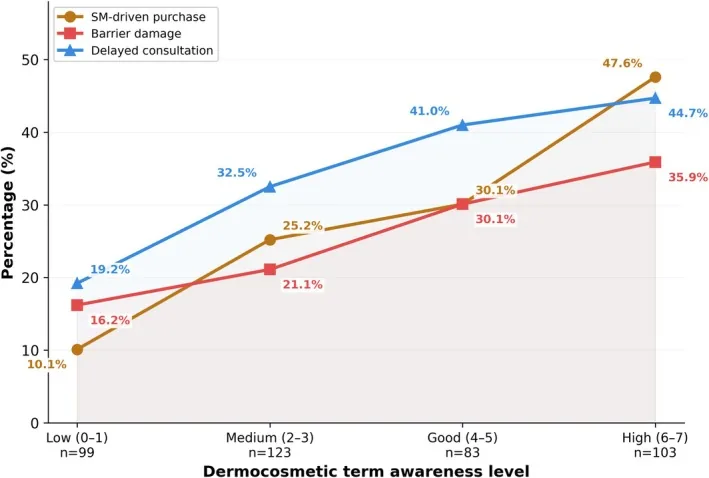
The study is cross-sectional, so it can't prove cause, but it matches what we see in clinic: long routines full of acids and exfoliants damage the barrier, the skin becomes dry and irritated, and spots can get worse. Following dermatologist-led sources was, in the same study, linked to less barrier damage.
Moisturiser makes treatment tolerable
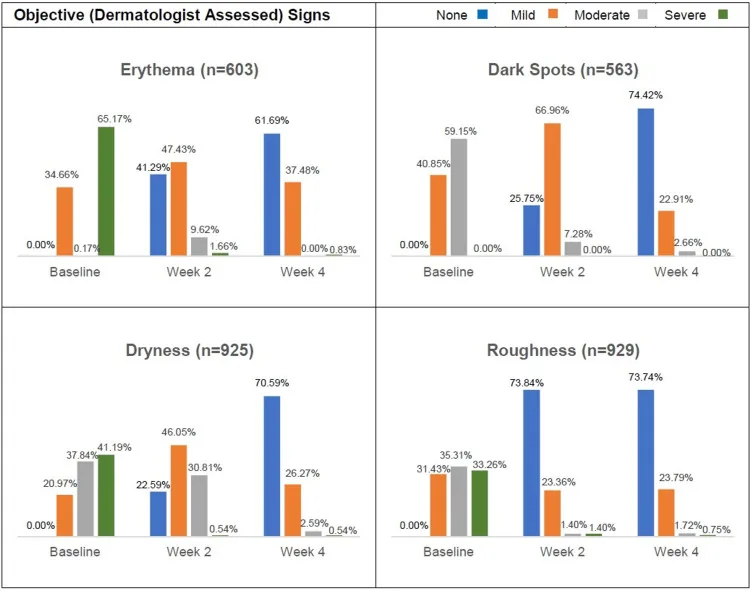
Retinoid dermatitis, with redness, dryness and burning, is one of the commonest reasons people give up acne treatment. In a 2026 retrospective study of more than one thousand three hundred patients in India with this irritation, redness, dryness and roughness fell over four weeks of a moisturiser with sunscreen:
Measured skin hydration also rose over the same period:
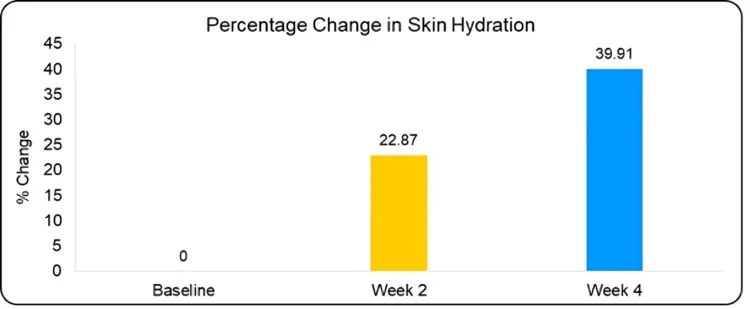
The study was retrospective with no comparison group and assessed a single commercial product, but it supports an idea that guidelines endorse: moisturiser is part of acne treatment, not its enemy.
A routine for dry, acne-prone skin
| Step | What to choose | What to avoid |
|---|---|---|
| Cleanser | Gentle, non-foaming or cream | Soap, harsh washes and hot water |
| Acne treatment | One product at a low strength, introduced gradually | Combining several drying products |
| Moisturiser | Ceramides or glycerin, non-comedogenic | Heavy oils and butters if spots worsen |
| Sunscreen | Light and non-comedogenic | Sun exposure without protection |
| Exfoliation | Usually none | Grainy scrubs and rubbing |
Apply the moisturiser after the treatment, or shortly before it if your skin is very sensitive, which softens the sting. If the treatment is prescribed, ask your dermatologist about using it less often rather than stopping. Benzoyl peroxide washes, which are rinsed off, are often gentler on dry skin than leave-on gels.
flowchart TD
  A[Dry skin with spots] --> B{Using several drying products?}
  B -->|Yes| C[Cut down to one treatment]
  B -->|No| D[Gentle cleanser and non-comedogenic moisturiser]
  C --> D
  D --> E{Strong irritation or peeling?}
  E -->|Yes| F[Use the treatment less often; moisturise more]
  E -->|No| G[Keep going and give it weeks]
  F --> H{Still a problem?}
  H -->|Yes| I[See a dermatologist]
Weather, air conditioning and daily habits
In a hot climate with air conditioning all day, or in a cold winter, the skin loses water faster, so it feels tight after washing even if it still makes oil. Wash with lukewarm, not hot, water, pat the face dry rather than rubbing, and apply moisturiser while the skin is still slightly damp. Don't wash your face more than twice a day; more washing strips natural oils and adds to dryness without preventing spots. If you wear make-up daily, choose non-comedogenic formulas and remove them with a gentle remover rather than scented wipes.
Choosing an acne treatment that suits dry skin
Some acne treatments are kinder to dry skin than others. Azelaic acid is relatively gentle, helps both spots and the dark marks they leave, and is often a good starting point when the skin is sensitive. Among retinoids, adapalene tends to be better tolerated than older options, and cream formulations are usually gentler than gels. Benzoyl peroxide can be used as a short-contact wash rather than a leave-on gel. Salicylic acid is useful for blackheads and whiteheads but adds to dryness if combined with everything else. Whatever you use, start a few nights a week, increase only as your skin settles, and keep the rest of the routine simple. If you're on a prescription treatment, your dermatologist can switch formulation or strength rather than leaving you to struggle with irritation. Introducing one change at a time also makes it easy to see what's helping and what's irritating.
When dryness is something else
If dryness comes with itching and red patches, in skin folds, or around the eyes and mouth, it may be eczema, perioral dermatitis or seborrhoeic dermatitis. These aren't treated with acne products, and some get worse with them. Itchy bumps are covered in itchy skin bumps, and moisturising in dry skin.
mindmap
  root((Dryness with spots))
    Causes
      The acne treatment itself
      Harsh cleansers
      Too many products
      Dry climate
    The fix
      Gentle cleanser
      One treatment introduced slowly
      Non-comedogenic moisturiser
    Avoid
      Scrubs
      Hot water
Frequently asked questions
Can you have dry skin and acne at the same time?
Yes. Acne starts inside pores, with blockage and inflammation, while dryness affects the skin's surface and barrier. So the two often occur together, especially with drying treatments or harsh cleansers, in adult women, or in cold, dry weather.
What is the best routine for dry, acne-prone skin?
A gentle, non-foaming cleanser, then one acne treatment at a low strength introduced gradually, then a non-comedogenic moisturiser with ceramides or glycerin, and sunscreen in the morning. Avoid harsh exfoliants and piling on products.
Does moisturiser make acne worse?
The right moisturiser doesn't; it helps you tolerate acne treatments and reduces irritation. Choose one labelled non-comedogenic, and avoid heavy oils and butters on the face if your spots get worse with them.
Why did my skin get dry after acne treatment?
Retinoids, benzoyl peroxide and salicylic acid dry and peel the skin, especially in the first weeks or when combined. The answer is usually to use them less often and add a moisturiser rather than stopping, and your dermatologist decides this if the treatment is prescribed.
When to see a clinician
See a dermatologist if dryness or burning continues despite moisturising and cutting back the treatment, if itchy, red, flaky patches appear, if spots are deep and painful or leave marks, or if they haven't improved after several weeks of a suitable routine. You may need a different treatment that suits dry skin better.
Related articles
Further reading
- Association of Social Media‐Driven Cosmetic Consumption With Skin Barrier Damage … in Acne Vulgaris — Journal of Cosmetic Dermatology
- Real-World Evaluation of a Moisturizer With Broad-Spectrum Sunscreen in Retinoid-Induced Dermatitis — Cureus
- Acne: Diagnosis and treatment — American Academy of Dermatology
Medical disclaimer: This article is for health education only and is not a substitute for professional medical advice. If you have a skin condition that concerns you, please consult a dermatologist.