
Itchy bumps on the skin are rarely ordinary acne: the commonest causes are fungal folliculitis, scabies, heat rash, allergic reactions, and insect bites. The shape of the bumps, where they are and when the itching is worst help tell them apart, but diagnosis needs a dermatologist, because each cause is treated differently and acne treatment doesn't help most of them.
The Arabic pages that rank for this search list long catalogues of diseases without explaining how to tell them apart, and without pictures. This article sorts the common causes by appearance, location and timing, with images from published cases.
Why the itch matters
Ordinary acne causes blackheads, whiteheads and red spots, and can be sore, but itching isn't its main feature. So when the itch bothers you more than the spots themselves, that's a clue to a different cause. A common mistake is to treat these bumps with acne creams or antibiotics for weeks without improvement, while the real cause needs entirely different treatment. Other causes of bumps on the body are covered in bumps on the body.
It helps to note a few things before you see a doctor: when the bumps started, whether anything changed beforehand (a new product, medicine, detergent, trip or hot weather), whether the itch is worse at night, and whether anyone else at home has it. These details often point to the cause faster than the bumps alone. A photo taken when the bumps are at their worst is also useful, since some rashes, hives in particular, may have faded by the time of the appointment.
Fungal folliculitis: acne-like bumps that itch
This is caused by overgrowth of a yeast that lives normally on oily skin, inside hair follicles. It shows up as small, uniform, itchy bumps on the forehead, chest and upper back, flaring with heat, sweating and tight clothing, and sometimes after antibiotics. A 2025 review describes it as underdiagnosed precisely because it mimics acne:
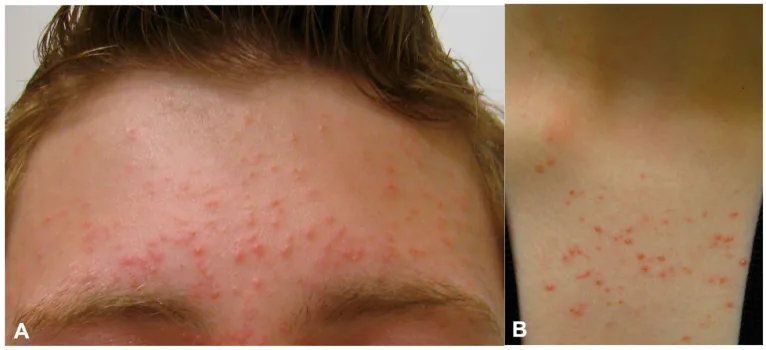
The key differences from acne: the bumps are all the same size, they itch, there are no blackheads among them, and they don't improve with usual acne treatment. Antibiotics can even make it worse, because they reduce competing bacteria and let the yeast thrive. It's treated with an antifungal chosen by a dermatologist after examination, and because the yeast is a normal resident of the skin, it can come back, especially in hot, humid weather.
Scabies: itching that's worse at night
Scabies is an infestation with a tiny mite that burrows under the skin. Its hallmark is intense itching that worsens at night, small bumps between the fingers and on the wrists, armpits and waistline, and more than one person in the household affected. Diagnosis can be delayed because it resembles eczema, as in a 2026 case report:
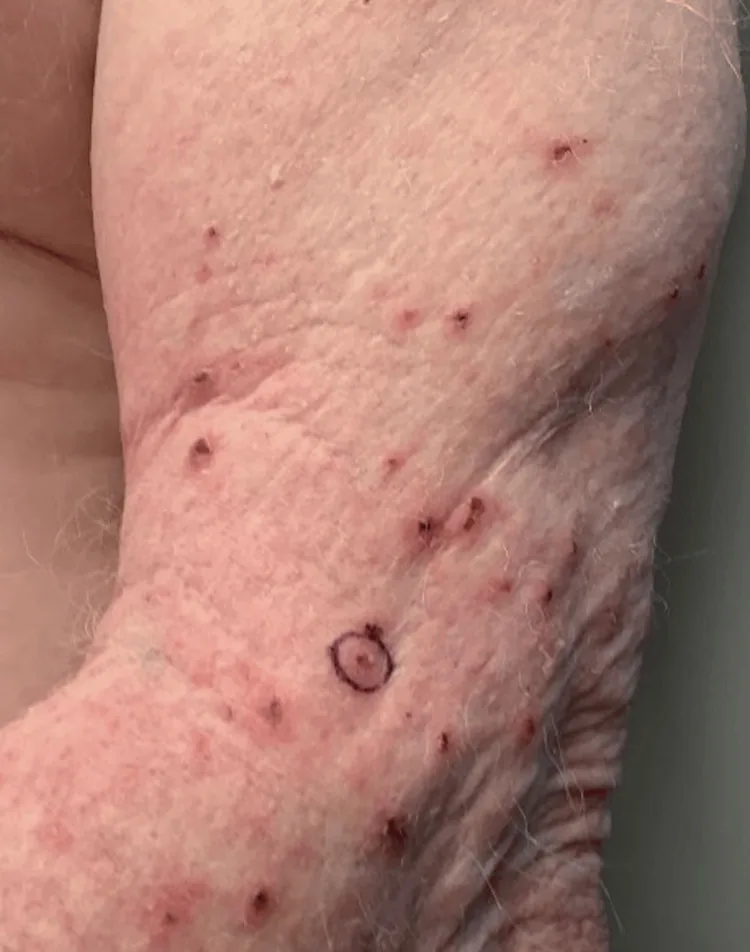
Scabies treatment is prescribed by a doctor and covers all close contacts at the same time, along with washing clothes and bedding in hot water. Itching can continue for a while after treatment without meaning it has failed. Scabies has nothing to do with personal cleanliness; it spreads through prolonged skin contact, so anyone can catch it.
Heat rash: bumps after heat and sweating
Heat rash, or miliaria, happens when sweat ducts become blocked, producing tiny pinhead bumps with prickling or itching, usually on the neck, chest, back and skin folds, and sometimes the face. In a 2025 case, small pustules appeared on the forehead and around the eyes alongside heat rash on the face and trunk:
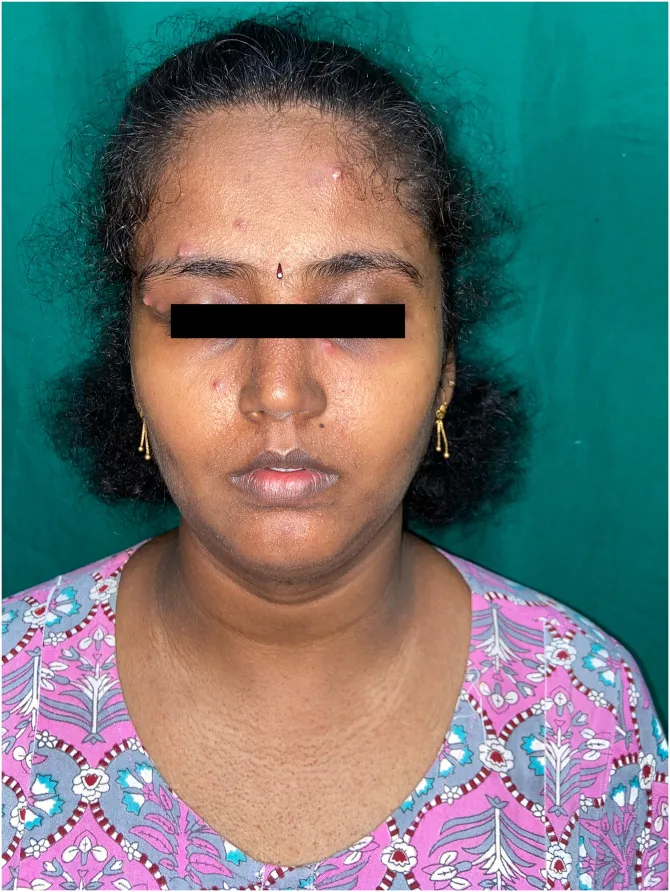
It usually improves by cooling the skin, reducing sweating, wearing loose cotton clothing, and avoiding heavy creams that block pores. Because it's triggered by trapped sweat, it's common in hot climates, during exercise, under tight clothing, and in people who are unwell with a fever.
Allergy and insect bites
Hives are raised red or pale swellings that itch intensely, appearing and fading within hours in different places. Contact dermatitis is itching, redness and sometimes tiny blisters where the skin touched a particular substance, such as a fragrance, hair dye, metal or new product. Insect bites are scattered bumps or small clusters on exposed skin, often noticed after sleeping or being outdoors.
| Cause | Appearance | Location | Telltale sign |
|---|---|---|---|
| Fungal folliculitis | Small, uniform bumps | Forehead, chest, back | Doesn't respond to acne treatment |
| Scabies | Small bumps and scratch marks | Finger webs, wrists, waist | Night-time itch; family affected |
| Heat rash | Pinhead bumps | Neck, chest, skin folds | After heat and sweating |
| Hives | Raised swellings | Anywhere | Come and go within hours |
| Contact dermatitis | Redness and tiny blisters | Where contact occurred | After a new product or material |
flowchart TD
  A[Itchy bumps] --> B{Fever, facial swelling or difficulty breathing?}
  B -->|Yes| C[Urgent care]
  B -->|No| D{Night-time itch and others affected?}
  D -->|Yes| E[Possible scabies - see a doctor]
  D -->|No| F{After heat and sweating?}
  F -->|Yes| G[Possible heat rash - cool the skin]
  F -->|No| H[Dermatologist to identify the cause]
What eases the itch until diagnosis
Cool compresses, lukewarm rather than hot showers, a gentle fragrance-free cleanser, a simple moisturiser, and loose cotton clothing. Try not to scratch; it breaks the skin and raises the risk of infection and dark marks. Keeping nails short helps, especially at night. Don't use steroid creams or antibiotics on your own: a steroid can worsen fungal folliculitis and mask scabies, delaying diagnosis. If a new product, detergent or medicine came just before the bumps, stopping the product (but not a prescribed medicine, without asking your doctor) is a reasonable first step. Irritation on the face is covered in facial skin inflammation.
mindmap
  root((Itchy bumps))
    Causes
      Fungal folliculitis
      Scabies
      Heat rash
      Allergy
      Insect bites
    What helps
      Cool compresses
      Lukewarm water
      Cotton clothing
    Avoid
      Scratching
      Steroid cream without advice
Frequently asked questions
What causes itchy bumps on the skin?
The commonest causes are fungal folliculitis, scabies, heat rash from heat and sweating, allergic reactions such as hives and contact dermatitis, and insect bites. Ordinary acne rarely itches much, so if itching is the main complaint, the cause is usually something else.
Can acne be itchy?
It can itch mildly at times, but itching isn't its defining feature. Small, uniform, itchy bumps on the forehead, chest and back, especially after heat and sweating or after antibiotics, may be fungal folliculitis, which doesn't respond to acne treatment.
How do I know if the itching is scabies?
Typical signs are intense itching that gets worse at night, small bumps between the fingers and on the wrists, armpits and waistline, and more than one person in the household affected. Diagnosis needs a doctor, and treatment covers all close contacts at the same time.
When are itchy bumps serious?
When they come with a fever, swelling of the face or lips, or difficulty breathing, when they spread quickly with blisters or peeling, or when they appear after starting a new medicine. These need urgent care.
When to see a clinician
See a dermatologist if bumps and itching last more than two weeks, don't improve with acne treatment, itch worse at night or affect others at home, or show signs of infection such as pus and increasing pain. Seek urgent care if they come with a fever, swelling of the face or lips, difficulty breathing, or widespread blisters after a new medicine.
Related articles
Further reading
- Scabies: Signs and symptoms — American Academy of Dermatology
- Malassezia Folliculitis: An Underdiagnosed Mimicker of Acneiform Eruptions — Journal of Fungi
- Hives: Overview — American Academy of Dermatology
Medical disclaimer: This article is for health education only and is not a substitute for professional medical advice. If you have a skin condition that concerns you, please consult a dermatologist.