Inflammation of the facial skin isn't one diagnosis but a description of redness, itching, flaking or burning with several different causes, the commonest being irritation from products, allergy to an ingredient, seborrhoeic dermatitis, rosacea and perioral dermatitis. Where the inflammation sits and what it looks like usually reveal the cause. In every case the first step is to simplify your routine, and the second is to treat the cause itself.
The Arabic pages that rank for this search give a long list of causes and then suggest home remedies with aloe, chamomile and turmeric, without helping you work out which cause is yours. This article separates the five common causes, with pictures, and explains what calms the skin and what makes it worse.
Irritation from products: the commonest cause
Using too many products, exfoliating often, high-strength retinoids and acids, and harsh cleansers all weaken the skin barrier, so the skin reddens, stings and flakes. This kind of irritation doesn't need an allergy; it only needs the skin to be given more than it can tolerate. The tell-tale sign is that almost every product stings, sometimes even water, and that it improves when you stop the active products and go back to a simple cleanser and moisturiser.
It's especially common when someone starts a new routine with several actives at once, or adds a prescription retinoid to an existing acid toner. The skin may cope for a week or two and then suddenly react. That delay leads many people to blame the most recent product rather than the cumulative load.
Allergy to a product: itching where it was applied
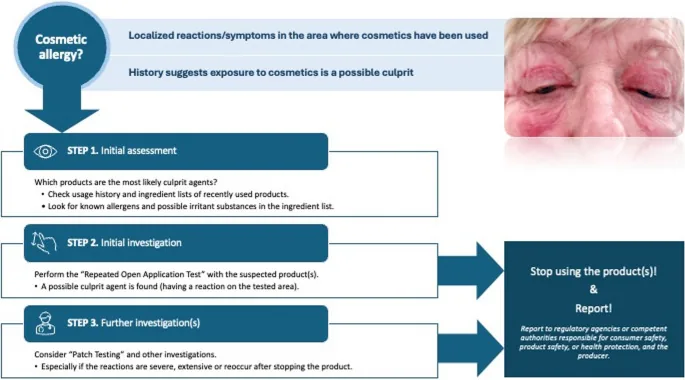
Allergic contact dermatitis is an immune reaction to a specific ingredient. A 2025 review found that fragrances remain the most common cosmetic allergens, followed by preservatives and hair dye chemicals, with newer allergens emerging in sunscreens, lightening products and "natural" ingredients. Itching, redness and sometimes swelling appear where the product is used, and the eyelids are among the most affected areas because their skin is thin. The culprit may be a product you've used for years, since allergy can develop after long use.
The same review suggests an organised approach: review the products and their ingredient lists, then try the suspected product repeatedly on a small area, then patch test if needed:
Patch testing identifies the exact ingredient. In two cases published in 2026, a rash followed skincare products containing a widely used antioxidant, and patch testing confirmed it as the cause:
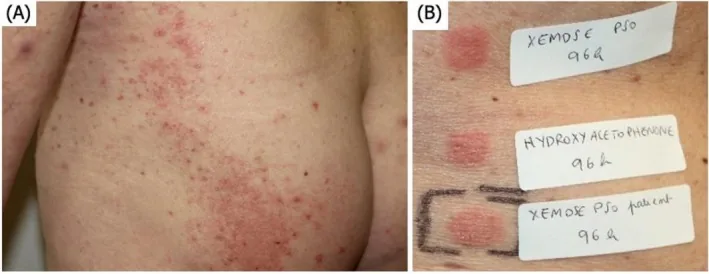
That image shows the body rather than the face, but the principle is the same: once you know the ingredient, you can avoid it in every product from then on, rather than guessing brand by brand.
Seborrhoeic dermatitis: flaking around the nose and eyebrows
This shows as redness with greasy yellow or white scale beside the nose, in and between the eyebrows, behind the ears, and often with dandruff on the scalp. It's linked to a yeast that lives normally on oily skin, and tends to flare with stress and cold weather. A 2026 case report shows the typical distribution:
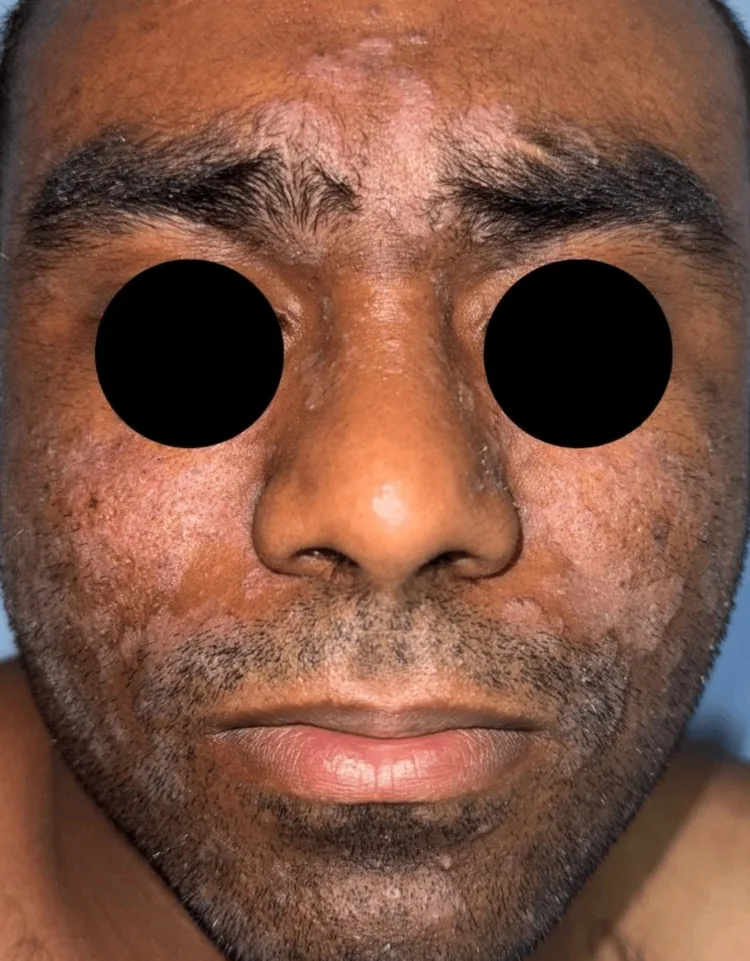
It's a long-term condition that settles and returns, and is treated with topical antifungals and calming treatments chosen by a dermatologist; the aim is control rather than permanent cure. The American Academy of Dermatology's overview notes that it's common in adults and in men with beards, where it can sit under facial hair.
Rosacea and perioral dermatitis
Rosacea is redness across the centre of the face that worsens with heat, sun, spicy food and emotion, sometimes with visible blood vessels and spots without blackheads. The AAD's guide to rosacea signs and symptoms describes how it can also affect the eyes. Perioral dermatitis is small red bumps around the mouth and nose, often linked to steroid creams; it's covered in creams for dark skin around the mouth.
Both are often mistaken for acne or for "sensitive skin", and both can be made worse by the very products people reach for: heavy creams, exfoliants and steroids.
How to tell the causes apart
| Cause | Where | Distinguishing sign | What helps |
|---|---|---|---|
| Irritation from products | Wherever products are applied | Stinging with almost every product | Simplify the routine |
| Contact allergy | Where the product is used; eyelids | Itching and swelling | Stop the product; patch test |
| Seborrhoeic dermatitis | Beside the nose; eyebrows | Greasy scale and dandruff | Treatment chosen by a dermatologist |
| Rosacea | Centre of the face | Redness worse with heat | Avoid triggers; medical treatment |
| Perioral dermatitis | Around the mouth and nose | Small bumps, clear rim by the lip | Stop steroids; medical treatment |
flowchart TD
  A[Redness or itching on the face] --> B{Started after a new product or exfoliating?}
  B -->|Yes| C[Stop active products and simplify]
  B -->|No| D{Greasy scale around the nose and eyebrows?}
  D -->|Yes| E[Likely seborrhoeic dermatitis]
  D -->|No| F{Central redness worse with heat?}
  F -->|Yes| G[Likely rosacea]
  F -->|No| H[Assessment by a dermatologist]
  C --> I{No better within a few weeks?}
  I -->|Yes| H
What calms the skin and what makes it worse
Whatever the cause, the first step is the same: a gentle cleanser, a fragrance-free moisturiser and a mineral sunscreen, with exfoliants, retinoids and new products paused for now. Introduce products back one at a time, several days apart, so that if the skin reacts you know which one did it.
What makes it worse: steroid creams on the face without a prescription, home mixtures with lemon, vinegar or essential oils, and trying a new product every couple of days. Steroid creams deserve particular caution because they work quickly, which makes them tempting, but long-term use on the face can thin the skin and lead to a cycle of flares; the risks of steroids hidden in unlabelled creams are covered in Pakistani whitening creams. And if the inflammation is on a bearded face, seborrhoeic dermatitis is one of the commonest causes and needs ongoing management rather than a single product.
mindmap
  root((Facial skin inflammation))
    Causes
      Product irritation
      Contact allergy
      Seborrhoeic dermatitis
      Rosacea
      Perioral dermatitis
    Calms
      Gentle cleanser
      Fragrance-free moisturiser
      Mineral sunscreen
    Worsens
      Steroids without prescription
      Home mixtures
      Too many products
Frequently asked questions
What causes inflammation of the facial skin?
The commonest causes are irritation from skincare or over-exfoliating, allergy to an ingredient in a product, seborrhoeic dermatitis around the nose and eyebrows, rosacea, and perioral dermatitis. Sometimes the cause is a steroid cream used on the face for a long time.
How do I know if my facial inflammation is an allergy to a product?
An allergy usually appears where the product was used, with itching, redness and sometimes swelling, particularly around the eyes. Stopping new products helps, but confirmation comes from patch testing with a dermatologist, because the culprit may be a product you've used for years.
Should I put hydrocortisone cream on an inflamed face?
Don't use steroid creams on your face without a prescription. They may calm redness quickly, but long-term use on the face can thin the skin and cause inflammation around the mouth and nose that flares when the cream is stopped.
What calms inflamed facial skin?
Simplifying: a gentle cleanser, a fragrance-free moisturiser and a mineral sunscreen, with exfoliants, retinoids and new products paused for now. If the skin hasn't improved within a few weeks, or the inflammation is severe, the cause needs a diagnosis and targeted treatment.
When to see a clinician
Seek urgent care if your face, lips or eyelids swell quickly with difficulty breathing or swallowing, if clusters of painful blisters or honey-coloured crusts appear, or if the inflammation comes with a fever. See a dermatologist if the inflammation hasn't improved within a few weeks of simplifying your routine, if it keeps coming back, if you've been using a steroid cream on your face and want to stop, or if you suspect an allergy to a product.
Related articles
- Creams for dark skin around the mouth
- Causes of facial peeling in summer
- Pakistani whitening creams
- Dry skin treatment
Further reading
- Seborrheic dermatitis: Overview — American Academy of Dermatology
- Rosacea: Signs and symptoms — American Academy of Dermatology
- What is New in Contact Allergy To Cosmetics for Physicians, Cosmetologists, and Cosmetic Users? — Current Allergy and Asthma Reports
Medical disclaimer: This article is for health education only and is not a substitute for professional medical advice. If you have a skin condition that concerns you, please consult a dermatologist.