Inflamed acne is an immune reaction inside a blocked pore: bacteria multiply in trapped oil, the immune system responds, and the spot becomes red, swollen and painful. A single spot can be calmed with a warm compress, a spot patch and a benzoyl peroxide product, without squeezing. Numerous or deep inflamed spots need treatment from a dermatologist, because leaving or squeezing them increases the risk of scarring and dark marks.
The Arabic pages that rank for this search suggest home mixtures such as toothpaste and lemon, which irritate the skin and can make inflammation worse. This article explains what happens inside a spot, and what actually calms it.
What happens inside an inflamed spot?
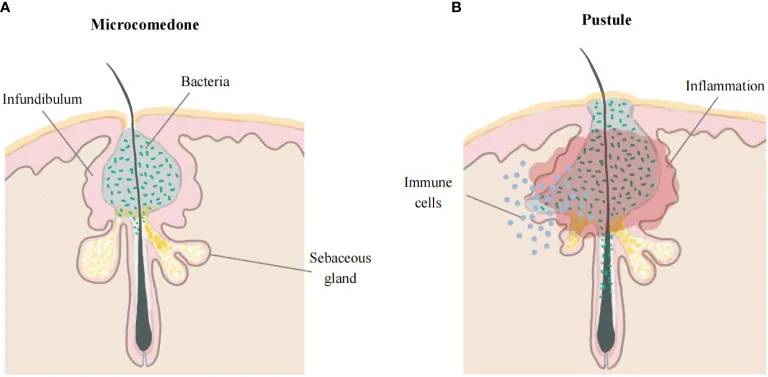
Every spot starts as a tiny, invisible plug inside the pore, made of oil and dead skin cells. As bacteria multiply in it, the skin calls in immune cells and it becomes a red pustule. A 2024 study illustrates the difference between the two stages:
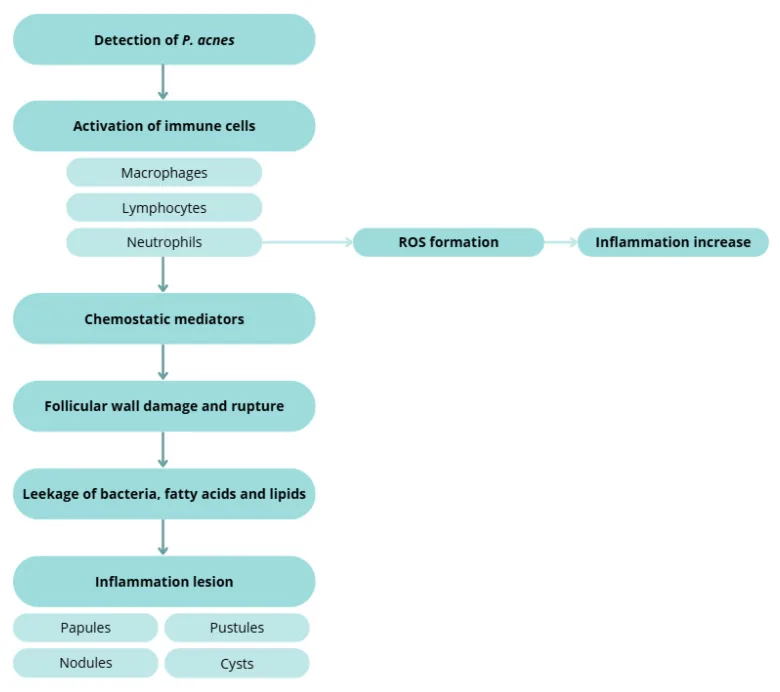
If inflammation intensifies, the pore wall is damaged and ruptures, and bacteria and oil leak into the surrounding skin, producing deeper spots. A 2025 review summarises this sequence:
This is why squeezing makes inflammation worse: pressure from outside tears the pore wall from inside, pushing its contents deeper instead of out. It also explains why inflamed spots can feel sore before anything is visible on the surface; the reaction is happening below.
Types of inflamed spot
| Type | What it looks like | What it needs |
|---|---|---|
| Papule | A small red bump with no head | Topical treatment |
| Pustule | A spot with a white or yellow head | Topical treatment; don't squeeze |
| Nodule | A firm, painful lump under the skin | A dermatologist |
| Cyst | A soft, deep, painful lump | A dermatologist |
A few papules and pustules usually respond to topical treatment. Nodules and cysts are the most likely to scar, and creams alone don't help them. Many people have a mixture of types at once, alongside blackheads and whiteheads, and treatment is chosen for the most severe type present.
How to calm an inflamed spot
- A clean warm compress for a few minutes eases pain.
- A hydrocolloid spot patch protects the spot from touching and absorbs fluid.
- Benzoyl peroxide at a low strength on the spot reduces bacteria, and bacteria don't develop resistance to it. Read more in benzoyl peroxide for acne.
- A gentle cleanser instead of scrubbing and harsh exfoliants.
Avoid toothpaste, lemon and alcohol on the spot; they irritate the skin and increase redness. Benzoyl peroxide can be drying at first and bleaches fabrics, so start with a low strength and use white pillowcases and towels. Over-the-counter creams are compared in the best acne ointments.
flowchart TD
  A[A red, inflamed spot] --> B{Deep and very painful, or many spots?}
  B -->|Yes| C[Dermatologist - prescription treatment]
  B -->|No| D[Warm compress and spot patch]
  D --> E[Low-strength benzoyl peroxide]
  E --> F{Improved after several weeks?}
  F -->|No| C
  F -->|Yes| G[Continue a gentle routine]
What makes inflamed acne worse?
Some everyday habits increase inflamed spots without you noticing. Touching your face and resting your chin on your hand, and friction from a face mask, a tight headscarf or a phone against the skin, all press on pores and carry dirt into them. Heavy cosmetics and oils on the face or hair can block pores, so choose products labelled non-comedogenic, and remove make-up before bed.
Hormones play a clear role for many women, increasing inflamed spots on the chin and jawline before a period. Stress and poor sleep may go along with worse flares in some people. No single food causes acne in everyone, but if you notice a consistent pattern with a particular food, discuss it with your dermatologist rather than starting a strict diet.
Why not squeeze?
Squeezing prolongs the life of a spot and raises the chance of a dark mark that lasts weeks or months afterwards, especially in darker skin, and it can leave a permanent scar. Spots around the nose and upper lip need extra caution. I explain this in detail in popping pimples.
If a pustule has come to a head and opened on its own, keep it clean and covered with a patch rather than pressing it further. Picking at the scab that follows also increases the chance of a mark. Covering a healing spot with make-up is fine if the product is non-comedogenic and removed gently at night, but avoid pressing or rubbing it while applying, and keep brushes and sponges clean so they don't carry bacteria back to the skin.
When you need prescription treatment
If inflamed spots are numerous, recurrent or deep, a dermatologist may prescribe a stronger topical treatment, and may add an oral antibiotic for a limited time, hormonal treatment for some women, or isotretinoin for severe cases. In a 2025 case series of patients with severe inflammatory acne, inflamed spots receded gradually over months of medical treatment, with some scarring remaining:
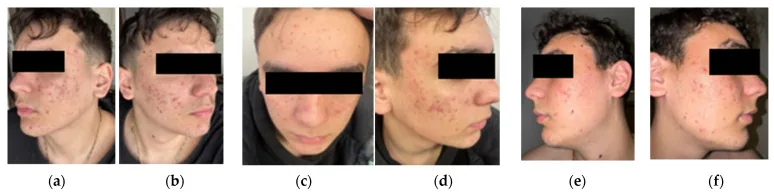
These are severe cases, not a rule for everyone, but they show that improvement takes time and that scars formed before treatment don't disappear with it. That's why early treatment helps. If you're prescribed an oral antibiotic, read about Tetralysal side effects. Once spots have settled, any dark marks or scars left behind are a separate problem with their own options, covered in treating acne marks and scars.
mindmap
  root((Inflamed acne))
    Cause
      Blocked pore
      Bacteria
      Immune response
    Calming it
      Warm compress
      Spot patch
      Benzoyl peroxide
    Avoid
      Squeezing
      Toothpaste
      Scrubbing
Frequently asked questions
Why do spots become inflamed?
A spot starts as a pore blocked with oil and dead skin cells, in which acne bacteria multiply, and the immune system responds by sending its cells to the area. That immune response causes the redness, swelling and pain, and if the pore wall ruptures, inflammation spreads deeper into the skin.
How can I calm an inflamed spot quickly?
A clean warm compress for a few minutes soothes a painful spot, and hydrocolloid spot patches protect it from touching. A low-strength benzoyl peroxide product can be applied to the spot. Most importantly, don't squeeze it, because squeezing pushes inflammation deeper and raises the risk of scarring and dark marks.
Should I squeeze an inflamed spot?
No. Squeezing tears the pore wall from inside and pushes bacteria and oil deeper, so inflammation lasts longer and dark marks and scars become more likely. A deep, very painful spot needs assessment by a dermatologist.
When does inflamed acne need a doctor?
When spots are deep and painful or numerous, leave scars or dark marks, or haven't improved after several weeks of appropriate home care. Moderate and severe inflamed acne needs prescription treatment to prevent permanent scarring.
When to see a clinician
See a dermatologist if deep, painful nodules or cysts appear, if spots start leaving scars or dark marks, if they haven't improved after several weeks of home care, or if they come with signs such as irregular periods and increased hair growth. Seek urgent care if hot, painful redness spreads around a spot and you have a fever.
Related articles
Further reading
- Acne: Diagnosis and treatment — American Academy of Dermatology
- Rebalancing the Skin: The Microbiome, Acne Pathogenesis, and the Future of Natural and Synthetic Therapies — Molecules
- Association of different cell types and inflammation in early acne vulgaris — Frontiers in Immunology
Medical disclaimer: This article is for health education only and is not a substitute for professional medical advice. If you have a skin condition that concerns you, please consult a dermatologist.