

Neck wrinkles come in two different kinds: horizontal lines that circle the neck like a necklace, and vertical bands that stand out from the neck muscle as it loosens. Horizontal lines can appear early because the skin folds in the same places, and the sun deepens them; vertical bands usually come with age. Each has its own tool: sunscreen and a retinoid for the skin, injections and devices for deeper lines, and the toxin for bands.
The Arabic pages that rank for this search list the general causes of wrinkles and recommend massage and natural remedies, without separating the two types or showing what the studies say about neck treatments. This article explains both types with pictures and puts each treatment in its place.
Type one: vertical bands from the neck muscle
Under the skin of the neck lies a thin, broad muscle, the platysma, that runs from the chest up to the jaw and the corner of the mouth. With age this muscle loosens and its front edges stand out as two vertical bands, most visible when you tense your neck or talk. The figure from a 2022 review shows the muscle and the bands it forms:
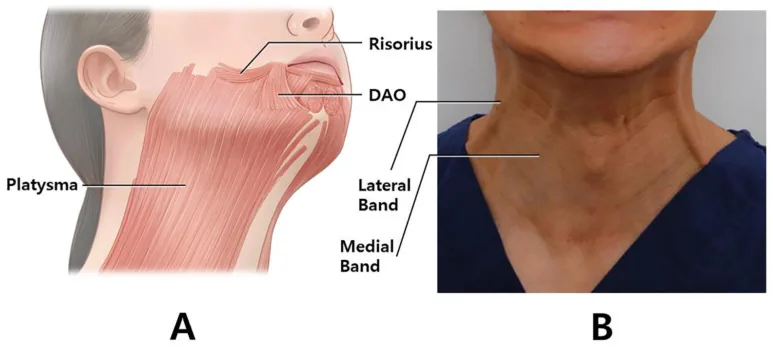
These bands are a muscle problem, not a skin problem, so no cream softens them. The toxin relaxes them temporarily in clinic, and severe cases with loose skin need a surgical assessment.
Type two: horizontal lines
Horizontal lines circle the neck and can appear in your twenties and thirties. They form because neck skin folds in the same places every time you lower your head, and over time declining collagen and the sun, which reaches the neck often without protection, set them in. The figure from a 2026 study shows these lines before and after radiofrequency treatment:
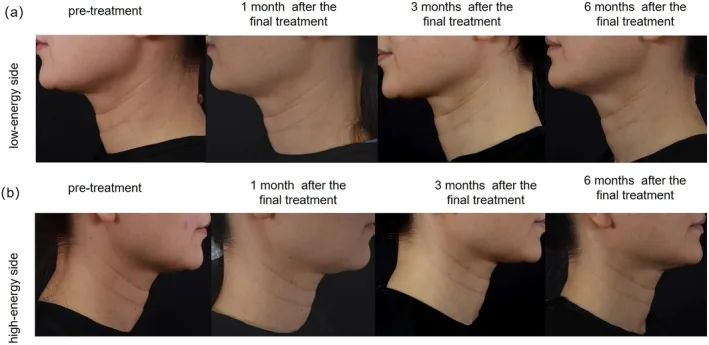
In this study of seventeen participants, each side of the neck was treated at a different energy level. Lines improved on both sides with no clear difference between them, and pain was lower with low energy. It is a small study with no untreated group, but it shows what the lines look like and the limits of improvement.
Some horizontal lines are partly structural rather than damage. A natural crease sits where the skin folds most, and in some people it is visible even in childhood. That is worth knowing before you spend money trying to erase a line that has always been part of your neck.
Why do neck wrinkles appear early?
- Sun: many people put sunscreen on their face and stop at the jaw, so the neck takes the same damage unprotected.
- Repeated folding: lowering your head folds the skin in the same places; there are no strong studies showing that phones alone cause wrinkles.
- Genetics and neck shape: some necks carry horizontal lines from youth.
- Smoking and weight change: weaken collagen, then stretch and loosen the skin.
The two types compared
| Horizontal lines | Vertical bands | |
|---|---|---|
| Look | Lines circling the neck | Two vertical bands at the front |
| Cause | Skin folding, sun and collagen loss | Loosening of the neck muscle |
| When they appear | Can appear early | Usually with age |
| What helps at home | Sunscreen, retinoid and moisturiser | Nothing relaxes the muscle |
| In clinic | Hyaluronic acid injections and devices | The toxin or a surgical assessment |
flowchart TD
  A[Wrinkles on the neck] --> B{Lines circling the neck?}
  B -->|Yes| C{Fine?}
  B -->|No: two vertical bands| D[Muscle laxity - the toxin or surgical assessment]
  C -->|Yes| E[Sunscreen, retinoid and moisturiser]
  C -->|No: deep| F[Injections or devices in clinic]
In-clinic treatments for horizontal lines
In a 2026 randomised trial of 156 participants, injections of two hyaluronic acid products improved moderate to severe horizontal lines at four weeks, with no meaningful difference between the products. "Skin boosters", which distribute hyaluronic acid through the dermis to improve skin quality, are also used:
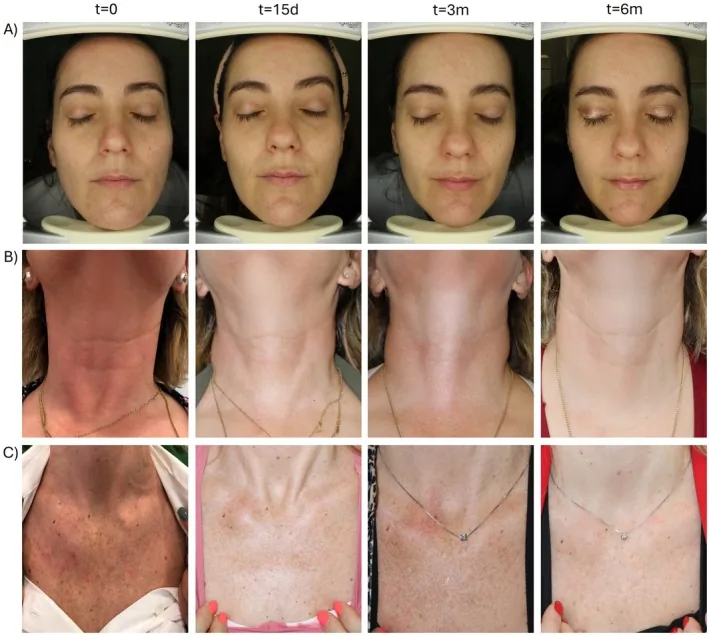
The skin booster study had no comparison group, some of its authors work for the company that sells the product, and lighting differs between the photographs, so read it as an example of what the treatment looks like rather than as evidence of how large the effect is. Your clinician chooses between injections and devices based on the depth of the lines and your skin tone.
It's also worth knowing that neck skin is thinner and heals differently from facial skin, so settings and techniques used on the face are not simply transferred to the neck. That is one more reason to have neck treatments done by someone who treats necks regularly.
Daily care for the neck
- Extend sunscreen to your neck every morning; it is the most important step.
- Introduce a retinoid gradually: neck skin irritates faster than facial skin, so start with a small amount on nights spaced apart.
- A good moisturiser makes fine lines less noticeable.
- No need for a special "neck cream": the ingredient matters more than the label; see best serum for wrinkles.
There's no good evidence that massage or neck exercises soften the lines, pleasant as they may be.
Frequently asked questions
What causes early neck wrinkles?
Horizontal lines can appear at a young age because neck skin folds in the same places with every movement, and they are made worse by unprotected sun, genetics, smoking and weight change. Vertical bands usually appear with age, as the neck muscle loosens and its edges stand out.
What is the best cream for neck wrinkles?
No neck-specific cream is necessarily better than any other. What helps is the ingredient: a retinoid at night, introduced gradually because neck skin irritates easily, a good moisturiser, and daily sunscreen extended to the neck. These improve skin quality and fine lines, but they don't remove deep lines.
Does using a phone cause neck wrinkles?
Repeatedly looking down folds the neck skin in the same places, which may make horizontal lines more noticeable. But there are no strong studies showing that phones alone cause neck wrinkles, and sun, age and genetics have clearer effects.
Can neck wrinkles be treated permanently?
There is no permanent treatment, because skin keeps ageing. In-clinic options such as hyaluronic acid injections and radiofrequency improve lines for months, the toxin relaxes vertical bands temporarily, and significant laxity needs a surgical assessment.
When to see a clinician
See a dermatologist if your neck lines are deep and bother you and you want to know which option suits them, or if clear vertical bands have appeared with sagging. See one too if new dark patches or thick, velvety skin appear on your neck, or you notice a lump under the skin or swelling in the neck: these aren't wrinkles and need examining.
Related articles
- Causes of a sagging face
- Best serum for wrinkles
- How to reduce wrinkles
- Chin wrinkles
- What causes darkening of the face and neck
Further reading
- How to Effectively Get Rid of Neck Lines — Dr Sophie Shotter
- Efficacy and Safety of Sodium Hyaluronate Injection for Moderate-To-Severe Neck Wrinkles — Journal of Cosmetic Dermatology
- Anatomical Proposal for Botulinum Neurotoxin Injection Targeting the Platysma Muscle — Toxins
Medical disclaimer: This article is for health education only and is not a substitute for professional medical advice. If you have a skin condition that concerns you, please consult a dermatologist.