
Small white bumps under the eyes are usually milia: tiny cysts filled with keratin, the protein that makes up the skin's outer layer, trapped just beneath the surface with no opening. That's why squeezing them doesn't work and why they don't respond to exfoliants the way whiteheads do. They're harmless and may clear with time, and if they bother you, removing them with a sterile needle in clinic is a simple procedure. But not every pale bump around the eye is milia, which is why it's worth having them looked at.
The Arabic pages that rank for this search list home remedies, from steam and rose water to manuka honey, but they don't explain why squeezing fails, they don't mention what can look like milia around the eye, such as xanthelasma and sebaceous hyperplasia, and they don't point out that some milia are secondary, appearing after a cream, a procedure or a medicine. This article fills those gaps.
What are milia and why do they appear under the eyes?
Your skin renews itself constantly: new cells rise to the surface and old ones shed without you noticing. When keratin gets trapped under the surface instead of shedding, it collects in a small, pearly white cyst about the size of a pinhead. That is a milium, and a cluster of them is milia. They're most common around the eyes, on the eyelids, cheeks and nose, where the skin is thinnest.
There are two broad kinds:
- Primary milia appear on their own with no obvious trigger. They're very common in newborns and also appear in teenagers and adults.
- Secondary milia appear after something has damaged the skin, such as burns or blistering, deep peels or laser resurfacing, long-term use of steroid creams, and occasionally certain medicines.
One example of secondary milia is described in a case report of milia that erupted during oral acne treatment, with many small white bumps around the eyes and temples:
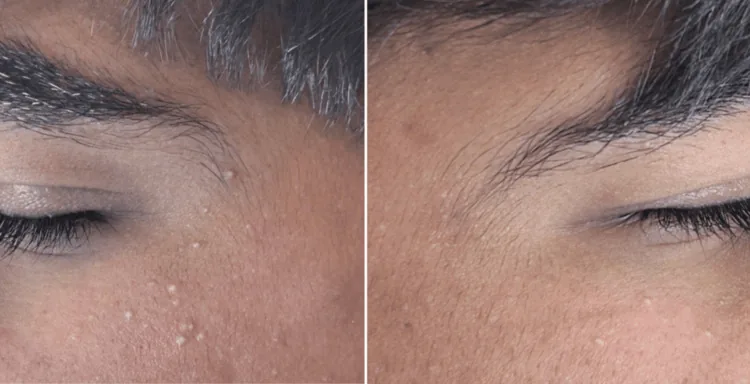
The report describes this as a rare side effect, so it doesn't mean the medicine causes milia in everyone. The useful lesson is that milia which appear suddenly and in large numbers are worth a question about what changed recently: a new cream, a procedure or a medicine.
Milia are also not a sign of poor hygiene. They aren't caused by dirt, and washing more often won't prevent them. Nor are they acne: there's no inflammation, no bacteria involved and no hormonal pattern, which is why acne treatments aimed at oil and bacteria do little for them.
Why squeezing milia under the eyes doesn't work
An ordinary whitehead is a blockage inside a pore that has an opening; a milium is a closed cyst under a thin layer of skin. When you press on it, the keratin has nowhere to go, so the surrounding skin is squeezed and inflamed instead. The thin skin under the eye can tear or be left with a dark mark, especially in olive and brown skin. Grainy scrubs don't reach the cyst either; they just irritate the area around it.
Exfoliating acids and retinoids can help renew the skin's surface, but the skin around the eyes is sensitive and may react with redness, flaking and stinging, and these products don't usually clear a cyst that's already there. So don't use them close to the eye unless your doctor suggests it and explains how. The difference between whiteheads and milia is covered in more detail in what causes whiteheads.
This chart shows what tends to happen with each approach:
graph TD
  A[A hard white bump under the eye] --> B{What did you do?}
  B -->|Squeezed it| C[The keratin has no way out]
  C --> D[Inflammation and risk of a mark]
  B -->|Scrubbed it| E[Irritated skin, cyst still there]
  B -->|Left it| F[May clear with time]
  B -->|Removal in clinic| G[Surface opened with a sterile needle]
What else can look like milia around the eyes?
Not every pale bump around the eye is milia, and mix-ups are common because so many pages lump them all together as "white bumps". In consultation we often see women who have spent months on scrubs and eye creams for bumps that were never milia, which is why the first step is always to identify what the bump is:
| Condition | What it looks like | Usual place | What matters |
|---|---|---|---|
| Milia | Pearly white, hard, pinhead-sized | Under the eye, eyelid, cheek | Harmless; removed in clinic |
| Xanthelasma | Flat, soft yellow patches | Inner corner of the eyelid | A doctor may check blood lipids |
| Sebaceous hyperplasia | Yellowish or skin-coloured bump with a central dip | Forehead and cheeks | Common with age and harmless |
| Syringoma | Small skin-coloured or yellowish bumps | Usually the lower eyelid | Can't be emptied with a needle; treated differently |
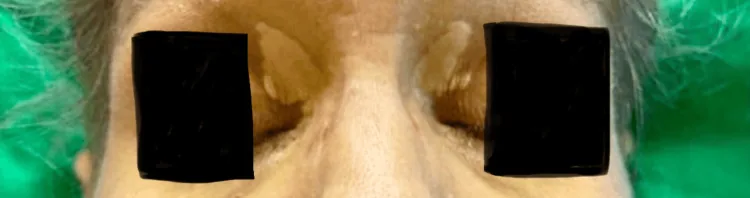
Xanthelasma deserves particular attention, because it is sometimes linked to raised cholesterol, as a case report on xanthelasma and its differential diagnosis explains:
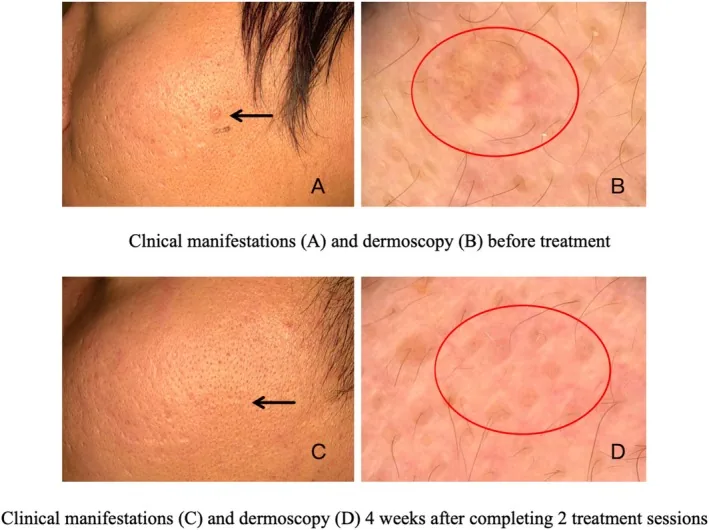
Sebaceous hyperplasia is recognised by the small dip in the middle of each bump, and under a dermatoscope it shows yellowish globules ringed by fine vessels, as in a study of treatment for facial sebaceous hyperplasia:
Syringomas are the look-alike most often mistaken for stubborn milia, because they sit in the same place on the lower eyelids. They come from sweat ducts in the deeper skin, so a needle that would empty a milium finds nothing to release. Other small skin-coloured bumps are covered in skin-coloured bumps on the face.
Milia treatment: what actually works
If they don't bother you, waiting is a perfectly good option, because milia do no harm. Newborn milia usually clear within weeks; in adults, especially under the eyes, they can last for months or longer.
If they do bother you, removal in clinic is the most reliable route. The clinician cleans the skin, opens the surface of each bump with a fine sterile needle and lifts out the keratin. The cyst usually goes in the same session, without stitches, and the tiny opening heals within days. For widespread or stubborn milia, other approaches such as freezing, laser or a prescribed cream may be used, but close to the eye these need extra care, and the choice depends on how many there are and where.
This mind map sums up the options:
mindmap
  root((Milia treatment))
    Waiting
      If they don't bother you
      Newborn milia usually clear
    In clinic
      Opening with a sterile needle
      Freezing or laser for widespread cases
    At home
      Gentle cleanser
      Sunscreen
      Lighter textures near the eyes
    Avoid
      Squeezing
      Grainy scrubs
Don't try to open them with a needle at home, even if you've seen it done in videos. The skin under the eye is thin, the eye itself is close, and sterility at home can't be guaranteed. Home "milia extractors" sold online carry the same problem: they press rather than open, which is exactly what doesn't work.
How to make milia less likely to come back
Milia can return after removal, especially if whatever triggered them is still there. Start by looking at what you put around your eyes. Very rich creams and heavy ointments may contribute to milia in some people, although the evidence for this is not strong; if bumps appear after starting a new product, try stopping it or switching to a lighter texture. Choosing an eye cream by its ingredients rather than its brand is covered in an alternative to Kiehl's eye cream.
Don't use steroid creams on your face without medical supervision. Long-term use thins the skin and can cause milia among other problems, and some unlicensed lightening creams contain a steroid that isn't listed on the jar, as explained in Pakistani whitening creams. Protect the area from the sun, since sun damage thickens and roughens the skin so it sheds less easily. And remove eye make-up gently every day, without rubbing.
If you've had milia after a procedure such as a peel or laser resurfacing, tell the clinician before your next session. Adjusting the aftercare, particularly the heavy occlusive ointments often used while skin heals, can sometimes reduce the chance of them appearing again.
Frequently asked questions
Do milia under the eyes go away on their own?
In newborns, milia usually clear within weeks. In adults, and especially under the eyes, they can last for months or longer, because the skin there is thin and renews slowly. If they don't bother you, it's fine to leave them; if they do, removal in clinic is quick.
How do I get rid of white bumps under my eyes?
The safest way is removal in clinic: the clinician opens the surface of each bump with a fine sterile needle and lifts out the keratin. Don't squeeze them or scrub them, because each one is a closed cyst with no opening, and squeezing injures the thin skin around the eye and can leave a mark.
Can eye cream cause milia?
Very rich creams around the eyes may contribute to milia in some people by slowing the skin's natural shedding, although the evidence for this is not strong. If bumps appear after starting a new cream, try stopping it or switching to a lighter texture.
What is the difference between milia and fatty bumps under the eyes?
Milia are pearly white, very small and hard, like a grain of sand. Flat, soft yellow patches at the inner corner of the eyelid may be xanthelasma, and yellowish bumps with a central dip may be sebaceous hyperplasia. Telling them apart needs an examination.
When to see a clinician
See a dermatologist if bumps appear suddenly and in large numbers, if they're yellow and flat on the eyelid, if any bump grows, changes or bleeds, or if one becomes inflamed after you've tried to squeeze it. See an eye doctor if a bump sits on the edge of the eyelid or inside it, or comes with eye pain, redness or any change in your vision.
Related articles
- What causes whiteheads
- Skin-coloured bumps on the face
- An alternative to Kiehl's eye cream
- Causes of under-eye puffiness
- Pakistani whitening creams
Further reading
- Treating white bumps under the eye — WebTeb
- What to do about milia under the eyes — Arabic Post
- Milia: how to get rid of a white spot on the eyelid — All About Vision
Medical disclaimer: This article is for health education only and is not a substitute for professional medical advice. If you have a skin condition that concerns you, please consult a dermatologist.