Acne on cheeks is usually ordinary acne made worse by friction and pressure: phones, pillowcases, face masks and touching the face. Removing the source of friction is as much part of treatment as any cream. But not every red, bumpy cheek is acne; persistent redness with small bumps and no blackheads may be rosacea, or the effect of steroid creams.
The Arabic pages that rank for this search list general acne causes, and some link where a spot appears to an internal organ. This article reads the cheek pattern specifically, using what the evidence supports.
Why do spots appear on the cheeks in particular?
Cheek skin is less oily than the forehead and nose, but it is the part of the face most exposed to whatever touches it: a phone for hours, a pillowcase every night, a palm when you rest your face on your hand, a mask. That repeated friction and pressure has a medical name, acne mechanica. It doesn't create acne out of nothing, but it worsens blockage and inflammation in someone who is prone to it.
What gives this type away is the distribution. Spots cluster on the side where you hold your phone, the side you sleep on, or under the edge of a mask. It is worth checking for that pattern deliberately for a week or two: which side is worse, whether it changed when your routine changed, whether it improves on holiday when you're on the phone less.
Masks and cheek acne: what did studies find?
In a 2025 study of doctors and medical students who wore medical face masks at work, researchers compared the area between the eyebrows, which a mask doesn't touch, with the junction of cheek and chin beneath its edge:
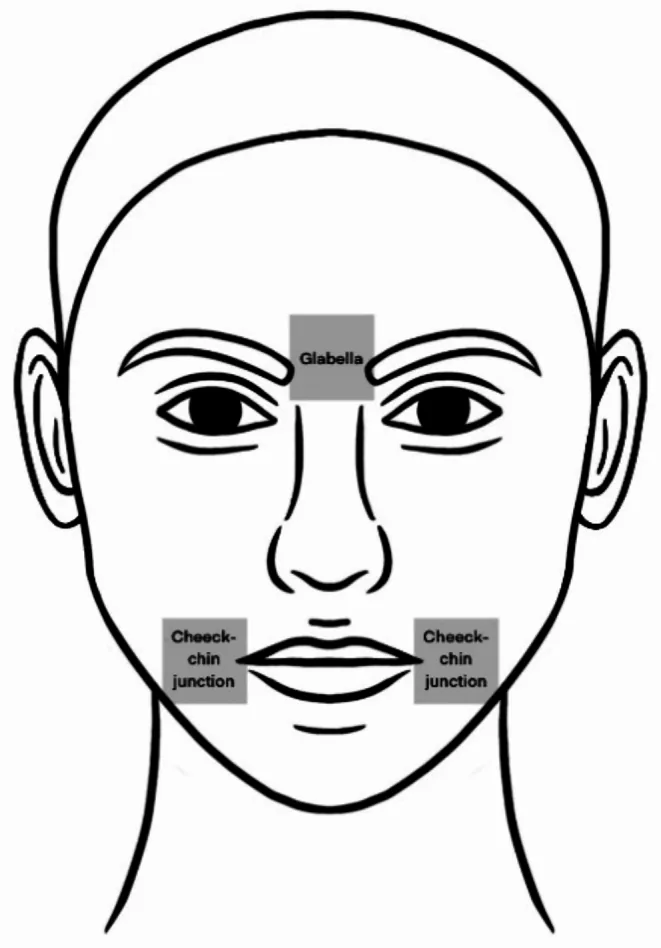
Examination found more inflammatory spots on the cheeks and chin than on the forehead, and microscopic imaging showed more blocked and inflamed follicles under the mask's edge:

The study was small, but its finding matches what we see in clinic: whatever touches the cheek every day shapes its spots. The same logic applies to phones, pillowcases and hands.
Face mapping: is cheek acne linked to the stomach or lungs?
Online "face maps" link cheek spots to the lungs or stomach. There is no scientific evidence for this. Location is explained by what touches the skin, by products, and — for the jaw and chin pattern specifically — by hormones, as covered in hormonal acne. Spots on and around the chin have their own reading, explained in what causes chin acne.
When cheek spots aren't acne
| Acne on the cheek | Rosacea | Steroid effect | |
|---|---|---|---|
| Blackheads and whiteheads | Present | Absent | Usually absent |
| Redness | Only around spots | Diffuse redness and flushing | Persistent redness with burning |
| Fine visible vessels | No | Often | Often |
| What worsens it | Friction, heavy products | Heat, sun, spicy food | Stopping the cream abruptly |
The image below, from a study of steroid-induced redness, shows how cheek skin can look in these conditions: redness, small bumps and visible vessels, without blackheads:
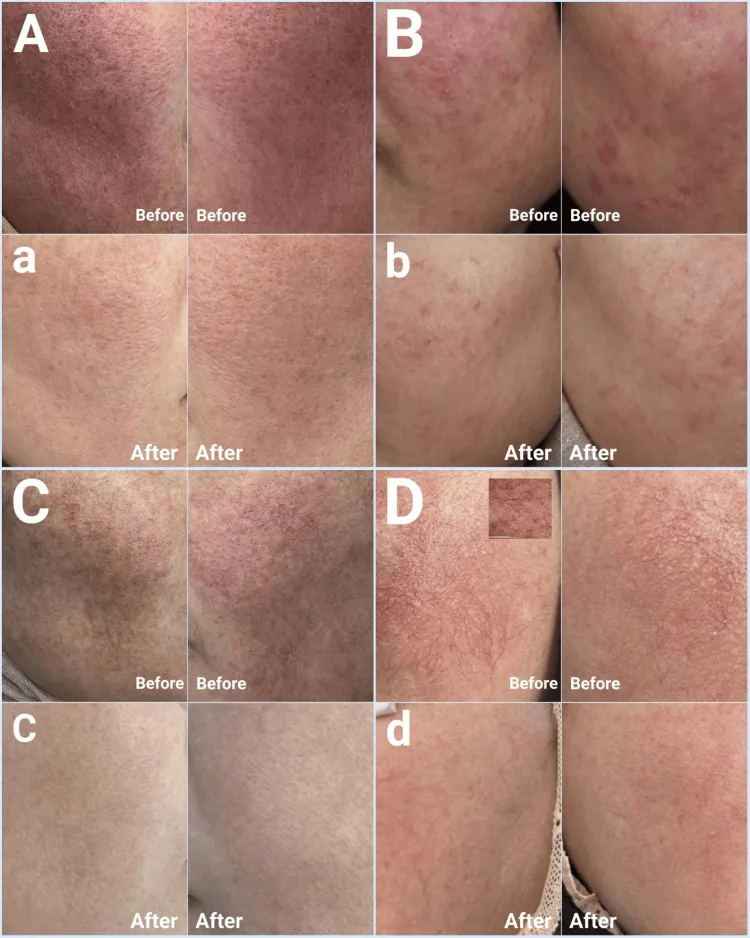
Strong acne treatments can make rosacea worse, which is why persistent redness on the cheeks deserves an assessment before you buy an acne cream.
The flowchart below puts the questions in order:
flowchart TD
  A[Spots on the cheeks] --> B{Blackheads and whiteheads among the spots?}
  B -->|Yes| C{Clustered on the phone side, pillow side or under a mask?}
  C -->|Yes| D[Friction acne - remove the source plus a topical treatment]
  C -->|No| E[Acne - a treatment plan and a gentle routine]
  B -->|No| F{Diffuse redness, fine vessels and burning?}
  F -->|Yes| G[Possible rosacea or steroid effect - assessment before any treatment]
  F -->|No| H[Diagnosis in clinic]
Cheek acne treatment: start with what touches it
- Clean your phone screen regularly, and use earphones for long calls.
- Change your pillowcase often, and sleep on the less affected side if you can.
- Keep your hands off your face, especially resting your cheek on your palm while working.
- Choose a well-fitting mask and change it when it gets damp.
- Review your products: a heavy foundation, a cream blush, or facial oils.
Make-up deserves its own mention, because the cheeks are where most of it goes. Cream blushers, heavy foundations and setting balms sit on exactly the skin that also takes the phone and the pillow, and brushes that aren't washed carry oil and old product back onto it every morning. You don't need to stop wearing make-up; you need lighter, non-comedogenic formulas, clean brushes and sponges, and a gentle but thorough cleanse at night so nothing stays on overnight.
Then comes topical treatment matched to the spots: benzoyl peroxide for red spots, as in benzoyl peroxide for acne, or a retinoid for blockage, as in Epiduo gel.
Give the changes time. Spots you see today started forming in the pore weeks ago, so removing a trigger won't show on the skin straight away; judge the difference after several weeks, not several days. If the spots on one side clearly settle while the other side doesn't, that tells you something useful about what was driving them.
Frequently asked questions
What causes acne on the cheeks?
Most of it is ordinary acne made worse by friction and pressure: a phone held against the cheek, sleeping on a dirty pillowcase, a face mask, and touching the face. Heavy products can contribute. Persistent redness with small bumps and no blackheads may instead be rosacea or the effect of steroid creams.
Is acne on the cheeks linked to the stomach or lungs?
There is no scientific evidence for a face 'map' linking where spots appear to a particular internal organ. Cheek spots are usually explained by friction, products and skin type, while spots along the jaw and chin may have a hormonal component.
How do I get rid of cheek acne fast?
There is no one-day fix, but removing the source of friction makes a difference within weeks: cleaning your phone, changing your pillowcase regularly, keeping your hands off your face, plus a well-studied topical treatment such as benzoyl peroxide or a retinoid depending on the spots.
Can a face mask cause cheek acne?
Yes, friction and humidity under a mask increase spots on the cheeks and chin, and a study of healthcare workers wearing medical masks found more inflammatory spots in the cheek and chin area than on the forehead.
When to see a clinician
See a dermatologist if your cheeks are persistently red with burning or fine visible vessels; if you have used a steroid-containing cream on your face; if the spots are deep and painful or leaving marks and scars; or if they haven't improved after several weeks of removing friction sources and using a suitable topical treatment. For the causes of facial spots more broadly, read what causes spots on the face.
Related articles
- What causes spots on the face
- What causes chin acne
- Hormonal acne
- Benzoyl peroxide for acne
- Bacterial pimples
Further reading
- Acne On Cheeks — Eucerin UK
- Acne on Cheeks: Causes, Treatment, and Prevention Tips — Apollo 247
- What causes acne on your cheeks — Tiege Hanley
Medical disclaimer: This article is for health education only and is not a substitute for professional medical advice. If you have a skin condition that concerns you, please consult a dermatologist.