The best serum for acne is one that contains a proven ingredient matched to your type of spots: salicylic acid for blackheads, whiteheads and oily skin, niacinamide for redness and sensitive skin, and azelaic acid for spots and the brown marks they leave. The brand and price matter less than the ingredient, its strength and how well your skin tolerates it. Avocin solution, meanwhile, isn't a cosmetic serum at all: it's a topical antibiotic containing clindamycin.
The Arabic pages that rank for this search are product lists that change every year, and some mix up cosmetic serums with Avocin, which is a medicine. This article helps you choose the right ingredient first, and the product second.
Why the ingredient matters more than the name
Acne has four drivers: blockage, oil, bacteria and inflammation. Each ingredient acts on one or more of them. A 2026 review groups ingredients by what they target:
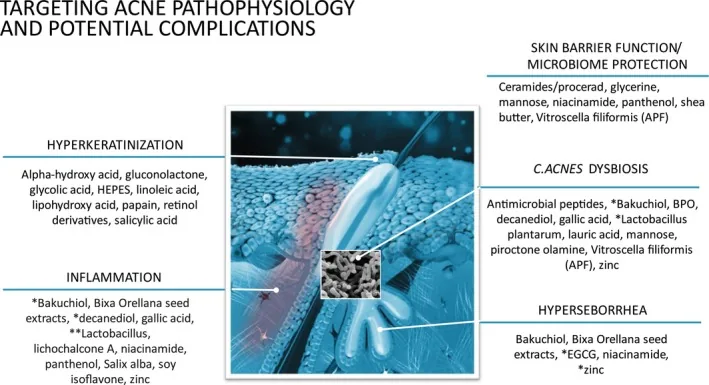
The review's authors consult for skincare companies, but the grouping itself matches what's well established: salicylic acid, other acids and retinol act on blockage; niacinamide and zinc act on inflammation and oil. Choose according to what dominates your skin. If you mostly get blackheads, an anti-inflammatory serum won't do much; if you mostly get red, tender spots, a pore-clearing acid alone may not be enough.
The best-studied serum ingredients
| Ingredient | Suits | Note |
|---|---|---|
| Salicylic acid | Blackheads, whiteheads, oily skin | Can be drying |
| Niacinamide | Redness, sensitive and oily skin | Usually gentle |
| Azelaic acid | Spots and brown marks | Suits darker skin |
| Retinol | Blockage and texture | Needs gradual introduction; drying |
| Vitamin C | Brown marks and radiance | Not an acne treatment |
| Hyaluronic acid | Hydration | Doesn't treat spots |
Salicylic acid: for blackheads and oily skin
Salicylic acid is oil-soluble, so it gets into pores and loosens blockages. In a 2025 Chinese study of forty-two people with mild to moderate acne, severity improved gradually over twenty-one days with a salicylic acid gel, and oil levels fell:
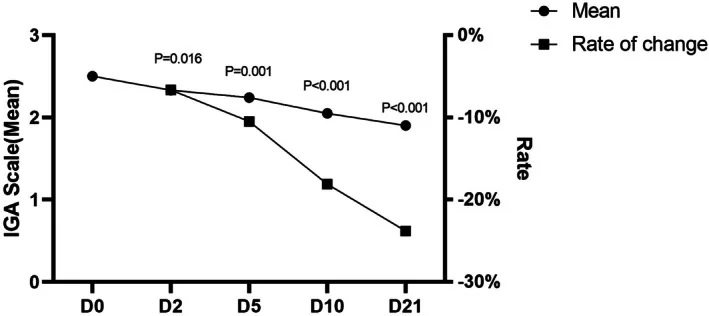
The study was short and had no comparison group, but it fits with salicylic acid being one of the most useful non-prescription ingredients for mild acne. It can dry and sting at first, so start with one application a day and see how your skin responds.
Niacinamide: for redness and sensitive skin
Niacinamide, a form of vitamin B3, calms inflammation, helps regulate oil and supports the skin barrier, and it's tolerated by most skin types. That makes it a sensible first serum for people whose spots come with redness, or whose skin reacts to acids and retinoids. Its effect on spots is milder than prescription treatments, so it's best seen as a supporting ingredient for mild acne or as a companion to a stronger treatment, not a replacement for one. Higher strengths aren't necessarily better; some people find very concentrated niacinamide serums cause flushing or stinging.
Azelaic acid: for spots and marks together
Azelaic acid reduces blockage and inflammation, has some antibacterial action, and also lightens brown marks, which makes it particularly useful in olive and brown skin where marks often bother people more than the spots. It's available in lower strengths in cosmetic products and higher strengths on prescription. It can tingle for the first week or two, which usually settles; persistent burning is a reason to stop.
A serum for acne marks
The brown marks spots leave, especially in olive and brown skin, need an ingredient that reduces pigment plus daily sunscreen. Azelaic acid and niacinamide are gentle options that address both spots and marks; vitamin C can help radiance but doesn't treat spots themselves. More important than any serum is preventing new spots, because every new inflamed spot leaves a new mark. Pitted scars, though, aren't filled by any serum and need in-clinic treatments.
Ordering your routine with a serum
A simple order makes a serum more useful and less irritating. In the evening: a gentle cleanser, then the serum on dry skin, then a light non-comedogenic moisturiser. In the morning: cleanser, moisturiser, then broad-spectrum sunscreen. If your dermatologist has prescribed a treatment such as a retinoid or benzoyl peroxide, ask where the serum fits in, or whether you need it at all, because random combining is the commonest cause of irritation.
Don't be swayed by trends
Interest in skincare ingredients follows marketing waves. A 2025 study found that searches for niacinamide, azelaic acid and bakuchiol jumped in recent years as they spread on social media:
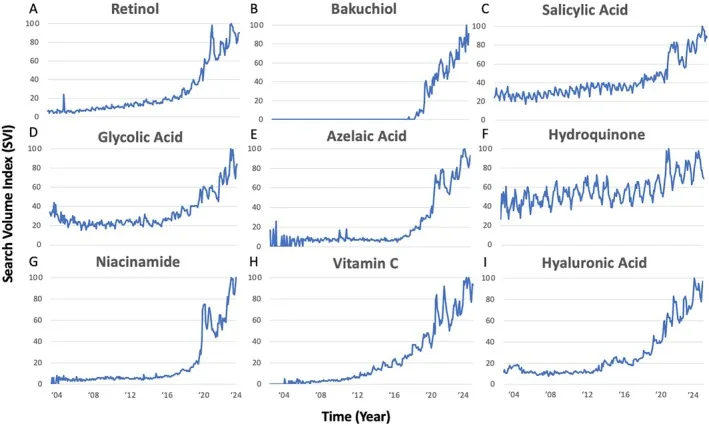
Popularity doesn't mean an ingredient suits you. Bakuchiol, for example, has far less evidence than retinoids, and hyaluronic acid is a moisturiser, not an acne treatment. Before buying a trending serum, read the ingredient list, find the active ingredient and where it sits on the list, and ask whether it targets what actually dominates your spots.
Avocin solution: an antibiotic, not a serum
Many people search for "Avocin solution" among acne serums, but it's a medicine containing clindamycin, like Derma-T solution. It's used for inflamed acne on prescription, preferably alongside benzoyl peroxide to reduce bacterial resistance, and not on its own for long periods. If your spots are inflamed enough to need it, a topical retinoid such as Sure Cure gel under a dermatologist's guidance may be the better foundation.
flowchart TD
  A[Looking for an acne serum] --> B{Blackheads and oily skin?}
  B -->|Yes| C[Salicylic acid]
  B -->|No| D{Redness and sensitive skin?}
  D -->|Yes| E[Niacinamide]
  D -->|No| F{Brown marks after spots?}
  F -->|Yes| G[Azelaic acid]
  F -->|No| H{Deep inflamed spots?}
  H -->|Yes| I[See a dermatologist - medical treatment]
Using a serum safely
Start with one product on clean, dry skin, and follow with moisturiser, and sunscreen in the morning. Don't combine salicylic acid, retinol and other acids without advice, and give a product several weeks before you judge it. If marked stinging, redness or peeling appears, cut back or stop. The American Academy of Dermatology's acne treatment guide makes the same point about patience: most acne treatments need weeks of consistent use before results show.
mindmap
  root((Acne serum))
    For blockage
      Salicylic acid
      Retinol
    For inflammation
      Niacinamide
      Azelaic acid
    Not a treatment
      Hyaluronic acid
      Vitamin C
    Avocin
      Antibiotic
      Prescription
Frequently asked questions
What is the best serum for acne?
There's no single best serum for everyone. For blackheads, whiteheads and oily skin, salicylic acid suits; for redness and sensitive skin, niacinamide; for brown marks, azelaic acid. What matters is that it contains a proven ingredient and that your skin tolerates it.
Is Avocin solution an acne serum?
No. Avocin is a topical solution whose active ingredient is clindamycin, an antibiotic. It's used for inflamed acne on prescription, preferably alongside benzoyl peroxide to reduce bacterial resistance, and not on its own for long periods.
Is a serum enough to treat acne?
It may be enough for mild spots and blackheads. Moderate, deep or scarring inflamed acne needs medical treatment, and a serum may be a supporting step alongside it.
Can I use more than one acne serum together?
Combining several strong serums such as acids and retinoids without advice isn't recommended, because it irritates the skin and can worsen marks. Start with one product and add another after several weeks if you need to.
When to see a clinician
See a dermatologist if your spots are deep, painful or numerous, if they leave dark marks or pits, if they haven't improved after several weeks of a suitable serum, or if any product causes severe irritation. See one before using an antibiotic solution such as Avocin.
Related articles
Further reading
- Acne: Diagnosis and treatment — American Academy of Dermatology
- Integrating Dermocosmetics Into Acne Care in Latin America — Journal of Cosmetic Dermatology
- Clinical Efficacy of a Salicylic Acid-Containing Gel on Acne Management and Skin Barrier Function — Journal of Cosmetic Dermatology
Medical disclaimer: This article is for health education only and is not a substitute for professional medical advice. If you have a skin condition that concerns you, please consult a dermatologist.