Honey isn't a treatment for acne: in a randomised trial of one hundred and thirty-six people, a medical honey product with glycerine didn't improve acne more than soap alone. Honey does have antibacterial activity in the lab, and it's a gentle moisturiser that can soothe skin dried out by acne treatments. But relying on it to treat spots delays the treatment that prevents marks and scarring.
The Arabic pages that rank for this search say that manuka honey with glycerine is "more effective than antibacterial soap", which is the opposite of what the original trial found. This article sets out what the studies actually show, and where honey has a sensible place in your routine.
How acne forms, and where honey is supposed to act
Acne has four main drivers: excess oil, blockage of the follicle opening by dead cells, overgrowth of acne bacteria, and inflammation. A 2026 review summarises them:
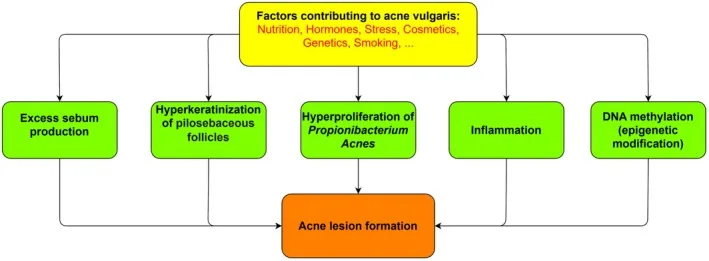
Honey is supposed to act on only two of these drivers: bacteria and inflammation. It doesn't reduce oil or clear blockages, which is what proven ingredients such as retinoids and salicylic acid do. So even if it has some antibacterial effect, it doesn't address the root of the problem.
That matters because acne treatment works best when it targets several drivers at once. A product that only nudges one of them, at best, is unlikely to make a visible difference on its own.
What did the randomised trial find?
In a 2016 randomised trial in New Zealand, every participant washed with an antibacterial soap twice a day for twelve weeks, and half of them also applied a medical-grade kanuka honey product with glycerine. The researchers found no evidence that adding the honey improved acne, and very few participants in either group improved substantially.
This trial is probably the source of the widely shared claim that manuka honey is "better than soap", but its actual result was negative. Medical-grade kanuka honey is sterile and standardised, so if it didn't help, it's unlikely that kitchen honey would do better. The trial is also a useful reminder to check original studies rather than repeating headlines about them.
What about the lab research?
In the lab, bee products do show activity against skin bacteria. In a 2025 laboratory study, propolis was stronger than honey, and activity increased markedly when a low level of salicylic acid was added:
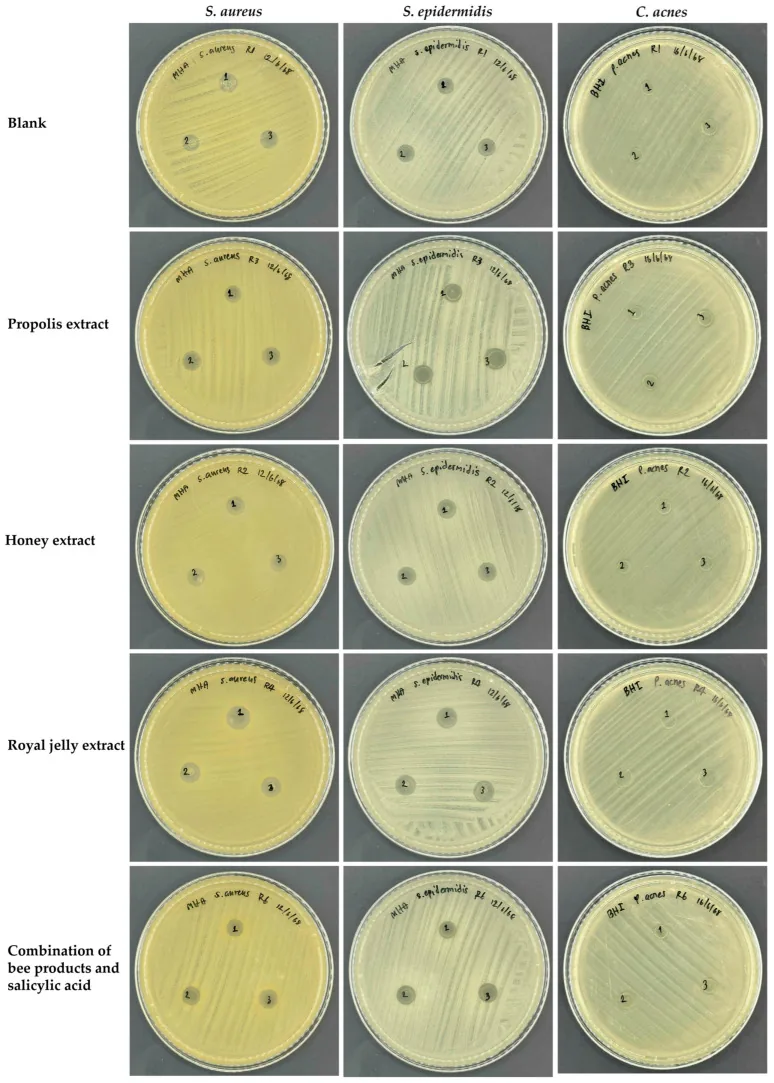
Activity in a lab dish doesn't mean improvement on the face. The concentration, how long it stays on the skin, and whether it reaches inside the follicle all differ. Notice, too, that the strongest result came with salicylic acid, a proven treatment that's available on its own.
Manuka, kanuka, raw: does the type matter?
Manuka and kanuka honeys come from related New Zealand plants and are the ones most often studied in medicine, mainly for wound care. Medical-grade honey is filtered, sterilised and tested so that its activity is consistent; kitchen honey and "raw" honey are not, and can vary widely from jar to jar. That standardisation is why wound dressings use medical-grade honey rather than supermarket honey. For acne, though, the type hasn't been shown to make a difference: the one randomised trial used medical-grade kanuka honey and still found no benefit. Paying more for a premium jar to put on your spots buys a nicer jar, not a better treatment.
Honey and the wave of "natural" remedies
The same review looked at herbal acne remedies promoted on social media and found that some had never been tested in a clinical trial, and that some of those tested showed no benefit:
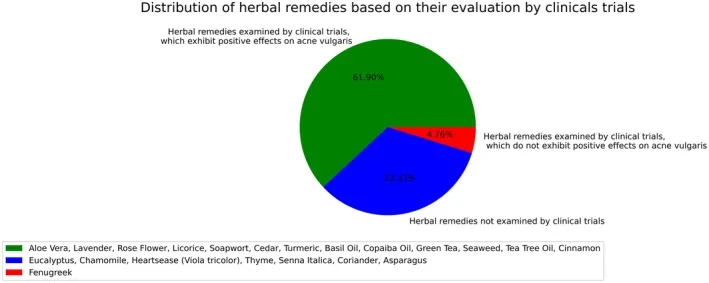
The authors conclude that digital platforms have promoted several acne remedies that haven't been scientifically verified. Common herbs and masks are compared in herbs for acne.
When does honey have a place?
| Use | Does it help? | Note |
|---|---|---|
| Treating acne | No good evidence | The randomised trial was negative |
| Moisturising skin dried by acne treatment | May soothe | Short mask, then rinse |
| Brown marks left by spots | No evidence | Sunscreen and a studied lightener |
| Mixed with cinnamon or lemon | May harm | Irritation and allergy |
| Minor wounds | Sterile medical honey only | Not kitchen honey |
flowchart TD
  A[Considering honey for acne] --> B{Inflamed or recurring spots?}
  B -->|Yes| C[Proven treatment: salicylic acid, benzoyl peroxide or a retinoid]
  B -->|No| D{Skin dried out by acne treatment?}
  D -->|Yes| E[A short honey mask may soothe - after a patch test]
  D -->|No| F[No need for it]
  C --> G{No improvement after several weeks?}
  G -->|Yes| H[See a dermatologist]
What actually treats acne?
The treatments with strong evidence act on the four drivers. Topical retinoids prevent blockages, salicylic acid dissolves oil inside pores, benzoyl peroxide reduces bacteria without bacteria becoming resistant to it, and azelaic acid calms inflammation and fades brown marks. Moderate and severe acne have medical treatments that a dermatologist decides on. These treatments are slow too, and need several weeks of regular use before you judge them, but they've been studied in many clinical trials, unlike honey. The American Academy of Dermatology's tips for managing acne stress giving a treatment time to work and not scrubbing the skin.
If you want to try a honey mask
Use plain honey on its own, patch test it first on a small area near your ear, then apply a thin layer to a clean face for a few minutes and rinse with lukewarm water. Don't add cinnamon, lemon or essential oils, and don't apply it to skin that's cracked from a strong treatment without asking your dermatologist. Avoid it if you're allergic to bee products. Think of it as a comfort step, not a treatment, and keep your actual acne treatment going alongside it.
mindmap
  root((Honey and acne))
    The evidence
      Negative randomised trial
      Lab activity only
    May help
      Gentle moisturising
    May harm
      Cinnamon and lemon
      Bee allergy
    Actual treatment
      Salicylic acid
      Benzoyl peroxide
      Retinoid
Frequently asked questions
Does honey treat acne?
There's no good evidence that it does. In a randomised trial of one hundred and thirty-six people, a medical honey product with glycerine didn't improve acne more than soap alone. Honey has antibacterial activity in the lab, but that didn't show up as a clear improvement on the face.
So what are the benefits of honey for the face?
Honey is a gentle humectant that draws water into the skin, and it may suit a short mask for skin dried out or irritated by acne treatments. But it isn't a treatment for the spots themselves, and it doesn't replace evidence-based treatment.
Does honey clog pores?
Honey rinses off with water and isn't generally considered pore-clogging when used as a short mask. The bigger problem is mixtures that add oils, lemon or cinnamon, which can irritate the skin or clog pores.
Is a honey and cinnamon mask good for spots?
There's no evidence it helps, and cinnamon can cause irritation or allergy on the face. If you want to use honey, use it on its own and patch test it first on a small area.
When to see a clinician
See a dermatologist if your spots are deep, painful or numerous, if they're starting to leave dark marks or pits, or if they haven't improved after several weeks of regular treatment with proven ingredients. Rinse the mask off straight away and see a doctor if redness, itching or swelling develops after honey or any home mixture.
Related articles
Further reading
- Acne: Tips for managing — American Academy of Dermatology
- Randomised controlled trial of topical kanuka honey for the treatment of acne — BMJ Open
- Medicinal Plants for Acne Vulgaris: An Evidence-Based Review of Treatments Promoted by Social Media — Journal of Cosmetic Dermatology
Medical disclaimer: This article is for health education only and is not a substitute for professional medical advice. If you have a skin condition that concerns you, please consult a dermatologist.