
The right cream for dark underarms depends on the cause, because "dark underarms" can be four different things: the shadow of dark hair under the skin after shaving, pigmentation after inflammation from shaving, deodorant and friction, acanthosis nigricans linked to insulin, or a superficial bacterial infection. The first doesn't need a cream at all but a different way of removing hair, and the last needs an antibiotic rather than a lightener.
The Arabic pages that rank for this search offer recipes with potato, lemon and turmeric, and mention deodorants and shaving as general causes. But they don't separate the types, or mention that some darkening is an infection or a skin condition. This article separates them before any cream is chosen.
Hair shadow: darkening that isn't in the skin
When you shave, part of each dark hair stays below the skin surface, so the underarm looks grey even if the skin itself is light. It's most obvious with thick, dark hair on fair skin. The figure from a 2025 study shows underarms before and after laser hair removal, with the grey shadow disappearing along with the hair:
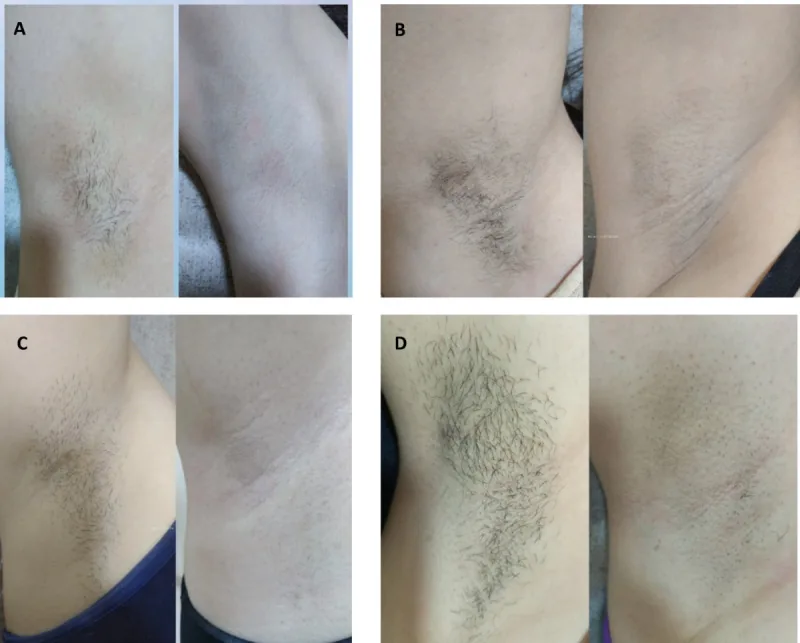
No cream lightens this kind of darkening, because the cause is hair, not pigment. It fades when hair is removed from the root by waxing or laser instead of shaving.
A simple check helps here: look at the underarm a few days after shaving and again just after. If it is darkest right after shaving, when the stubble is shortest and the roots most visible, and the skin between hairs looks normal close up, hair shadow is likely the main factor.
Post-inflammatory pigmentation: shaving, deodorant and friction
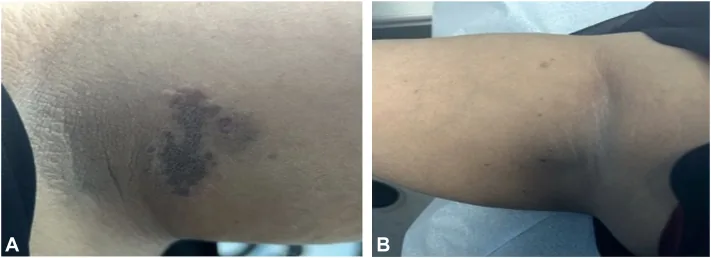
Repeated dry shaving, fragranced deodorants, and friction from tight clothing and sweat all cause mild, repeated inflammation, and inflammation in olive and brown skin leaves pigment behind. Even laser hair removal can occasionally trigger a skin condition that leaves pigmentation, as in a 2026 case where lichen planus pigmentosus appeared in the underarms after laser:
The treatment here is to stop the irritant first: shave with gel and a clean blade or switch to a gentler hair removal method, use a fragrance-free deodorant, and wear loose cotton clothing. Then add a gentle lightener. A 2025 systematic review of treatments for underarm pigmentation found topical ingredients such as niacinamide and fruit acids gave varying degrees of improvement, and Q-switched Nd:YAG laser was the most studied device, with mild side effects in those studies, though the studies were few and small. So a procedure remains a decision after assessment, not a first step.
Acanthosis nigricans: thick, velvety darkening
If the underarm skin is thick, velvety and dark, with similar darkening at the back of the neck, the first possibility is acanthosis nigricans, often linked to insulin resistance, obesity and polycystic ovary syndrome. The figure from a 2015 case shows this texture:
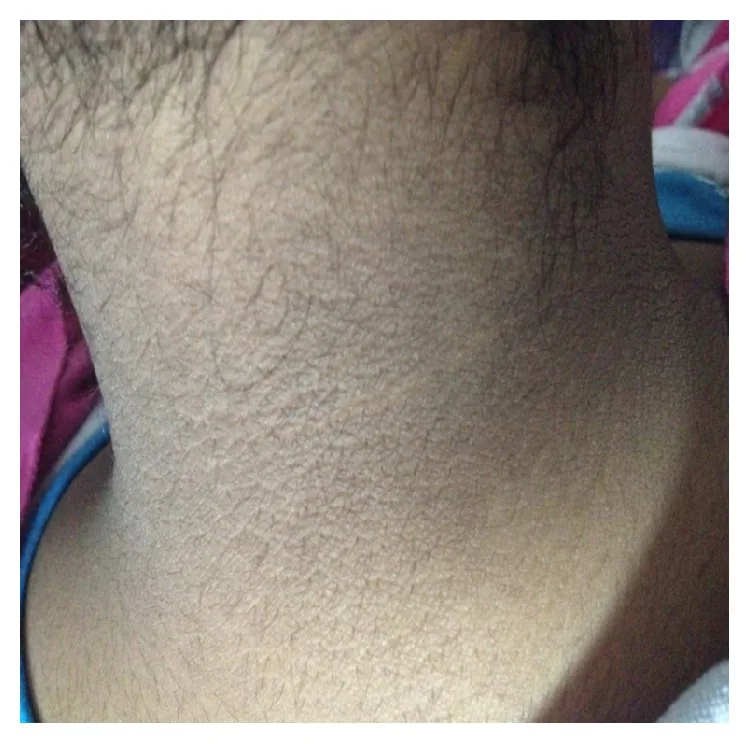
Its treatment starts in the body: blood sugar and hormone tests, improving insulin resistance, then a prescription cream. Details are in dark neck treatment.
Erythrasma: an infection that glows coral-red
Sometimes underarm "darkening", or similar patches under the breasts or between the thighs, is a thin, reddish-brown patch caused by a superficial bacterium, a condition called erythrasma. It looks like a fungal infection or pigmentation, but it glows coral-red under a Wood's lamp in clinic, as in this figure from a 2024 review:
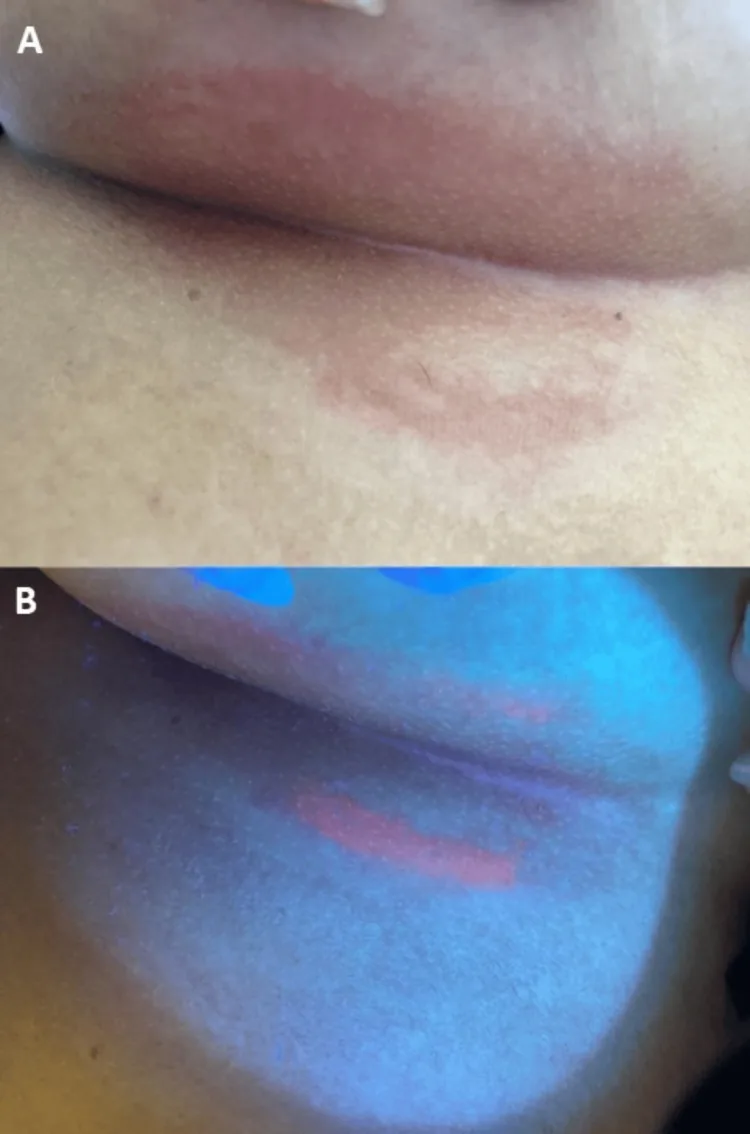
No lightening cream clears this type; it's treated with a topical or oral antibiotic chosen by your dermatologist. It's worth knowing about because it is easily missed, and months of lightening creams on an infection achieve nothing. It is more common in hot, humid climates, with heavy sweating, and in people with diabetes, so a patch that keeps coming back in the folds deserves that simple lamp check.
The types compared
| Type | Look | Distinguishing sign | What helps |
|---|---|---|---|
| Hair shadow | Grey after shaving | Fades as hair grows or is removed from the root | Waxing or laser instead of shaving |
| Post-inflammatory | Brown with a history of irritation | Preceded by redness or itching | Stop the irritant; niacinamide or a gentle lightener |
| Acanthosis nigricans | Thick, velvety, with the neck | The texture | Blood sugar and hormone tests; prescription treatment |
| Erythrasma | Thin, reddish-brown | Coral-red glow under a Wood's lamp | Antibiotic |
flowchart TD
  A[Dark underarms] --> B{Grey, and fades as hair grows?}
  B -->|Yes| C[Hair shadow - change how you remove hair]
  B -->|No| D{Thick and velvety, with the neck?}
  D -->|Yes| E[Acanthosis nigricans - blood sugar and hormone tests]
  D -->|No| F{Thin, reddish-brown, extending into skin folds?}
  F -->|Yes| G[Wood's lamp check - may be infection]
  F -->|No| H[Post-inflammatory - stop the irritant]
mindmap
  root((Dark underarms))
    Hair shadow
      Shaving
    Inflammation
      Deodorant
      Friction
    Acanthosis nigricans
      Insulin resistance
    Infection
      Erythrasma
A gentle underarm routine
Whatever the cause, a few habits stop the underarm getting darker while the main problem is dealt with. Wash with a mild, fragrance-free cleanser rather than scrubbing; pat dry rather than rubbing; leave deodorant until the skin is fully dry and avoid applying it straight after shaving; and choose breathable fabrics on hot days. If you shave, use a clean blade with a lubricating gel and shave in the direction of growth. These steps won't bleach the skin, but they remove the daily irritation that keeps renewing the pigment.
Frequently asked questions
What is the best cream for dark underarms?
It depends on the cause. If it's irritation from shaving or deodorant, the most important step is stopping the irritant, then a gentle lightener such as niacinamide. If it's acanthosis nigricans, treatment starts with insulin resistance alongside a prescription cream. If it's a bacterial infection, it needs an antibiotic, not a lightener.
Why do underarms go dark after shaving?
Shaving cuts the hair at the skin surface, leaving the dark root visible as a grey shadow, especially with thick, dark hair. Repeated shaving and friction also cause mild inflammation that leaves pigmentation over time.
Can deodorant cause dark underarms?
It can cause irritation or allergy in some people, especially fragranced products, and repeated inflammation leaves pigmentation. If itching or redness follows a particular product, try a fragrance-free one and watch for a difference.
Do home remedies lighten dark underarms?
There's no good evidence that home remedies lighten the underarms, and some, such as lemon and baking soda, irritate the thin skin there and increase the darkening. It's better to find the cause and stop the irritants.
When to see a clinician
See a dermatologist if the underarm skin is thick and velvety, if the darkening extends to the neck, or if it has appeared alongside weight gain, irregular periods or extra hair growth. See one if a reddish-brown patch appears in the underarm, under the breasts or between the thighs, if itching and redness won't settle, or if painful lumps keep recurring in the underarm. Seek prompt assessment if darkening appears suddenly and spreads quickly with unexplained weight loss.
Related articles
- Dark neck treatment
- Dark knees and elbows: pigment or thickened skin?
- Bikini darkening after laser: what actually darkened?
- Inner thigh darkening cream: find the cause before you buy
Further reading
- Axillary Hyperpigmentation Treatment: A Systematic Review of the Literature — Journal of Cosmetic Dermatology
- Acanthosis nigricans: Diagnosis and treatment — American Academy of Dermatology
- Erythrasma Revisited: Diagnosis, Differential Diagnoses, and Comprehensive Review of Treatment — Cureus
Medical disclaimer: This article is for health education only and is not a substitute for professional medical advice. If you have a skin condition that concerns you, please consult a dermatologist.