A nose thread lift lifts the tip a little and defines the bridge for a while — and that is all it does. It will not reduce a hump, narrow a wide nose or improve breathing. And the point most promotional pages leave out: a thread cannot be dissolved with an enzyme the way hyaluronic acid filler can, so if something goes wrong, getting it out takes a procedure.
One thing to be clear about: InJasmine is a dermatology clinic that consults and refers; we do not perform nose threads or rhinoplasty. My role here is to explain what the research shows and to help you work out whether your nose is suited to this at all.
What is a nose thread lift?
Fine threads, usually made of an absorbable material called polydioxanone (PDO), are passed under the skin of the nose with a needle or blunt cannula. Some run along the bridge to give it a clearer line; others go into the tip to lift and support it. They are often combined with filler in what clinics market as a "non-surgical nose job".
A 2024 review in Skin Research and Technology describes these as "volumizing threads" used alongside filler to give more precise nasal contouring than filler alone — and devotes most of its pages to complications and how to prevent them. A 2023 review of nose thread lifting notes that the technique lacks standardisation and can therefore give variable results and short durability.
The American Society of Plastic Surgeons makes the same distinction I make in clinic: a thread-based lift is a different outcome from rhinoplasty, suited to subtle refinement of the tip or bridge, while structural change belongs to surgery.
What it can achieve, and what it can't
This table is the most important part of the article. It is what I go through with anyone who asks me about threads:
| What you want | Can threads or filler do it? | Why |
|---|---|---|
| Lift a slightly droopy tip | Partly, temporarily | Light support for the tip |
| A clearer or higher bridge | Yes, temporarily | Adds volume and line |
| Disguise a small bump | Sometimes, with filler | Fills around the bump rather than removing it |
| Reduce a large hump | No | Needs bone and cartilage removed |
| A slimmer or smaller nose | No | Injections add, they don't remove |
| Better breathing or a straighter septum | No | An internal problem needing surgery |
Threads and filler add; they don't take away. If what bothers you is the size of your nose or a prominent hump, the treatment that addresses the cause is surgical, and the types are explained in the rhinoplasty guide.
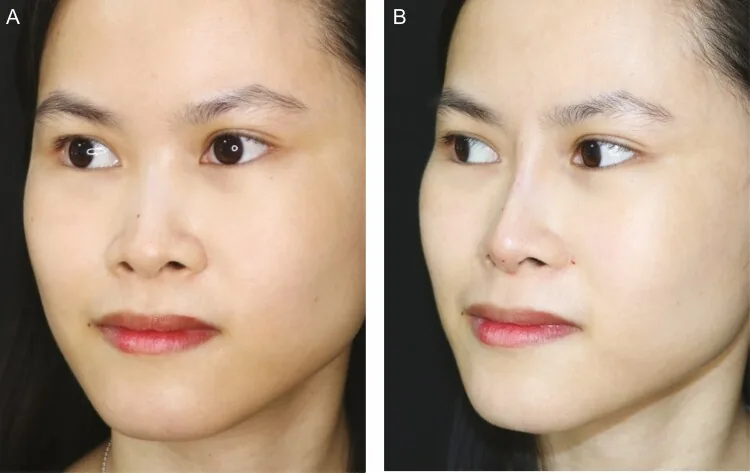
Filler on its own can change a low bridge quite visibly, as in this published case:
Threads or filler: the difference nobody mentions
The essential difference isn't the result; it is whether you can undo it. A 2026 review of non-surgical rhinoplasty describes hyaluronic acid filler as the gold standard because it is reversible and biocompatible, and lists combining filler with PDO threads among the newer techniques.
| Filler | Threads | |
|---|---|---|
| What it does | Adds volume | Supports and lifts |
| If you dislike the result | Dissolved with an enzyme | Wait for absorption, or have it removed |
| Most serious complication | Blocked blood vessel | Infection or abscess around the thread |
| Published evidence | Broader | Thinner, mostly case reports |
Combining them combines the risks of both. That isn't necessarily a reason to refuse, but it is a reason to know exactly what will be placed in your nose and what the plan is if something goes wrong.
This flowchart shows when threads are even a relevant question:
flowchart TD
  A[You want to change your nose shape] --> B{Want it smaller, a hump removed, or better breathing?}
  B -->|Yes| C[Surgical assessment - injections can't do this]
  B -->|No| D{Want a slight tip lift or a clearer bridge?}
  D -->|Yes| E{Comfortable with a temporary result and rare risks?}
  E -->|Yes| F[Filler or threads after assessment by a qualified clinician]
  E -->|No| G[No procedure for now]
  D -->|No| G
What complications have been reported?
The 2024 review sets out the complications of nose threads: threads becoming visible or poking through, migration, skin infection, dimpling, and inflammatory lumps around the thread (granulomas). It stresses that early intervention prevents them from becoming severe.
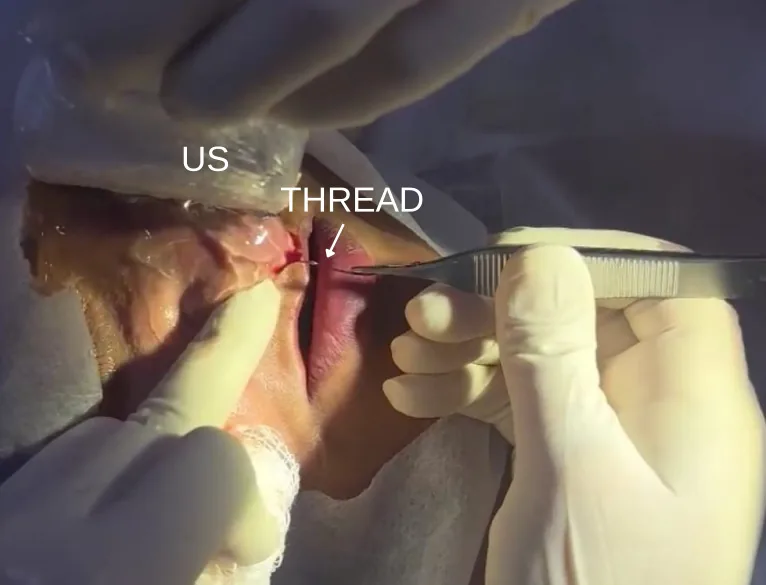
A case report published in 2026 described a woman with diabetes who developed swelling, pain and pus shortly after a non-surgical nose job using filler and PDO threads. Ultrasound showed an abscess around one thread's knot, and treatment required surgical removal of the threads under ultrasound guidance.
Diabetes or reduced immunity should be mentioned before any procedure, because both raise the risk of infection around anything implanted under the skin. The same goes for active acne or very oily skin on the nose, which a dermatologist should look at first.
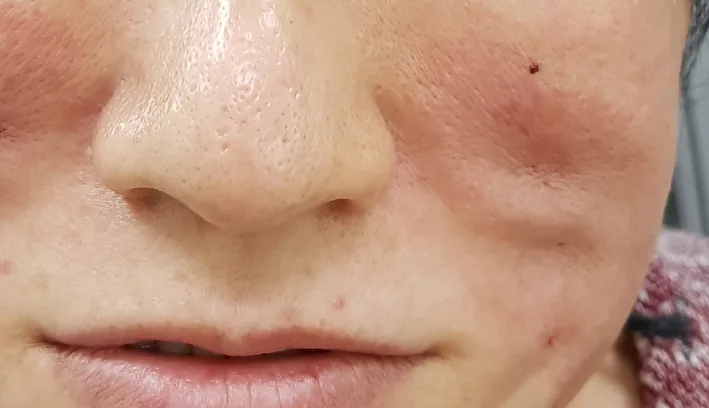
Dimpling is a recognised complication of threads in general, appearing as a small depression in the skin over the thread's path. The image below is from facial rather than nasal threads, but it shows the same thing:
This flowchart shows what needs attention afterwards:
flowchart TD
  A[After nose threads or filler] --> B{White or dusky skin with severe pain, or vision change?}
  B -->|Yes| C[Emergency care now - possible blocked vessel]
  B -->|No| D{Swelling increasing, pus or fever?}
  D -->|Yes| E[Urgent review - possible abscess around a thread]
  D -->|No| F{A thread visible or poking out, or skin dimpling?}
  F -->|Yes| G[Prompt review - early treatment is easier]
  F -->|No| H[Routine follow-up]
Frequently asked questions
How long does a nose thread lift last?
The threads used are usually absorbable, so they break down gradually and the effect fades over time; duration varies with the thread type, the area and your body. A 2023 review described results as variable and often short-lived, with little standardisation, so be wary of any promise of results that last years.
What is the difference between threads and filler for the nose?
Filler adds volume to smooth the bridge or lift the tip, and it can be dissolved with an enzyme if you dislike the result. Threads are inserted as fine supports to lift the tip and define the bridge, and they do not dissolve with an enzyme; removing them after a complication takes a procedure. Many clinicians combine the two, which combines the risks of both.
Can a nose thread lift make my nose smaller?
No. Threads and filler add; they don't take away. They cannot reduce a hump, narrow wide nasal bones, or fix a deviated septum or breathing problems. What they can do is lift the tip slightly and define the bridge, which sometimes creates the impression of a slimmer nose.
What are the complications of a nose thread lift?
Published reports describe threads becoming visible or poking through the skin, threads migrating, infection and abscess, skin dimpling, and inflammatory lumps around the thread. Most are manageable if caught early, and some need the thread removed. When filler is combined, the rare risk of a blocked blood vessel is added.
When to see a clinician
Seek emergency care immediately if the skin of your nose turns white or dusky with severe pain, or if your vision changes after an injection. See whoever performed the procedure the same day for swelling that is increasing, pus or fever, and soon if a thread becomes visible or pokes through, or the skin dimples. Before any procedure, have active spots or very oily skin on the nose looked at by a dermatologist first; managing oil and pores on the nose is covered in treating enlarged pores. If you later decide on surgery, read after rhinoplasty.
Related articles
- Rhinoplasty: types and what can be achieved
- What rhinoplasty really costs
- After rhinoplasty: splint, tape and red flags
- Non-surgical chin augmentation
- Facial cosmetic procedures
Further reading
- Thread Lifting of the Nose: Fully Comprehensive Approach to the Technique — Plastic and Reconstructive Surgery Global Open
- Nose thread lift: everything you need to know — Elite Aesthetics
- What is Nose Thread Lift? — Centre for Surgery
- Can you reshape your nose without surgery? Understanding the thread-based nose lift — ASPS
Medical disclaimer: This article is for health education only and is not a substitute for professional medical advice. If you have a skin condition that concerns you, please consult a dermatologist.