
Non-surgical chin augmentation is possible, but "the chin" is one word for three different problems: a receding chin that needs projection, fat underneath it (a double chin) that needs reducing, and loose skin along the jaw that needs tightening. Filler treats the first, does not dissolve the second and cannot lift the third. Many of the pages ranking for this topic blur them together — so fat-dissolving injections get offered to someone who needs projection, and filler to someone who needs fat reduced.
Three problems that all get called "the chin"
An attractive lower face has features you can actually measure: a well-defined jawline, a chin that sits close to the line of the lower lip in profile, and a moderately open angle between chin and neck. The illustration below, from a published review, shows those landmarks.
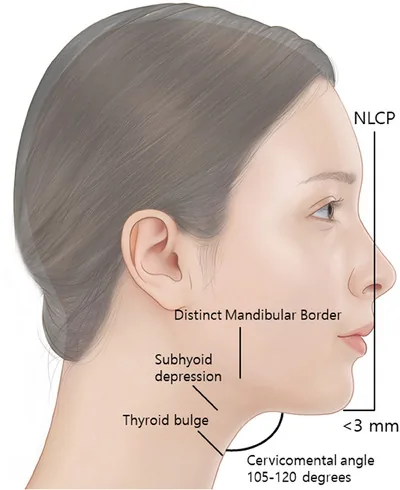
When one of those elements is off, the whole profile changes. So before any injection, I separate the causes:
| What you notice | Likely cause | Non-surgical option that fits |
|---|---|---|
| Chin looks small or set back in profile | Lack of bony or soft-tissue projection | Chin filler |
| Fullness under the chin that flattens when you pull the skin gently | Submental fat | Fat-targeting treatment |
| Loose skin along the jaw and neck | Skin and tissue laxity | Tightening devices or threads, with clear limits |
| Very receding chin or an unbalanced bite | Jaw and tooth structure | Surgical or orthodontic assessment |
If what bothers you is the surface of the chin itself, the dimpling when you press your lips together, that is a muscle problem rather than a volume one, covered in chin wrinkles.
The same sequence as a flowchart:
flowchart TD
  A[Unhappy with the chin] --> B{Chin set back in profile?}
  B -->|Yes| C{Large retrusion or an unbalanced bite?}
  C -->|Yes| D[Surgical or orthodontic assessment]
  C -->|No| E[Chin filler is an option]
  B -->|No| F{Fatty fullness under the chin?}
  F -->|Yes| G[Treatment that targets fat]
  F -->|No| H[Laxity - assess tightening devices or threads]
Chin filler: what do the studies show?
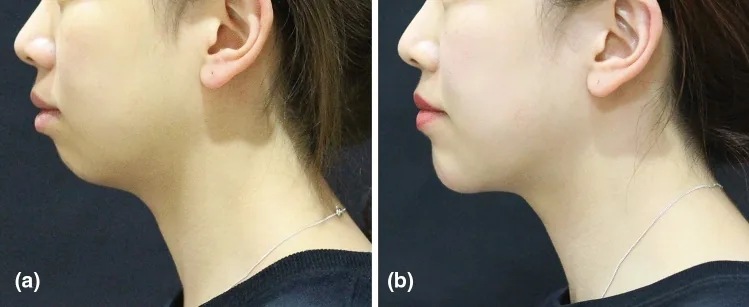
Hyaluronic acid filler is usually placed on the surface of the chin bone to add projection and length. This is not just marketing. A randomised controlled trial published in 2024 compared a flexible filler against no treatment, and blinded evaluators found clear improvement in chin retrusion in most treated patients at six months, against very little change in the untreated group.
How long does it last? That is always the first question. Another randomised trial, published in 2025, followed patients with photographs for twelve months, as in this sequence.
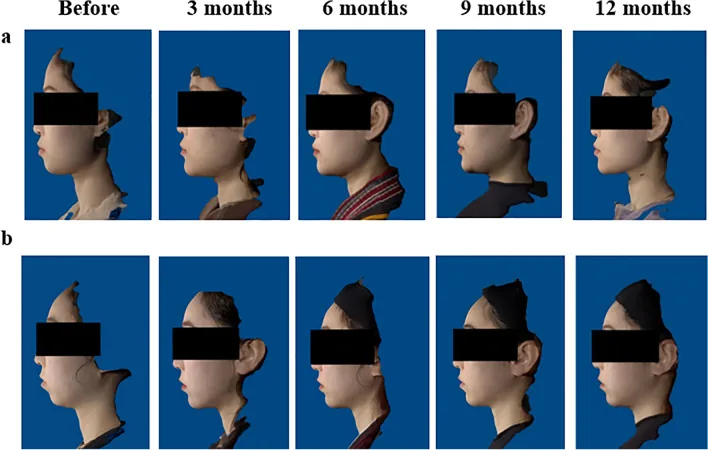
Real-world duration varies with the product and with you, and it cannot be guaranteed. The big advantage of hyaluronic acid is that it can be dissolved with an enzyme (hyaluronidase) if you dislike the result or a complication occurs — something no permanent filler offers.
What filler cannot do is worth saying plainly. It adds volume; it does not move bone. A chin that is very far back, or one tied to how your teeth meet, can look heavy or elongated when filler is pushed to do a surgeon's job.
A good appointment looks unhurried. Your clinician should study your profile from the side and at an angle, ask how your teeth meet, and photograph you before anything is injected. Many fillers contain a local anaesthetic, and the chin often looks slightly swollen and firm for the first days. A review visit after the swelling settles is the right moment to judge the shape, and to decide whether a small top-up is genuinely needed rather than booked in advance.
A double chin: filler does not dissolve fat
Fullness under the chin is usually a fat problem, and it is treated differently. A review of fat-dissolving agents explains that deoxycholic acid is the agent approved by the US Food and Drug Administration for reducing submental fat, while other mixtures common in beauty clinics lack cosmetic approval because of safety concerns.
Ask for the name of the product being injected, not the name of the "session". "Fat-dissolving injections" can mean a studied product or a cocktail whose exact composition nobody can tell you. And if fullness under the chin comes with general sagging of the face, the issue is bigger than the chin; that is covered in facial sagging: what actually works.
Threads: what they do and don't do
Dissolvable threads are passed under the skin to lift soft tissue slightly. They may improve mild laxity along the jawline, but they do not add projection to the chin or remove fat, and the evidence on how long the effect lasts is weaker than for filler. How threads and filler compare more broadly is covered in facial cosmetic procedures.
The risks: what to know before you're injected
Common effects are temporary: swelling, bruising and tenderness for a few days. The rare risk you must know about is filler blocking a blood vessel, and expert consensus recommendations on treating filler complications set out how it should be managed as an emergency.
This flowchart shows what needs your injector straight away:
flowchart TD
  A[After filler injection] --> B{Blanching, dusky or mottled skin with severe pain?}
  B -->|Yes| C[Contact your injector immediately - emergency]
  B -->|No| D{Hot, red swelling growing after a few days, or painful lumps?}
  D -->|Yes| E[See your clinician soon - possible inflammation]
  D -->|No| F[Mild swelling and bruising - expected]
Where you are treated matters as much as what is injected. Choose a clinician who knows the vascular anatomy of the lower face and keeps what is needed to treat a blockage on site. Injections in salons or at home lack all of that.
Frequently asked questions
How long does chin filler last?
It depends on the product, its density and your own body. Published studies of hyaluronic acid chin filler have followed patients for up to twelve months and found the improvement maintained in many of them over that time. After that the filler breaks down gradually, and a top-up may be needed if your clinician thinks it appropriate.
Does chin filler get rid of a double chin?
It can improve the look slightly, because a more projected chin visually tightens the neck line. But it does not dissolve the fat under the chin. When the problem is accumulated fat, the appropriate treatment targets the fat itself, and the two can be combined in one plan after assessment.
What are the risks of chin filler?
Common and temporary: swelling, bruising and mild tenderness. Rarer and more serious: filler blocking a blood vessel, which shows as blanching or a dusky, mottled skin colour with pain out of proportion. That is an emergency treated immediately, which is why filler belongs with a clinician who knows the anatomy and keeps emergency treatment on site.
Do threads work for the chin?
Threads lift soft tissue a little along the jawline, but they do not add projection to the chin or remove fat, and the evidence on how long they last is weaker than for filler. They may help a specific, mild laxity, not as a substitute for chin augmentation.
When to see a clinician
Contact whoever injected you immediately if the skin turns white, dusky or mottled after treatment with severe pain, or if your vision is affected — that is an emergency and should not wait until morning. See your clinician soon for hot, red swelling that grows after a few days, or painful lumps. Before any injection, your chin deserves an assessment that identifies the real problem: retrusion, fat or laxity. If the retrusion is large or linked to your bite, the surgical route and its recovery are covered in chin surgery recovery.
Related articles
- Chin surgery recovery
- Facial cosmetic procedures
- Facial sagging: what actually works
- Cosmetic procedures: surgical and non-surgical
- Rhinoplasty: types and what can be achieved
Further reading
- Non-Surgical Chin Augmentation — Cosmetic Skin Clinic
- Nonsurgical Augmentation of the Chin Using a Lateral to Medial Approach with Hyaluronic Acid Based Filler: A Case Series
- The Application and Efficacy of Hyaluronic Acid Fillers for Chin Enhancement and Retrusion Correction: A Systematic Review
- Treatment of Soft Tissue Filler Complications: Expert Consensus Recommendations
Medical disclaimer: This article is for health education only and is not a substitute for professional medical advice. If you have a skin condition that concerns you, please consult a dermatologist.