Recovery after chin surgery depends first on which operation you had: a synthetic implant placed over the bone, or a sliding genioplasty that cuts and advances part of the jaw. Implant recovery is often shorter but infection risk is higher; bone advancement more often brings temporary numbness of the lip and chin. Either way, swelling takes weeks to settle, and your surgeon's instructions override any general advice.
One thing to be clear about: InJasmine is a dermatology clinic that consults and refers; we do not perform chin surgery. What follows is what I explain to patients who ask before an operation or come back afterwards: how to understand recovery, what concerns the skin and the wound, and which symptoms mean you should call your surgeon now.
Two kinds of chin advancement
Chin advancement corrects a small or receding chin (microgenia). A 2025 systematic review describes two main approaches and compares them:
| Chin implant | Sliding genioplasty | |
|---|---|---|
| What happens | A synthetic implant sits over the chin bone | The front of the jaw is cut, moved and fixed with plates |
| Incision | Inside the mouth or under the chin | Usually inside the mouth |
| More associated with, in the review | Infection and wound breakdown | Temporary numbness of the lip and chin |
| Often suits | Mild to moderate retrusion | Larger retrusion, or a need to change height or symmetry |
The review found high satisfaction in both groups, with a trend towards higher satisfaction after genioplasty. There is no universally "better" option; the choice depends on the shape of your chin, jaw and bite, and it is a decision for a surgeon who has examined you. There is also a non-surgical route with injectable filler, more limited in what it can achieve and covered in non-surgical chin augmentation; how surgical and non-surgical routes compare in general is covered in cosmetic procedures, surgical and non-surgical.
Recovery after chin surgery
The American Society of Plastic Surgeons explains that incisions may be covered with gauze or bandages, that an elastic bandage or compression garment may minimise swelling and support the chin, and that healing continues for several weeks as swelling decreases. If the incision is inside the mouth, you may be asked to follow a liquid diet and use special mouth rinses.
This is the general course of recovery:
flowchart TD
  A[First days: swelling, tightness, compression dressing] --> B[Head raised, cold compresses, soft food]
  B --> C[Wound care: rinses for an intraoral cut, gentle cleaning for one under the chin]
  C --> D[Weeks: swelling settles, sensation returns gradually]
  D --> E[Follow-up with your surgeon as scheduled]
Practical things make a difference in the first week. Sleep on your back with your head raised, so you are not pressing the chin into a pillow. Keep cold compresses wrapped, never directly on the skin. Avoid smoking, which slows wound healing and raises infection risk, and ask your surgeon specifically when you can resume exercise, since bending and straining increase swelling.
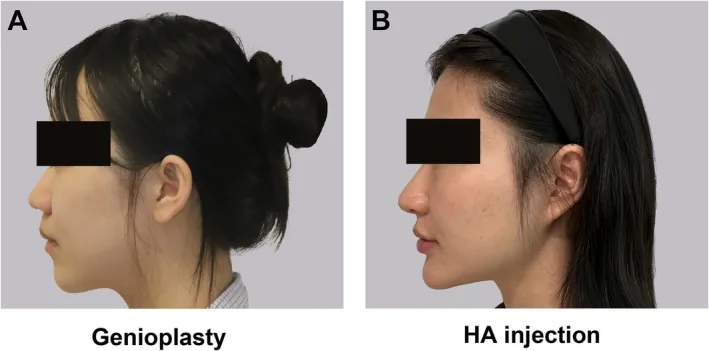
What you see in the early weeks is not the result. Swelling can make the chin look larger or uneven, and it can fluctuate between morning and evening. Judging the outcome means waiting for the swelling to go down. The image below, from a published study, shows the profile a year after sliding genioplasty alongside a filler-treated chin.
Lower lip numbness: expected or worrying?
The nerve that carries sensation from the lower lip and chin leaves the jawbone very close to where chin surgery happens. That is why the systematic review found temporary sensory changes common after sliding genioplasty, persisting in a smaller proportion of patients.
Numbness is not the same as weakness. Numbness is a loss of feeling. Weakness is difficulty moving the lip — the lower lip does not pull down on one side when you smile or speak. Weakness is rarer, and has been described after chin augmentation and submental liposuction, as in this published case.
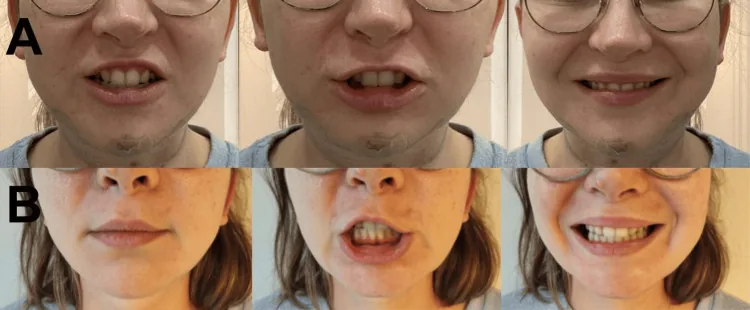
In the two published cases, movement recovered fully with follow-up and facial exercises. The message is not alarm but early reporting: any weakness in lip movement should be seen by your surgeon, not waited out at home.
The skin over the chin: what a dermatologist adds
This is the part the top-ranking guides leave out. A compression strap and dressings cover the chin and jawline for days, and the skin underneath sweats and rubs.
- Spots and friction under the strap: common with heat and sweat. Cleanse gently around the area without scrubbing, and don't squeeze.
- A scar under the chin: if the incision is there, sun protection in the first months reduces the chance of the scar darkening, particularly in olive and brown skin. A raised or widened scar can be assessed by a dermatologist once healed; the logic of scar treatment is covered in treating facial scars.
- Active products can wait: acids, topical retinoids and peels on the chin are postponed until your surgeon clears them.
Late complications: why follow-up matters
Some implant complications do not appear in the first weeks. A published case report described someone who had a silicone chin implant placed, had no follow-up afterwards, and was later found on imaging to have erosion of the bone beneath the implant site.
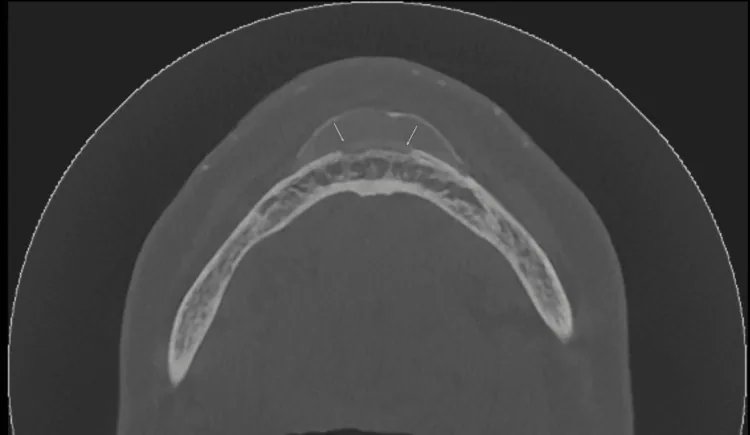
That does not mean every implant will damage bone, but it explains why the operation does not end when you go home. Tell your dentist you have an implant, and keep your follow-up appointments. This flowchart shows what needs your surgeon:
flowchart TD
  A[Symptom after chin surgery] --> B{Fever, pus, or redness and pain getting worse?}
  B -->|Yes| C[Call your surgeon urgently - possible infection]
  B -->|No| D{Wound opening, or the implant visible or shifting?}
  D -->|Yes| C
  D -->|No| E{Weak lip movement, or numbness not improving?}
  E -->|Yes| F[See your surgeon soon]
  E -->|No| G[Routine follow-up]
Frequently asked questions
Is lower lip numbness after chin surgery normal?
Temporary numbness of the lower lip and chin is common, particularly after sliding genioplasty, because the nerve that supplies sensation to the area exits the bone close to the operating site. A systematic review found it usually settles, persisting in a smaller proportion of patients. Tell your surgeon about it, and go back if it is not gradually improving.
What can I eat after chin surgery?
It depends on where the incision is. When it is inside the mouth, many surgeons ask for a liquid or soft diet at first, with special mouth rinses to keep food debris away from the wound. When the incision is under the chin, eating is usually easier. Your surgeon's instructions decide what and for how long.
What is the difference between a chin implant and a sliding genioplasty?
An implant is a synthetic shape placed over the chin bone through a small incision; a sliding genioplasty cuts the front of the jawbone itself, moves it forward and fixes it with plates. A systematic review found implants associated with more infection and wound breakdown, and genioplasty with more temporary numbness, with high satisfaction in both groups.
How much does chin augmentation cost?
It varies with the technique — implant or bone advancement — and with the country, hospital and anaesthetic, and prices change quickly as of 2026. Compare what the price includes: who operates, the type of implant or fixation, and follow-up after surgery, before comparing the figure itself.
When to see a clinician
Call your surgeon straight away for fever, pus, increasing redness and pain, a wound that opens, or a feeling that the implant is moving or showing. See them soon if you notice weakness in lower lip movement or numbness that is not improving over time. Difficulty swallowing or breathing, or rapid swelling of the lower face and neck, is an emergency. A raised or discoloured scar, or persistent spots around the chin once healed, belong in a dermatology clinic. If you are still comparing procedures, read about what rhinoplasty costs — the same logic for reading a price applies here.
Related articles
- Facial cosmetic procedures
- Cosmetic procedures: surgical and non-surgical
- Treating facial scars
- After rhinoplasty: splint, tape and red flags
- Facial sagging: what actually works
Further reading
- Chin Augmentation (Mentoplasty) Recovery: What to Expect — Dr Maresky
- Recovery time after chin implant surgery — Dr David Hecht
- Chin implant surgery: guide to recovery and results — Virginia Facial Plastic Surgery
- Chin surgery recovery — American Society of Plastic Surgeons
Medical disclaimer: This article is for health education only and is not a substitute for professional medical advice. If you have a skin condition that concerns you, please consult a dermatologist.