
A hair specialist is all you need for anything to do with the hair itself: cutting, colour, styling, curly hair care, and repairing damage from heat and chemicals. But when hair falls out in patches, your scalp itches, reddens and flakes, or your skin swells after colouring, those are conditions a dermatologist needs to diagnose, not care problems that a salon session can fix.
The Arabic pages that rank for "hair specialist" are service ads and remote consultations, and they rarely say where a specialist's limits lie. This article explains the difference, the signs that it's time to see a doctor, and how to protect your scalp when you colour.
Who is a hair specialist, and who is a dermatologist?
"Hair specialist" is a broad label that covers hairdressers, colourists, curly hair specialists, and sometimes people who call themselves trichologists or scalp specialists. Their training varies a great deal between countries and between individuals, and their work is on the hair and how it's cared for. A dermatologist is a doctor trained in the skin, hair and nails as organs, who examines the scalp, orders tests, takes a biopsy if needed, and prescribes treatment.
Trichologists sit somewhere in between. Many take a careful history and look closely at the scalp, and the good ones refer on when something looks medical. But a trichologist is usually not a doctor and cannot prescribe, so a condition that needs medication or a biopsy will end up with a dermatologist anyway.
| Hair specialist | Dermatologist | |
|---|---|---|
| Focus | The hair, its look and its care | Hair and scalp diseases |
| Tools | Cutting, colour, cosmetic treatments | Dermatoscope, tests, biopsy, medication |
| Hair loss | Reduces breakage and notices changes | Diagnoses and treats the cause |
| Dye allergy | Stops and advises a check-up | Diagnoses with patch testing and treats |
| Curly hair | Care routine and cutting | Scalp flaking, inflammation and hair loss |
Signs that it isn't a care problem
- Bald patches, however small.
- A widening parting or more scalp showing in the light.
- Sudden heavy shedding after an illness, a birth or a diet.
- Itching, redness, scaling, pain or burning on the scalp.
- Hair breaking at the root, or short, broken hairs in one area.
These signs need a diagnosis, because some kinds of hair loss destroy the follicles and leave permanent scarring if treatment is delayed. The figure from a 2025 review shows how a dermatologist thinks about hair loss: first the pattern of distribution, then whether it is scarring, then the clues the dermatoscope reveals:
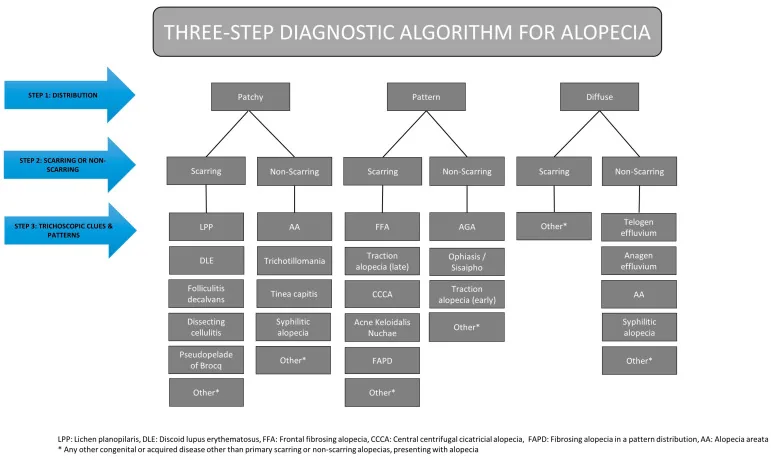
Every box in this chart is a different condition with a different treatment, and they can't be told apart by eye in a salon mirror.
The dermatoscope: what a doctor sees that the eye doesn't
A dermatologist examines the scalp with a dermatoscope, which magnifies the hairs and follicle openings and reveals signs that separate one condition from another. The figure from the same review shows a patch on the crown of a woman's head and what the dermatoscope found in it:
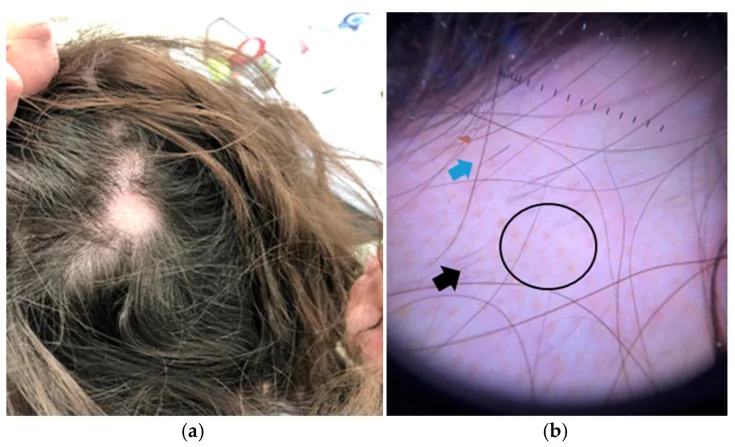
A hair specialist may spot a patch like this while cutting, and that is genuinely valuable: they see the back and crown of your head far more often than you do. Their role at that point is to tell you, not to treat it with an oil or a hair mask.
Hair colour specialists and dye allergy
Hair dyes are among the best-known causes of allergy to hair products. A 2024 review summarises that dye allergy is the most common of these, and that hairdressers are at higher risk than the general population because of their prolonged exposure. The best-known culprit is para-phenylenediamine (PPD). The allergy is diagnosed by patch testing with a dermatologist, as in this published case:
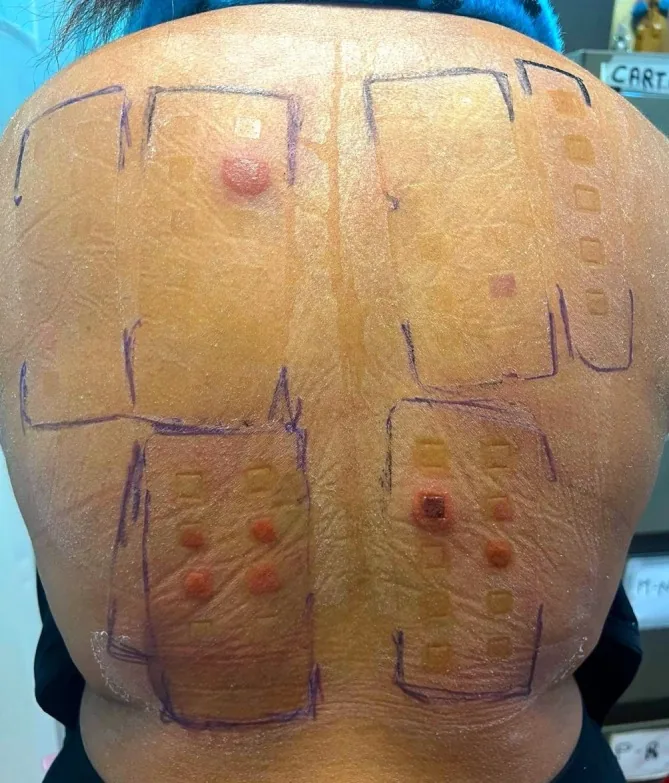
If itching, redness or swelling appears on your scalp, face or eyelids after colouring, don't use that dye again, and seek urgent care if your face swells badly or you find it hard to breathe. A reaction tends to be worse the next time, not milder, so "it was only a bit itchy last time" is a reason for caution rather than reassurance.
Curly hair specialists
Curly hair is drier and breaks more easily, and a curly hair specialist can help with the right cut, a moisture routine and styling without excess heat. But watch for two things that need a doctor: repeated tight styles, which can cause hair loss along the hairline, and scalp flaking with itching and redness, which isn't always dryness, as explained in what causes a dry scalp.
flowchart TD
  A[A problem with my hair] --> B{Patches, a widening parting or sudden shedding?}
  B -->|Yes| C[Dermatologist]
  B -->|No| D{Itching, redness, scaling or pain on the scalp?}
  D -->|Yes| C
  D -->|No| E{Breakage and dryness after colour or heat?}
  E -->|Yes| F[Hair specialist - routine and cut]
  E -->|No| G[General care routine]
How to choose a hair specialist
- They ask about your history with dye and any previous reaction.
- They carry out the allergy test the manufacturer recommends before colouring.
- They know their limits: they point out a patch or flaking, and don't sell you a "hair loss treatment".
- They don't promise medical results such as "stopping shedding" or "regrowing hair".
A good specialist and a good dermatologist complement each other. The specialist sees your hair regularly and notices change early; the dermatologist explains what it means and treats it. If you're dealing with a scalp or hair condition, it's worth telling your hair specialist, so they can adjust products and styling while treatment works.
mindmap
  root((Hair specialist))
    Enough for
      Cutting and styling
      Colour
      Curly hair
      Heat damage
    Not enough for
      Bald patches
      Sudden shedding
      Scalp inflammation
      Dye allergy
Frequently asked questions
What's the difference between a hair specialist and a dermatologist?
A hair specialist works on the hair itself: cutting, colour, styling, curly hair care and repairing damage from heat and chemicals. A dermatologist is a doctor who diagnoses and treats scalp diseases and hair loss, and can examine the scalp with a dermatoscope, order tests and prescribe medication.
When do I need a dermatologist instead of a hair specialist?
When hair falls out in patches, your parting widens, shedding increases suddenly, your scalp itches, reddens, scales or hurts, or a rash and swelling appear after colouring. These are signs of a condition that needs diagnosing, not a care problem.
Can a hair specialist treat hair loss?
A hair specialist can notice hair loss and reduce breakage caused by heat, tension and chemicals, but cannot diagnose or treat its cause. Hair loss has many causes, some of which leave permanent scarring if treatment is delayed, so it needs a doctor.
How do I choose a hair colour specialist?
Choose someone who asks about any previous reaction to dye, carries out the allergy test the manufacturer recommends before colouring, uses products with clear ingredient lists, and stops and advises you to see a doctor if redness, itching or swelling appears.
When to see a clinician
See a dermatologist if bald patches appear, your parting widens, shedding increases suddenly for weeks, or your scalp itches, reddens, scales or hurts. Seek urgent care if your face or eyelids swell badly after hair dye, or you find it hard to breathe.
Related articles
- What causes a dry scalp
- Why is my skin and hair so dry?
- Hair transplant in Turkey
- How to become a certified skincare specialist
Further reading
- Trichologist vs Dermatologist: What's the Difference? — Wimpole Clinic
- Hair Product Allergy: A Review of Epidemiology and Management — Cureus
- A Three-Step Diagnostic Algorithm for Alopecia: Pattern Analysis in Trichoscopy — Journal of Clinical Medicine
Medical disclaimer: This article is for health education only and is not a substitute for professional medical advice. If you have a skin condition that concerns you, please consult a dermatologist.