
Darkening on the sides of the face has several causes, the commonest being melasma in its cheek or jawline pattern, pigmentation after irritation or allergy to cosmetics and fragrance, acanthosis nigricans linked to insulin resistance, and less common conditions that affect the sides of the face and neck. Each cause has a different treatment, but the shared foundation is a daily tinted sunscreen and avoiding irritants. So the right first step is an examination.
The Arabic pages that rank for this search offer homemade lightening recipes; some mention melasma, but they don't separate the different causes of dark patches on the sides of the face, or mention that cosmetics themselves can be the cause. This article sorts the causes and what helps each one, from published research.
Melasma on the cheeks and jawline
Melasma is brown patchy pigmentation that's usually symmetrical, with distinct patterns of distribution on the face, as a 2026 paper illustrates:
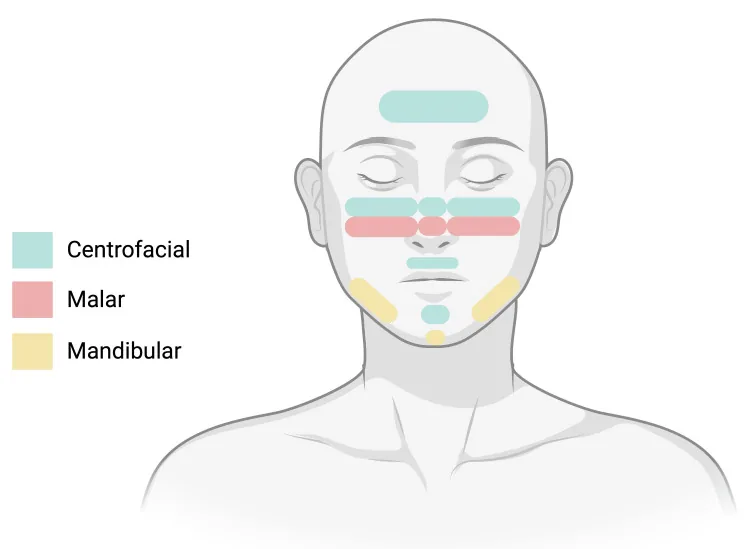
The malar and mandibular patterns affect the sides of the face specifically, and worsen with sun, heat, pregnancy and the contraceptive pill. The colour may be more obvious on the side of the face that gets more sun, such as the driver's side. Melasma needs a long-term plan with a dermatologist; more in melasma medication.
Other causes that look like melasma
Not every facial pigmentation is melasma. A 2026 study of people with skin of colour shows several types of facial pigmentation, in normal light and under a Wood's lamp, which helps tell them apart:
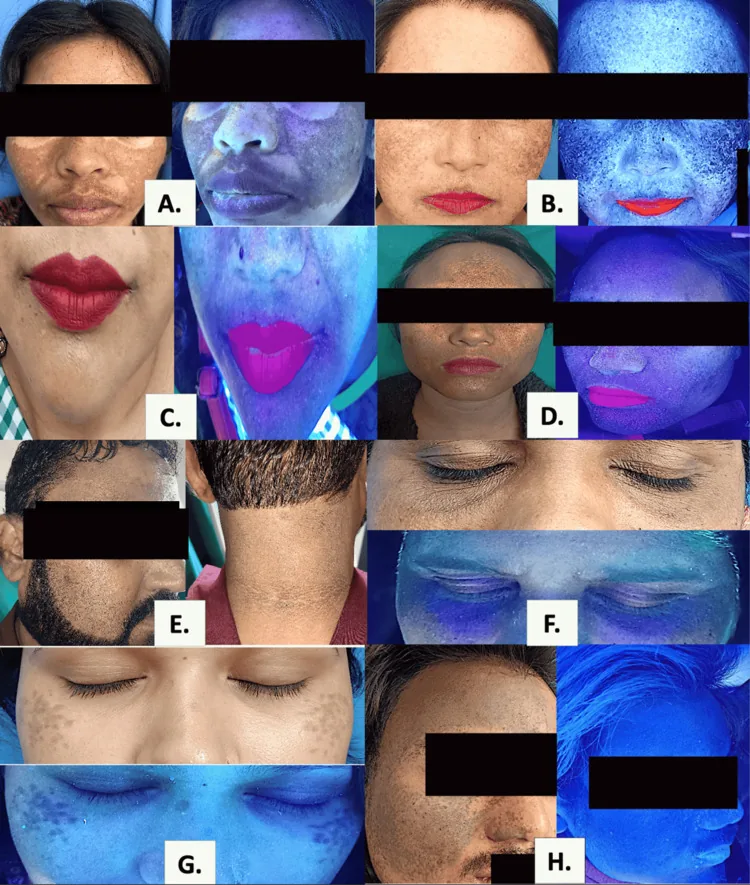
These conditions look very alike, and telling them apart needs an examination, sometimes with dermoscopy or a Wood's lamp. The most relevant for the sides of the face:
| Cause | Clues | What helps |
|---|---|---|
| Melasma | Symmetrical brown patches on the cheeks or jaw | Tinted sunscreen and a dermatologist's plan |
| Pigmentation after cosmetic allergy | Earlier itching or redness; grey or brown colour | Stopping the product and patch testing |
| Lichen planus pigmentosus | Grey or grey-brown colour, sometimes with itching | Assessment and treatment by a dermatologist |
| Acanthosis nigricans | Velvety, thickened dark skin, usually with the neck | Treating insulin resistance |
| Marks after spots | Patches where spots were | Treating acne and a pigment ingredient |
A condition that affects the sides of the face and neck
A less common condition that affects the sides of the face specifically is erythromelanosis follicularis faciei et colli, which causes redness and pigmentation with small bumps at the hair follicles. A 2021 case series shows its distribution:
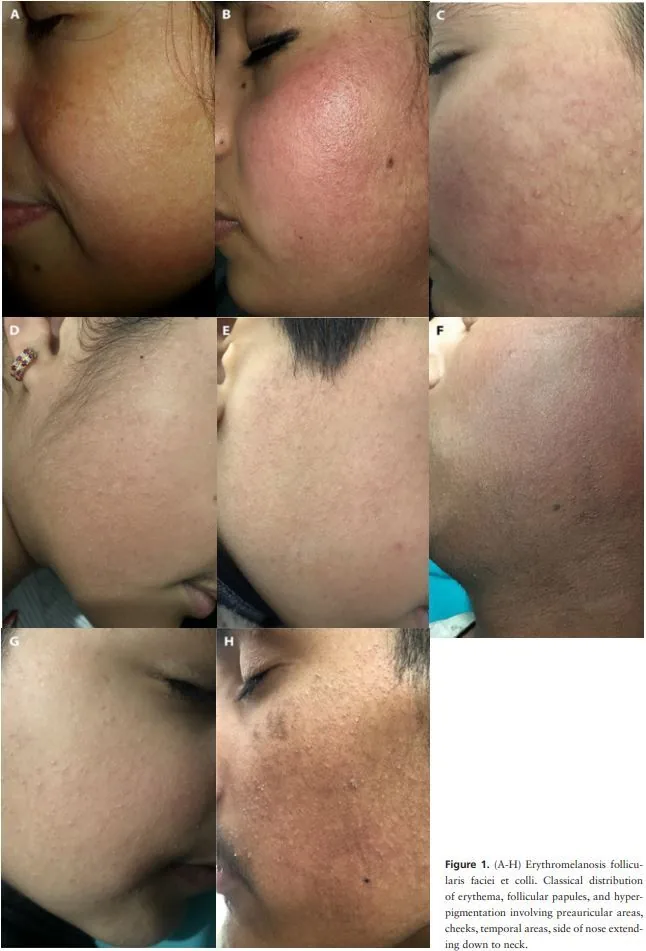
This condition isn't dangerous, but it's often confused with melasma or acne, and treated with lightening products that don't help it. A dermatologist diagnoses it by examination and dermoscopy. It often starts in adolescence or early adulthood, and some people also have rough bumps on the upper arms, a common, harmless condition called keratosis pilaris that's thought to be related. Gentle skincare and sun protection help, and a dermatologist can discuss treatments for the redness and texture if they bother you.
flowchart TD
  A[Darkening on the sides of the face] --> B{Symmetrical, brown and worse with sun?}
  B -->|Yes| C[Probably melasma]
  B -->|No| D{Preceded by itching or redness after a product?}
  D -->|Yes| E[Allergy: stop the product and patch test]
  D -->|No| F{Velvety, thickened skin with the neck?}
  F -->|Yes| G[Acanthosis nigricans: check blood sugar]
  F -->|No| H[Assessment by a dermatologist]
What helps in every case
A broad-spectrum tinted sunscreen every day, because visible light and ultraviolet light worsen most types of pigmentation. A simpler routine, cutting out fragrance and unnecessary products, especially if itching came before the darkening. A gentle pigment ingredient such as azelaic acid or niacinamide once the cause is clear. And avoiding lemon, coarse scrubs and strong creams of unknown origin, because irritation deepens darkening. How facial darkening compares with the rest of the body is covered in why the face is darker than the body.
Cosmetics: an often-forgotten cause
Some fragrances, colourants and preservatives in cosmetics can cause mild, repeated allergy that doesn't always show as an obvious rash, but over time leaves grey or brown pigmentation, especially on the sides of the face and neck where perfume and foundation are applied. If you use many products, try simplifying your routine for several weeks to a gentle cleanser, a fragrance-free moisturiser and sunscreen, and notice whether the darkening stops spreading. Patch testing with a dermatologist can identify the responsible ingredient precisely. Hair dyes and hair products that run onto the temples are worth considering too.
Don't try to hide the darkening with strong lightening creams of unknown origin: some contain harmful ingredients, and long-term use of some can leave a darker colour that's hard to treat.
Acanthosis nigricans and your general health
Acanthosis nigricans deserves a special mention because it can be a visible clue to something happening inside the body. The skin becomes darker, thicker and velvety, most often on the back of the neck and in the armpits, but sometimes on the sides of the face and around the jawline. It's commonly linked to insulin resistance, which can come before type 2 diabetes, and to some hormonal conditions such as polycystic ovary syndrome. Lightening creams won't fix it on their own; it tends to improve when the underlying cause is addressed, for example through weight management, physical activity and treatment your doctor recommends. If you notice these changes, a simple blood test is a sensible first step.
mindmap
  root((Darkening on the sides of the face))
    Causes
      Melasma
      Cosmetic allergy
      Acanthosis nigricans
      Follicular conditions
    Helps
      Tinted sunscreen
      Simpler routine
      A gentle ingredient
    Harms
      Lemon
      Creams of unknown origin
Frequently asked questions
What causes darkening on the sides of the face?
Common causes include melasma in its cheek or jawline pattern, pigmentation after irritation or allergy to cosmetics and fragrance, acanthosis nigricans linked to insulin resistance, and less common conditions that affect the sides of the face and neck. An examination identifies the cause.
Is darkening on the side of my face from my phone or friction?
Repeated friction can increase pigmentation where it happens, and heat can worsen melasma. But widespread, symmetrical darkening on both sides of the face usually has another cause, such as melasma or allergy, so don't assume your phone is the only reason.
How do I treat darkening on the sides of the face?
Once the cause is known: a tinted sunscreen every day, stopping any product suspected of causing allergy, and a gentle pigment ingredient such as azelaic acid or niacinamide. Acanthosis nigricans improves by treating its cause, such as insulin resistance.
Is darkening on both sides of the face and neck a sign of disease?
Usually not, but velvety, thickened dark skin on the neck and sides of the face can be acanthosis nigricans linked to insulin resistance or diabetes, and is worth checking with a doctor.
When to see a clinician
See a dermatologist if the darkening increases or spreads, if itching or redness came first, if it's grey or bluish, if it comes with velvety thickened skin on the neck, if a spot appears that changes in size, colour or border, or if it doesn't improve with sun protection.
Related articles
- Melasma medication
- Causes of a dark face and neck
- Why the face is darker than the body
- Causes of skin pigmentation
Further reading
- Facial Melanosis in Skin of Color: An Integrated Clinical, Dermoscopic, and Quality of Life Analysis — Cureus
- Global consensus on the management of melanin hyperpigmentation disorders — JEADV
- Melasma: diagnosis and treatment — American Academy of Dermatology
Medical disclaimer: This article is for health education only and is not a substitute for professional medical advice. If you have a skin condition that concerns you, please consult a dermatologist.