

Eva Collagen cream for women over 40 may help as a moisturiser that temporarily improves how the skin feels and looks, but collagen in a cream doesn't enter the skin to replace the collagen lost with age. Collagen molecules are large and act on the surface by attracting water. Real collagen stimulation after 40 comes from retinoids, vitamin C and daily sunscreen. We found no full published ingredient list for this cream and no studies of it.
The Arabic pages that appear for this search are shop listings repeating the manufacturer's description, without explaining what collagen in a cream can and can't do. This article explains that from published research. We have no connection with the manufacturer, an Egyptian skincare brand.
Why collagen falls after 40
Collagen is the protein that gives skin its strength and firmness, and it's made by cells in the dermis called fibroblasts. With age, production falls and breakdown rises, and this speeds up as oestrogen drops around menopause. A 2026 review illustrates the decline:
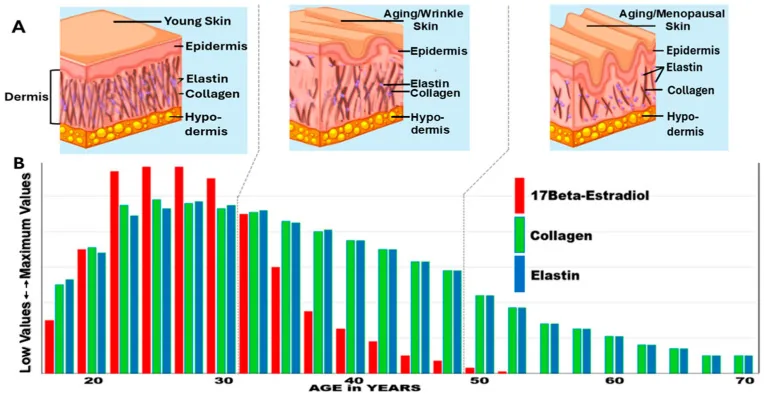
The chart illustrates the general trend rather than measurements from any one woman, but it explains why many notice a clear change in their skin between 40 and 50. Sun exposure accelerates the same process, which is why skin on the face and backs of the hands often looks older than skin that's usually covered.
How collagen is made in the skin
Collagen isn't built from ready-made collagen; fibroblasts make it from amino acids, through stages inside and then outside the cell, until strong fibres form. A 2025 review summarises these stages:

That's why what matters is stimulating these cells rather than putting collagen on the surface. Retinoids and vitamin C do this, and sunscreen protects the result.
What does collagen in a cream do?
Whole collagen is a huge molecule that can't cross the skin's outer layer. Hydrolysed collagen is smaller; it attracts water and hydrates the surface. In a 2025 study, skin hydration in volunteers rose in the first hours after applying formulations containing hydrolysed collagen, then returned close to baseline after one and two days:

The result confirms that topical collagen is a useful moisturiser, but its effect is on the surface and temporary, so it needs daily use like any moisturiser. Plumper, well-hydrated skin does make fine lines look softer, which is the effect most people notice.
| Ingredient | What it does | Strength of evidence |
|---|---|---|
| Collagen in a cream | Hydrates the surface temporarily | Good as a moisturiser; doesn't replace collagen |
| Retinol and retinoids | Stimulate collagen and improve wrinkles | The strongest among topicals |
| Vitamin C | Supports collagen production; antioxidant | Moderate |
| Peptides | May improve texture | Limited |
| Sunscreen | Prevents collagen breakdown | Strong |
flowchart TD
  A[Skin after 40] --> B{Goal is hydration and softness?}
  B -->|Yes| C[A moisturiser with collagen or ceramides]
  B -->|No| D{Goal is fewer wrinkles?}
  D -->|Yes| E[Retinol introduced slowly with a moisturiser]
  C --> F[Daily sunscreen]
  E --> F
  F --> G{Want a more visible result?}
  G -->|Yes| H[In-clinic procedures with a dermatologist]
How to read a collagen cream label
The word "collagen" in a product's name doesn't tell you much. Look at the ingredient list: if hydrolysed collagen comes near the end, the amount is probably small, and the cream's value lies in its other moisturising ingredients, such as glycerin, hyaluronic acid and oils. If your goal is wrinkles, look for studied ingredients such as retinol, niacinamide or peptides. If your skin is sensitive, avoid heavily fragranced formulas. Phrases like "fills wrinkles" or "3D effect" usually describe a temporary effect as the surface swells with water, not a real change in the skin's structure.
Your 40s aren't only about wrinkles
After 40, many women also notice more dryness, brown sun spots, a duller tone and slight sagging along the jaw. Each has a different answer: moisturising for dryness, sunscreen and brightening ingredients for spots, and retinoids for texture and fine lines. So no single cream fixes everything; a simple routine of three or four steps that you'll actually stick to works best.
Where in-clinic treatments fit
When creams alone aren't enough, in-clinic treatments can stimulate collagen more powerfully. Fractional lasers, microneedling (with or without radiofrequency) and some chemical peels work by causing controlled micro-injury that prompts fibroblasts to lay down new collagen over the following months. They suit different skin types to different degrees: darker skin, common in the Middle East, is more prone to dark marks after aggressive treatments, so settings and choice of procedure matter. Injectables such as fillers restore lost volume rather than rebuilding collagen, although some are designed to stimulate it gradually. None of these replaces daily sunscreen, which protects both natural collagen and the results of any treatment. A dermatologist can explain what suits your skin, your goals and your budget, and whether a combination of a home routine and occasional procedures makes more sense than either alone.
What about collagen supplements?
Collagen supplements are everywhere, but the evidence is conflicting, and many studies are small or funded by manufacturers. A 2026 review questioned how reliable the meta-analyses pooling these studies are. So don't rely on them instead of sunscreen and retinoids.
A realistic routine for your 40s
Morning: a gentle cleanser, then a vitamin C serum if you like, then a moisturiser, then a broad-spectrum sunscreen. Evening: a cleanser, then retinol at a low strength a few times a week to begin with, then a moisturiser, which could be the collagen cream if you like its texture. More on choosing in face firming cream and the best face cream after 50.
mindmap
  root((Collagen after 40))
    Why it falls
      Age
      Oestrogen
      Sun
    What stimulates it
      Retinoids
      Vitamin C
    What protects it
      Sunscreen
    Collagen cream
      A moisturiser
      Doesn't replace lost collagen
Frequently asked questions
Is Eva Collagen cream good for women in their 40s?
It may help as a moisturiser that temporarily improves how skin feels and looks, because collagen in a cream draws water to the surface. But it doesn't enter the skin to replace lost collagen, and we found no full published ingredient list for it and no studies of it.
Does collagen in a cream get into the skin?
Whole collagen is far too large to cross the skin's outer layer, and hydrolysed collagen is smaller but works mainly on the surface as a moisturiser. The collagen in your skin is made by fibroblast cells in the dermis, and other ingredients, such as retinoids, are what stimulate them.
What boosts collagen after 40?
The best-proven topical option is a retinoid such as retinol, followed by vitamin C, with daily sunscreen because it prevents collagen breakdown. In clinic, procedures such as laser and microneedling stimulate collagen, chosen by a dermatologist to suit your skin.
Are collagen supplements better than collagen cream?
The evidence on collagen supplements is conflicting; many studies are small or funded by manufacturers, and a recent review questioned how reliable the meta-analyses pooling them are. So they shouldn't replace sunscreen and retinoids.
When to see a clinician
See a dermatologist if a new spot appears that changes shape or colour or bleeds, if a new cream causes redness and itching, or if you want a plan for wrinkles and sagging that goes beyond creams. After 40, regular skin checks become part of good skincare.
Related articles
Further reading
- Promoting collagen synthesis: a viable strategy to combat skin ageing — Journal of Enzyme Inhibition and Medicinal Chemistry
- Collagen Hydrolysates from Animal By-Products in Topical Cosmetic Formulations — International Journal of Molecular Sciences
- 10 skin care secrets for healthier-looking skin — American Academy of Dermatology
Medical disclaimer: This article is for health education only and is not a substitute for professional medical advice. If you have a skin condition that concerns you, please consult a dermatologist.