
A dark forehead isn't one condition: it can be melasma, a suntan, repeated friction such as prostrating in prayer, or pigmentation after spots or irritation from hair dyes and hair products. Each cause has a different treatment, but the common foundation is daily sunscreen, stopping rubbing and friction, and avoiding irritating recipes. So fading a dark forehead starts with knowing what's causing it.
The Arabic pages that rank for this search offer creams and homemade recipes with lemon, starch and yoghurt; few mention prayer marks or melasma, and none explain how to tell the causes apart. This article sorts the causes and what helps each one, from published research.
Melasma: the commonest cause of symmetrical patches
Melasma is brown patchy pigmentation that usually appears on the face in a symmetrical pattern and worsens with sun, heat, pregnancy and the contraceptive pill. A 2026 paper illustrates the patterns it follows on the face:
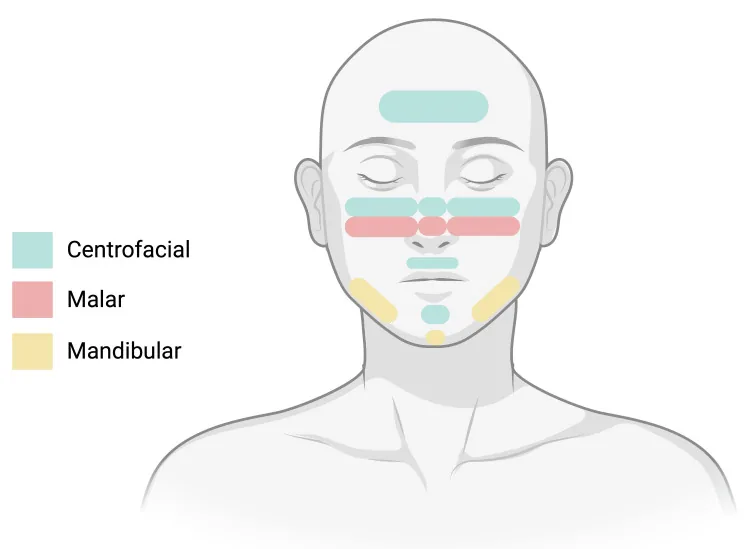
The centrofacial pattern, which includes the forehead, is the most common according to the paper, so if your forehead darkening is symmetrical and comes with patches on the cheeks or above the lip, melasma is a strong possibility. Melasma isn't driven by ultraviolet light alone but also by visible light, as a 2022 review explains:
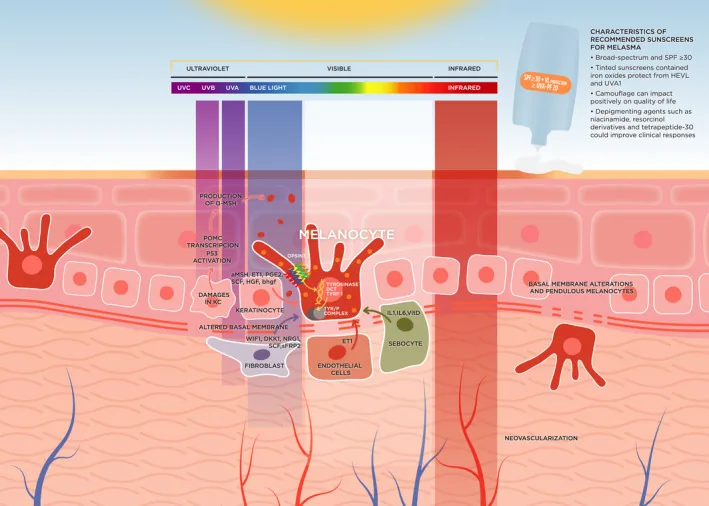
That's why a tinted sunscreen containing iron oxides is recommended, because it also protects against visible light. Heat can also worsen melasma, so long hours in hot kitchens or saunas may matter as well as direct sun. Melasma needs a long-term plan with a dermatologist; more in melasma medication.
Friction: prayer marks on the forehead
Repeated friction and pressure stimulate pigment production and thicken the skin, so some people who pray regularly develop a dark patch where the forehead touches the ground. A 2025 case report describes forehead skin changes linked to friction during prayer:
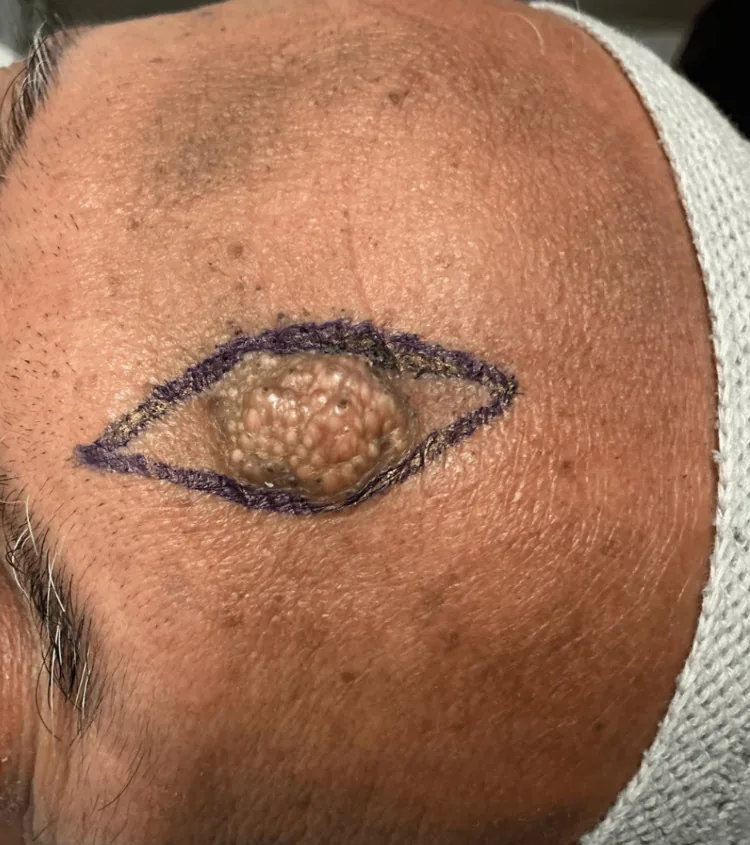
The raised plaque in the photo is a rare finding that needed removal; what's common is the mild pigmentation and thickening. They usually fade as friction is reduced: a soft prayer mat, not pressing hard, and moisturising the area. Coarse scrubs and strong creams can increase irritation and darkening. Women who wear a headscarf may notice similar friction at the hairline from rough fabrics, and a soft fabric helps.
Other causes of a dark forehead
| Cause | Clues | What helps |
|---|---|---|
| Melasma | Symmetrical patches, with cheeks or upper lip | Tinted sunscreen and a dermatologist's plan |
| Suntan | General darkening that eases in winter | Sun protection and time |
| Friction and prayer | At the point of pressure, with thickening | Less friction and moisturising |
| Marks after spots | Patches where spots were | Treating the acne and pigment ingredients |
| Irritation from hair dye or henna | At the hairline, after earlier itching | Stopping the product and allergy assessment |
flowchart TD
  A[Darkening on the forehead] --> B{Symmetrical, with patches on the cheeks?}
  B -->|Yes| C[Probably melasma: tinted sunscreen and a dermatologist]
  B -->|No| D{At the point of prayer or pressure?}
  D -->|Yes| E[Friction: a soft surface and moisturising]
  D -->|No| F{At the hairline after dye or henna?}
  F -->|Yes| G[Irritation or allergy: stop the product]
What helps in every case
A broad-spectrum sunscreen every morning, reapplied during long periods outdoors, ideally tinted, with a wide-brimmed hat outside. A gentle product with a pigment ingredient such as azelaic acid or niacinamide, once the cause is clear. And avoiding lemon, baking soda and coarse scrubs, because irritation itself leaves darkening. If the darkening is at the hairline, watch for a link with hair dye, black henna or hair products, some of which cause allergy that leaves pigmentation. Black henna in particular can contain a chemical that causes severe allergy, so if itching or redness appears at the hairline after colouring, stop it and see a dermatologist; you may need allergy testing.
How to track progress
Pigmentation fades slowly, because excess pigment leaves gradually as the skin renews itself, and deeper pigment takes longer. So photograph your forehead in the same light every few weeks rather than judging it in the mirror each day. Expect the darkening to return if you stop sun protection, especially with melasma, because protection is a permanent part of the routine rather than a temporary step. If you're pregnant or breastfeeding, ask your doctor before using any pigmentation product, because some ingredients aren't used during this time.
Don't try to scrub the darkening away with a loofah or pumice: rubbing increases thickening and darkening, especially at the point of prayer. If you want to cover it in the meantime, a tinted foundation or tinted sunscreen both disguises and protects.
Why lightening creams can backfire
Strong lightening creams bought without advice are a common reason forehead darkening gets worse rather than better. Irritation from harsh products, or from layering several actives at once, triggers more pigment in brown skin. Some unregulated creams also contain potent steroids or other ingredients that thin the skin or cause rebound darkening when stopped. If a product stings, peels your skin or makes the area red, stop it, however quickly it promises results. A slow, gentle approach with sun protection usually outperforms an aggressive one over a few months.
Is it something else?
Occasionally forehead darkening has a less obvious cause. Velvety, thickened dark skin that also affects the neck or armpits can be linked to insulin resistance, and is worth mentioning to your doctor. A dark patch with a scaly surface or a single spot that grows may need examination. And darkening that appeared after starting a new medicine is worth raising with whoever prescribed it, because some medicines increase pigmentation or sun sensitivity.
mindmap
  root((Dark forehead))
    Causes
      Melasma
      Sun
      Prayer and friction
      Spots
      Hair products
    Helps
      Tinted sunscreen
      Less friction
      A tested ingredient
    Harms
      Lemon
      Coarse scrubs
Frequently asked questions
What causes a dark forehead?
The commonest causes are melasma, suntan, repeated friction such as prostrating on a rough surface during prayer, and pigmentation after spots or after irritation from hair dyes and hair products. Identifying the cause decides the treatment; melasma, for example, needs a longer plan than a suntan.
Does a prayer mark on the forehead fade?
It usually fades as friction is reduced, for example by praying on a soft surface without pressing hard, and with moisturising and sun protection. Thickened skin can take longer, and strong lightening products can irritate it.
How can I tell if my dark forehead is melasma?
Melasma usually appears as symmetrical brown patches on the forehead, cheeks and upper lip, and worsens with sun, pregnancy and the contraceptive pill. A firm diagnosis comes from a dermatologist, because its treatment differs from the other causes.
Is there a cream that removes forehead darkening?
There's no single cream for every cause. Sunscreen is essential in all cases; then the ingredient is chosen by cause, such as azelaic acid or niacinamide for pigmentation. Strong creams should be used under a dermatologist's supervision, because irritation can deepen the darkening.
When to see a clinician
See a dermatologist if the darkening appears suddenly or spreads, if it comes with itching, flaking or increasing thickening, if a spot appears that changes in size, colour or border, or if it doesn't improve with protection and less friction. See them before using any strong lightening cream.
Related articles
- Melasma medication
- Causes of a dark face and neck
- The fastest way to remove facial pigmentation
- Getting rid of dark knees and elbows
Further reading
- Melasma: The need for tailored photoprotection to improve clinical outcomes — Photodermatology, Photoimmunology & Photomedicine
- Innovations in Refractory Melasma: Mechanism-Based Management and Emerging Therapeutic Strategies — Cureus
- Melasma: diagnosis and treatment — American Academy of Dermatology
Medical disclaimer: This article is for health education only and is not a substitute for professional medical advice. If you have a skin condition that concerns you, please consult a dermatologist.