Closed rhinoplasty is done entirely through incisions inside the nostrils, so it leaves no visible scar — but that alone isn't a reason to choose it. The real question isn't "open or closed?" but what your nose needs, and which technique your surgeon has the longer track record with. The pages ranking for this topic often present closed as the "better", scar-free option and say little about the cases it doesn't suit.
One thing to be clear about: InJasmine is a dermatology clinic that consults and refers; we do not perform rhinoplasty. What follows will help you understand what your surgeon tells you and ask the right questions, and it adds the part that concerns the skin and the scar.
What is closed rhinoplasty?
In closed (endonasal) rhinoplasty, the surgeon reaches the bone and cartilage through incisions in the inner lining of the nose only. The skin of the nose is not fully lifted, so the surgeon works through a narrower space and relies more on feel and experience than on direct sight. Some reviews describe it as the more conservative approach, focused on preserving the nose's native structure.
In open rhinoplasty, a small incision across the columella — the thin strip of skin between the nostrils — joins the internal incisions. The skin of the nose is lifted like a cover and the surgeon sees the whole cartilage framework. The image below marks both incisions.
Open vs closed rhinoplasty: the real differences
This table sums up what each option means in practice:
| Closed | Open | |
|---|---|---|
| Incisions | Inside the nostrils only | Internal plus a small columellar incision |
| Visible scar | None | A fine columellar line that fades |
| Surgeon's view of the cartilage | Limited | Direct and complete |
| Usually suits | Small hump, limited tip change | Complex tip, severe deviation, revision surgery |
| Tip swelling | May be slightly less | May last a little longer |
| Tip numbness | Usually less | Common at first, recovers over months |
A small prospective study published in 2025 comparing the two approaches found both effective at improving breathing and appearance, but the open approach gave better aesthetic results and fewer complications, particularly in complex deformities. The numbers were small, so it shouldn't be over-generalised, but it supports what most surgeons say: complexity is what tips the balance.
Sources genuinely disagree on recovery. Some argue open surgery means more swelling; others argue that because open access gives the surgeon more room, it can need less forcing of internal structures. That disagreement is a good question to put to your own surgeon — their answer tells you a lot about how they work.
This flowchart shows how a surgeon typically thinks it through:
flowchart TD
  A[What does your nose need?] --> B{Revision, severe deviation or a complex tip?}
  B -->|Yes| C[Usually open - more visibility and control]
  B -->|No| D{Small hump or limited change?}
  D -->|Yes| E{Surgeon experienced in closed technique?}
  E -->|Yes| F[Closed is a good option]
  E -->|No| C
  D -->|No| G[Detailed discussion with the surgeon]
What can be done from the inside
Closed rhinoplasty is not a "minor" operation. Bones can be broken and reset, humps reduced, the septum adjusted, and the middle vault of the nose rebuilt with specific techniques. A 2024 study describes folding excess cartilage inwards after hump reduction so that it supports the airway from within, as in the diagram below.
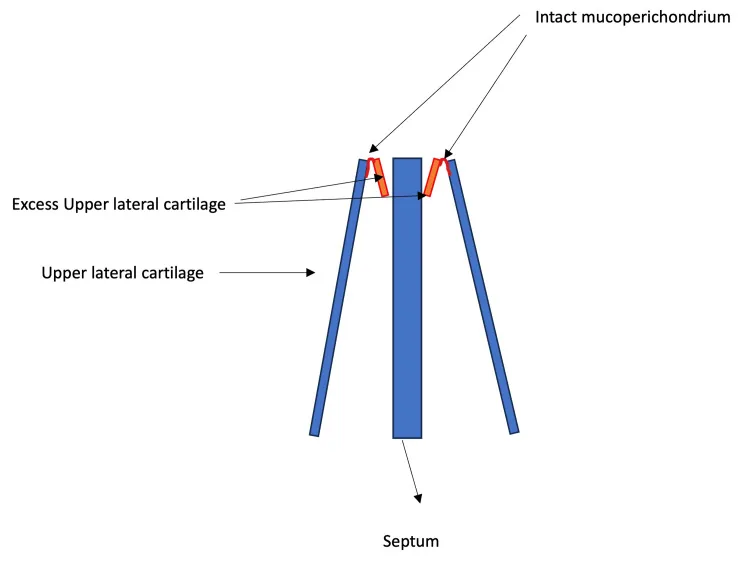
The practical point: a surgeon skilled in closed rhinoplasty can achieve a great deal from the inside. So ask about their experience with the technique they propose, not just the technique itself.
Questions to ask your surgeon
- Which approach do you recommend for my nose, and why? A good answer names your specific anatomy, not a house preference.
- How many of each approach do you perform? Experience with the technique matters more than the technique.
- What will you do inside the nose? Bone work, septum and tip changes shape recovery more than the incision does.
- Could my plan change during surgery? Some surgeons start closed and convert to open if needed; you should know beforehand.
- What happens to the scar and tip sensation? Ask to see healed columellar scars on skin like yours.
The open rhinoplasty scar: what a dermatologist adds
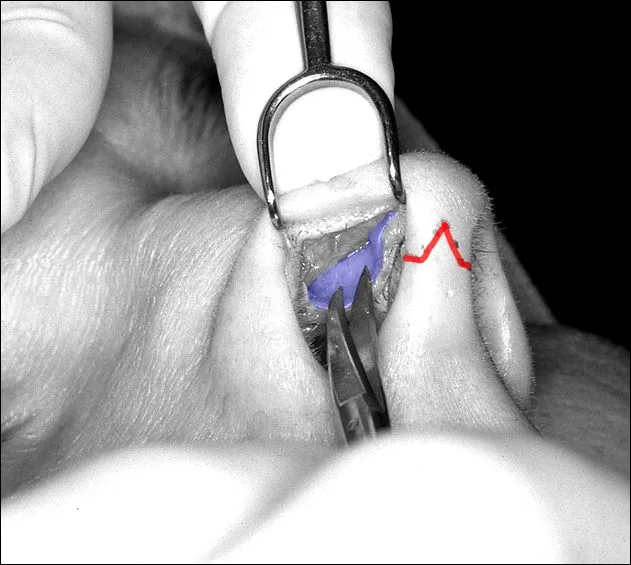
The columellar incision is small and usually ends up as a fine line that fades over months. The photograph below shows where it sits during surgery.
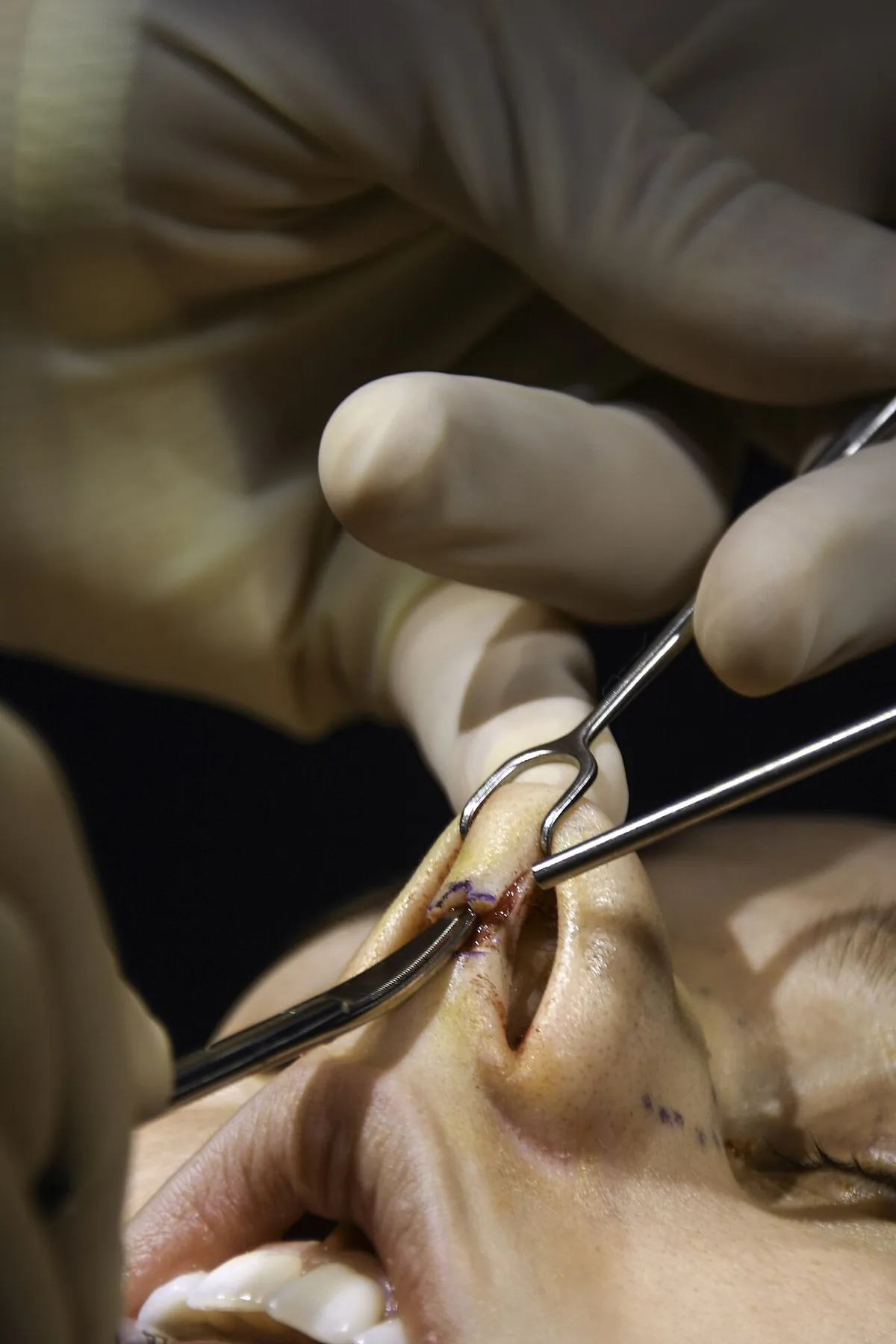
What shapes the final scar, from what I see in clinic:
- Skin type: olive and brown skin tends to darken along scars after inflammation; sun protection in the first months limits this.
- A tendency to raised scars: if you have had thick or keloid scars before, tell your surgeon. It can change their choice of approach.
- What the numbers say: a Saudi study of a hundred open rhinoplasty patients found the columellar scar unnoticeable in most of them, with similar results and satisfaction whichever of two suture types was used for closure.
Sensation in the nasal tip dips after open surgery, but a study in patients with thick nasal skin found it had returned to normal by six months.
Recovery: what actually differs?
Recovery is determined by what was done inside the nose more than by the type of incision. Breaking the nasal bones means bruising around the eyes with either approach, and tip work means longer tip swelling. The practical detail on splints, tape and cleaning is in after rhinoplasty.
flowchart TD
  A[Recovery after either approach] --> B[Days: splint, swelling, bruising]
  B --> C[Weeks: most swelling settles]
  C --> D[Months: the tip and final shape settle]
  A --> E[Open: care of the columellar incision and sun protection]
Frequently asked questions
What is the difference between open and closed rhinoplasty?
In closed rhinoplasty every incision is inside the nostrils, so there is no external scar. Open rhinoplasty adds a small incision across the columella — the strip of skin between the nostrils — so the surgeon can lift the skin and see the cartilage directly. Closed disturbs less tissue; open gives more visibility and control in complex cases.
Is closed rhinoplasty better?
Not as a rule. It usually suits limited changes such as a small hump or a modest tip adjustment in the hands of a surgeon experienced with it. For a complex tip, a severe deviation or revision surgery, many surgeons prefer the open approach. Your nose and the surgeon's experience decide, not the name of the technique.
Does open rhinoplasty leave a scar?
It leaves a fine line on the columella that usually fades and becomes hard to notice over time. How it settles depends on the closure, aftercare and your skin type. If you have darker skin or tend to form raised scars, tell your surgeon before the operation.
Is recovery faster after closed rhinoplasty?
Tip swelling may be slightly less because the skin is not lifted completely, but recovery depends more on what was done inside the nose, such as breaking the bones or reshaping cartilage. With either approach, initial swelling settles over weeks and the final shape over months.
When to see a clinician
After any rhinoplasty, call your surgeon immediately for bleeding that won't stop, fever, worsening pain or a change in the colour of the nasal skin. Once healed, a columellar scar that becomes raised, darkens or itches deserves a dermatology assessment, as do spots and pigmentation on the nose. And before deciding at all: if what you want is a small refinement, a non-surgical option with clear limits might be enough — those limits are set out in nose thread lift.
Related articles
- Rhinoplasty: types and what can be achieved
- What rhinoplasty really costs
- After rhinoplasty: splint, tape and red flags
- Nose thread lift
- Treating facial scars
Further reading
- Closed vs. Open Rhinoplasty – The Differences to Know — UCSF Facial Plastic Surgery
- Open vs Closed Rhinoplasty: Which Is Best? — Karidis
- Open vs closed rhinoplasty: weighing the pros and cons — Dr Turner
- Comparative Evaluation of Open Versus Closed Rhinoplasty Techniques
Medical disclaimer: This article is for health education only and is not a substitute for professional medical advice. If you have a skin condition that concerns you, please consult a dermatologist.